
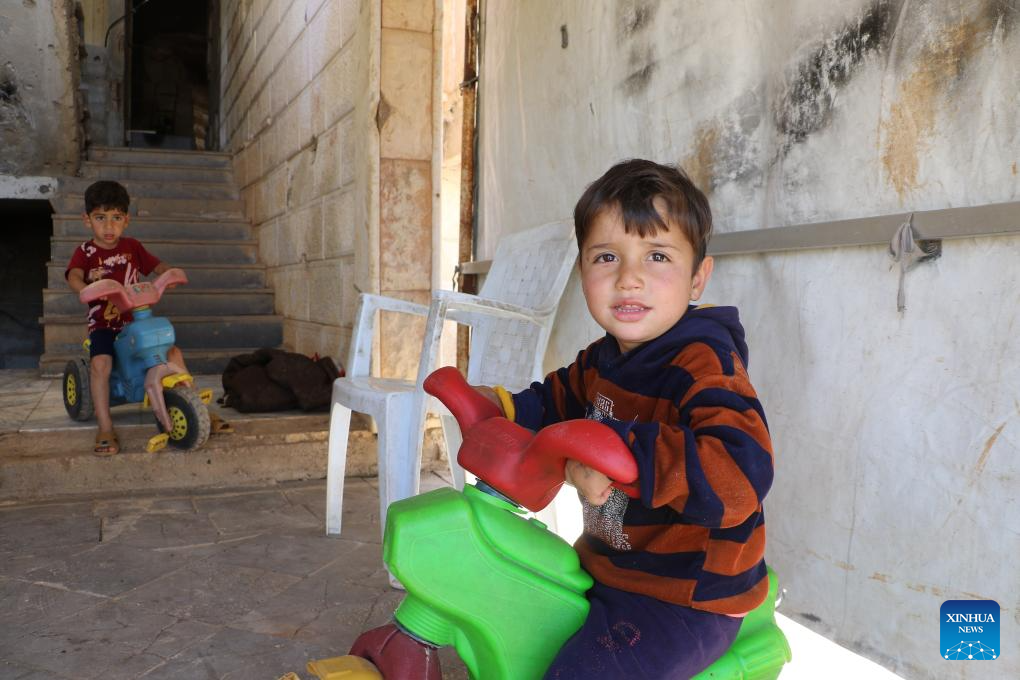
Children are seen inside a damaged apartment building in Atman, Daraa province, Syria, May 10, 2026. (Str/Xinhua)
By Hummam Sheikh Ali
DARAA, Syria, May 23 (Xinhua) -- Umm Abdulrahman spent years in exile in Jordan dreaming of returning home. When she finally did, she found a half-collapsed apartment block with cracked walls, exposed steel bars, and rooms left open to the wind.
She shares the structure with 12 family members. It was the only place they could afford, which is to say, it was free.
"When I came here, I never imagined I would live in a place like this," she said. "Life here is very difficult."
Her story is not unusual. Since the collapse of Syria's former government in December 2024, more than 1.64 million Syrian refugees have returned from neighboring countries, according to United Nations estimates. Nearly 200,000 came from Jordan alone. Another 2 million displaced Syrians have returned to their home regions from elsewhere inside the country.
Many came back to almost nothing. Half the country lay in ruins. And rebuilding is slow since an economy so fragile as Syria's can barely support the effort.
Across Syria, where the economy shrank by 54 percent between 2011 and 2025, the infrastructure of ordinary life -- affordable housing, steady work, functioning utilities -- remains largely out of reach. The World Bank estimated last October that repairing more than 13 years of war damage would cost roughly 216 billion U.S. dollars, nearly 10 times Syria's gross domestic product for 2024.
For Umm Abdulrahman's family, the math is brutal. A modest apartment for her 13-member household would cost 250 to 300 dollars a month. Her son, the family's sole breadwinner, earns around 200 dollars from temporary labor. The ruined building, dangerous as it is, costs nothing.
On the upper floor, Mohammad Marzouq Forough arrived not from exile abroad but from displacement within Syria, driven not by bombs but by poverty. In his hometown of al-Sanamayn, there was no work and no room; he, his wife, and their two children had been crowded into his parents' two-room house with no prospect of change.
"We were forced to come here because there was no work and no housing," he said.
His monthly income also hovers around 200 dollars, which is merely enough to cover food and little else. The walls around him are open to the elements. Electrical wiring is exposed. The sewage system does not work. It is, for now, the best they can do.
"What we fear most is collapse," Forough said. "Sometimes when strong winds come, you feel as if the building will fall on your head."
The physical danger extends well beyond unstable walls. Aid organizations estimate that hundreds of thousands of landmines and unexploded munitions remain buried across former front lines and residential areas. A report by the Syrian Network for Human Rights documented at least 3,799 civilians killed by mines and cluster munitions between 2011 and April 2026, including 1,000 children. Casualties have risen sharply since the political transition, as families return to contaminated land.
More than 16.7 million Syrians still require humanitarian assistance, the United Nations says. More than 80 percent of families struggle to secure enough food.
In Atman, the building where Umm and her family shelter stands like a scar from Syria's long war. Laundry hangs between cracked pillars, children play in dusty corridors, and families try to reconstruct a sense of normal life from what remains.
"We are living in danger," Umm said. "If there were other options, nobody would accept living like this."
For many who made the journey back, return has come to mean something different than they imagined: not the end of displacement, but its continuation, inside the ruins of the country they once called home. ■
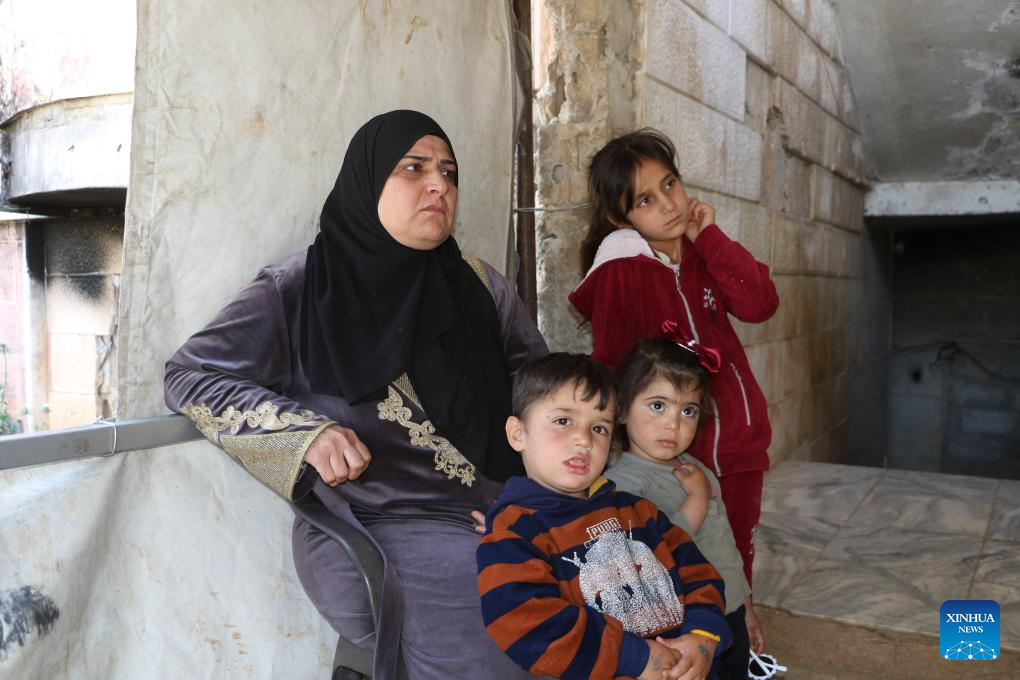
Umm Abdulrahman (1st L) sits with children inside a damaged apartment building in Atman, Daraa province, Syria, May 10, 2026. (Str/Xinhua)
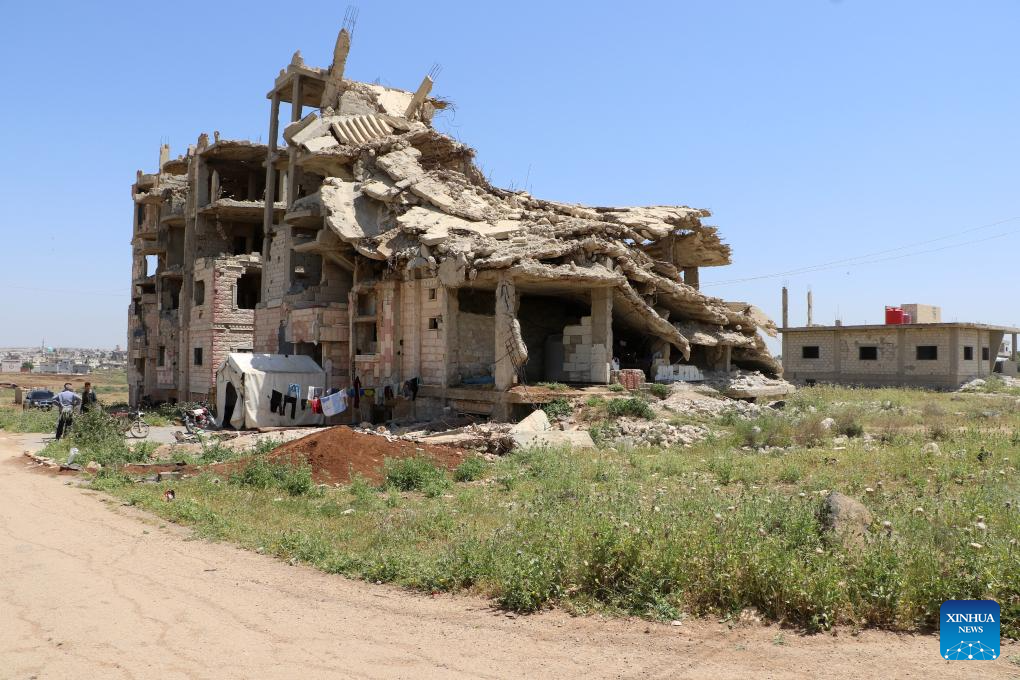
A damaged apartment building that shelters several displaced and returning Syrian families is pictured in Atman, Daraa province, Syria, May 10, 2026. (Str/Xinhua)


