
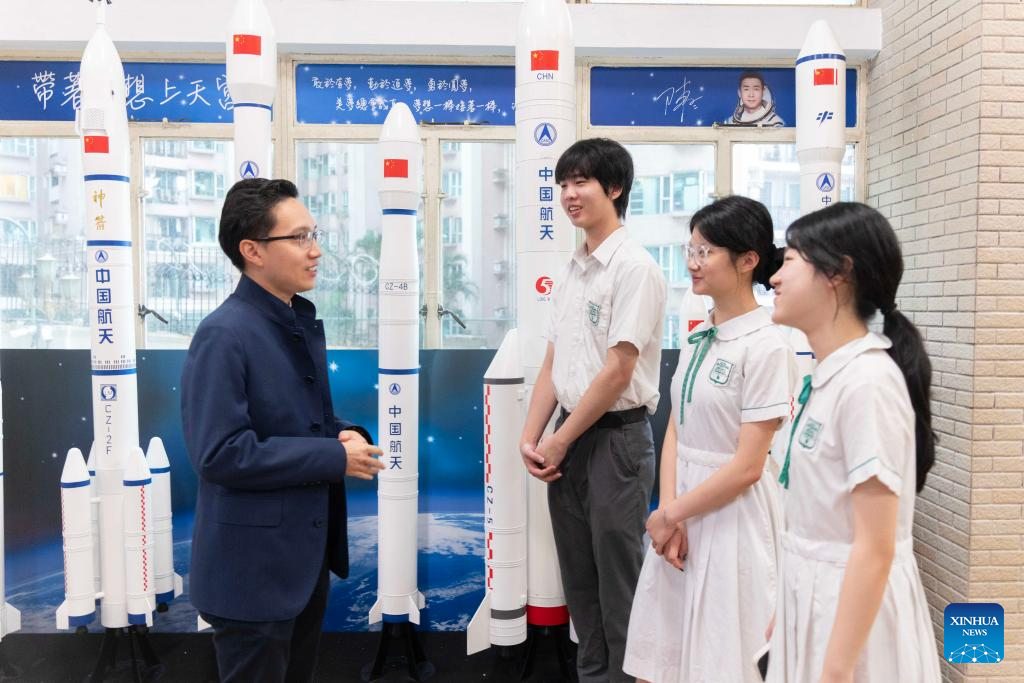
Nicholas Muk Ka-chun (1st L), a history teacher at Pui Kiu Middle School, visits a space exhibition with students in Hong Kong, south China, May 21, 2026. (Xinhua/Lui Siu Wai)
HONG KONG/MACAO, May 23 (Xinhua) -- China on Saturday unveiled the crew lineup for its Shenzhou-23 manned space mission, with Hong Kong native Li Jiaying, or Lai Ka-ying in Cantonese, on the roster.
She is the first member of China's fourth batch of astronauts to take on an in-orbit mission, as well as the first female payload specialist from the Hong Kong Special Administrative Region (HKSAR) and the Macao Special Administrative Region to join the country's manned space program.
The landmark achievement has sparked immense excitement and pride across the two regions. Many believe that it brings space exploration closer to local communities, testifies to Hong Kong's scientific research strengths, highlights the central government's confidence in the city, and represents a major step forward for regional integration into national development under the "one country, two systems" policy.
In a statement issued on Saturday morning, John Lee, chief executive of the HKSAR, expressed gratitude to the country for its support for and trust in the region, and wished the Shenzhou-23 crewed spaceflight mission great success.
"The HKSAR is embracing a historic moment in the pursuit of its aerospace dream," said Lee, adding, "We are deeply inspired by this moment of extraordinary significance, where a Hong Kong specialist takes part in the spaceflight mission as an astronaut for the first time."
Formerly a Hong Kong Police Force staff member, Lai wins high praise from the local disciplined services. Chris Tang Ping-keung, secretary for security of the HKSAR government, said Lai embodies the disciplined services's loyalty and perseverance, wishing her a successful space voyage.
The University of Hong Kong (HKU), Lai's alma mater, conveyed warm congratulations. HKU president Zhang Xiang noted Lai's journey from campus labs to outer space sets an inspiring example for "a new generation of Hong Kong scientists to reach for the stars and contribute to our nation's glorious space odyssey."
Local educators and students share the delight. Nicholas Muk Ka-chun, a history teacher at Pui Kiu Middle School, which offers science and space-related courses, said Hong Kong residents have shifted from mere spectators to active participants in national space undertakings, with students eager to embark on relevant career paths.
Jonathan Choi, chairman of the Chinese General Chamber of Commerce of Hong Kong, said this historic milestone proves Hong Kong's solid scientific strength, galvanizes efforts to build the city into an international innovation and technology hub, and stirs young people's passion for technological research.
U U Sang, president of the Administrative Committee of the Science and Technology Development Fund in Macao, said Lai's accomplishment inspires Macao's research community, believing that Macao will further press ahead with aerospace and cutting-edge technology research in line with national strategic plans.
As China's space station welcomes its first Hong Kong payload specialist, the Multi-Spectral Imaging Carbon Observatory, abbreviated as MUSICO, jointly developed by the Hong Kong University of Science and Technology (HKUST), has been mounted on China's space station. As the station's first spaceborne greenhouse gas detector, it fully reflects Hong Kong's profound engagement in national space projects.
Zhang Limin, a core researcher of the MUSICO project at HKUST, said Lai may conduct extravehicular operations on the device. The team will prioritize greenhouse gas monitoring covering Hong Kong and the Guangdong-Hong Kong-Macao Greater Bay Area to assist regional carbon reduction targets. Many young researchers have participated in the project and gained precious and memorable experience, he said.
So Chu-wing, curator of Hong Kong Space Museum, alongside HKSAR Legislative Council members, believed that the milestone connects the public with space exploration, evidencing Hong Kong's abundant talent pool and earnest support from the central government.
Ip Kuai Peng, vice rector of City University of Macao, said that Hong Kong and Macao compatriots have become core contributors to national space endeavors, adding that the achievement boosts national pride and fosters scientific curiosity among young people. He also hopes more Macao specialists will take part in upcoming space missions.
The Chinese University of Hong Kong has long participated in national space programs. Jiang Liwen, vice president for external affairs of the university, who is now in northwest China's Jiuquan for mission-related events, expressed excitement over Lai's selection.
The achievement affirms the capabilities of Hong Kong researchers and motivates local academics and youngsters to dedicate themselves to national innovation and aerospace development, he said.
Hoi Shan Hsu, a member of the Committee on Innovation, Technology and Industry Development of the Innovation, Technology and Industry Bureau of the HKSAR government, said Lai's selection vividly demonstrates that Hong Kong boasts versatile talents competent for major national missions.
Endowed with global vision and sound fundamental research capabilities, local researchers will gain more opportunities to join follow-up payload projects, he said.
Macao science educators believed the news resonates strongly with frontline science popularization practitioners, noting that such talent selection is not accidental, but a fruitful result yielded by years of systematic aerospace education rolled out in Hong Kong and Macao.
Communities of the two regions pledged to live up to national trust, harness the strengths of "one country, two systems," and contribute more local wisdom to China's pursuit of technological and space strength. ■
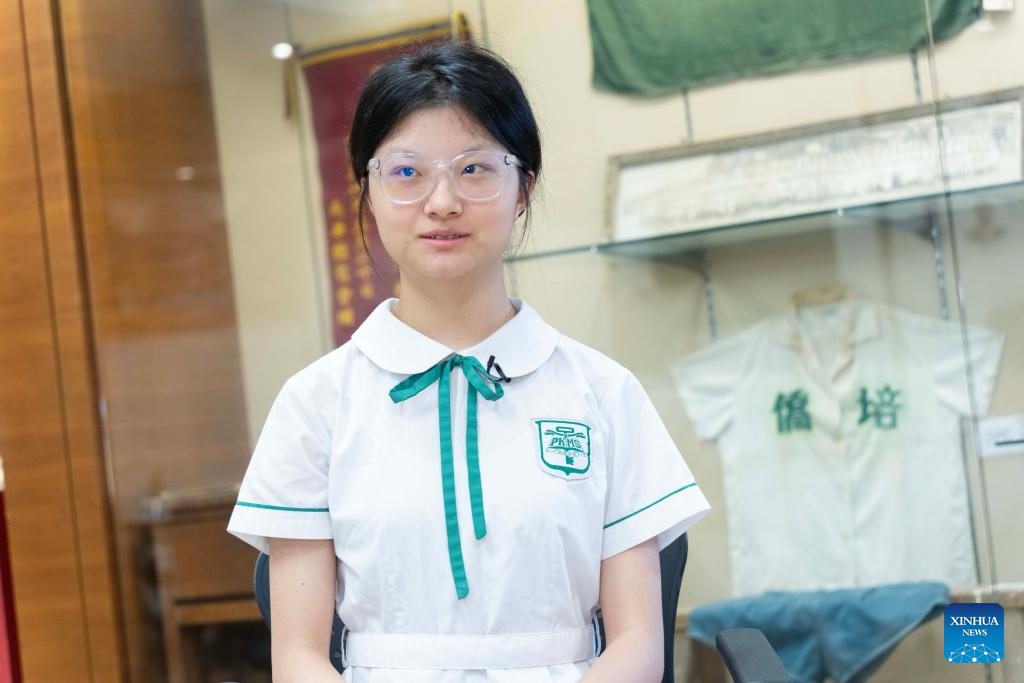
A student of Pui Kiu Middle School receives an interview in Hong Kong, south China, May 21, 2026. (Xinhua/Lui Siu Wai)
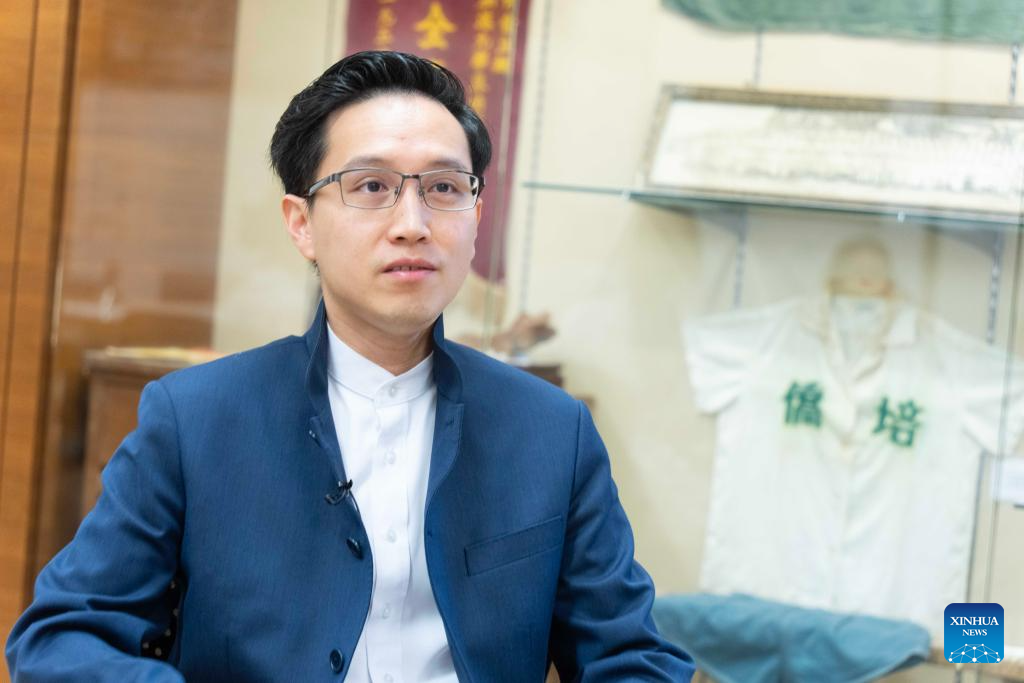
Nicholas Muk Ka-chun, a history teacher at Pui Kiu Middle School, receives an interview in Hong Kong, south China, May 21, 2026. (Xinhua/Lui Siu Wai)
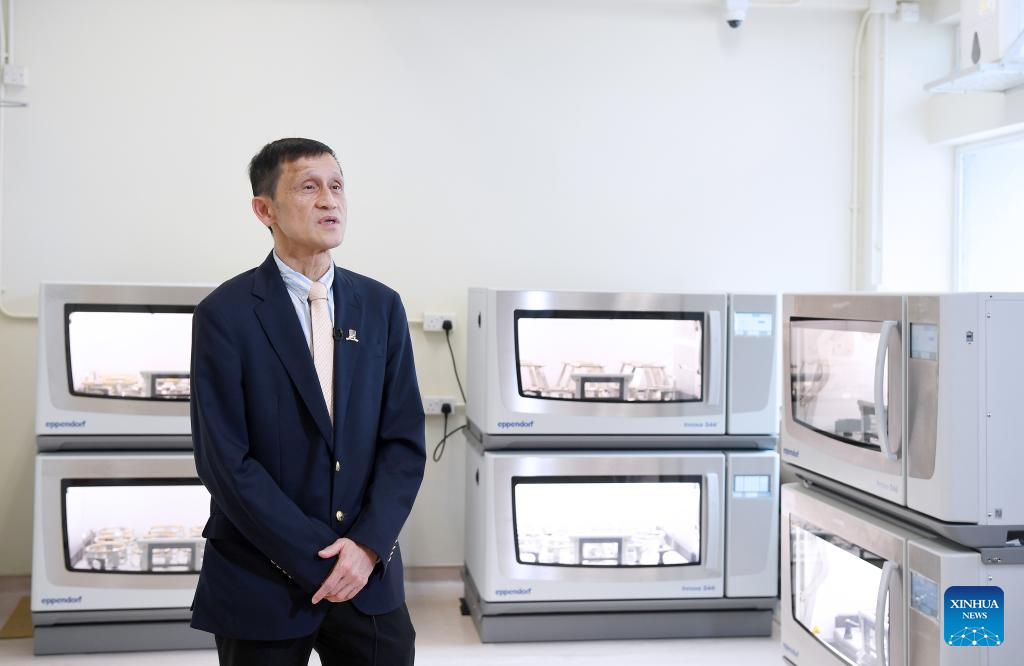
Jiang Liwen, vice president for external affairs of the Chinese University of Hong Kong, receives an interview in Hong Kong, south China, May 22, 2026. (Xinhua/Chen Duo)


