
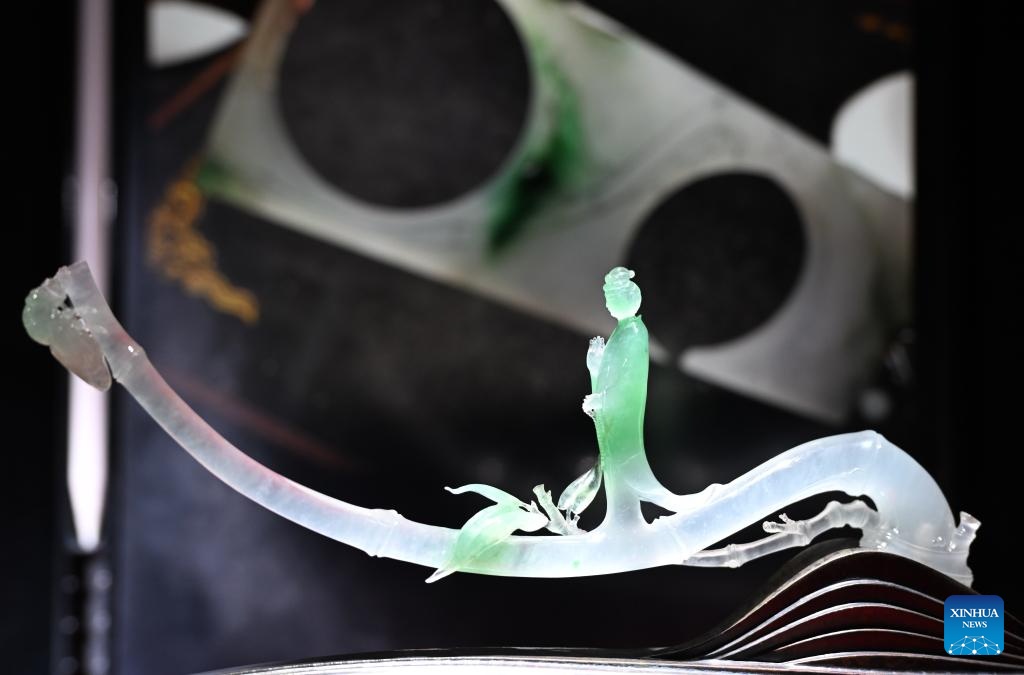
This photo taken on May 15, 2026 shows a jade carving artifact at a jade carving studio in Jieyang City, south China's Guangdong Province. Jieyang has emerged as a major national base for the design, processing and trade of jadeite, although it does not produce jade locally.
The jade industry of Jieyang originated in Yangmei Village of Pandong Subdistrict, with jadeite as the dominant produce type. The jade carving craft, known as "Yangmei jadeite carving," was inscribed onto the second batch of China's national intangible cultural heritage list in 2008. Over 100,000 people are engaged in the jade sector in Jieyang, which encompasses nearly 5,000 merchants and hosts more than 500 jade design and carving studios. A complete industrial chain has taken shape at present, integrating rough jade auction, jade design, processing, trade, exhibition, appreciation, tourism and convention events. (Xinhua/Deng Hua)
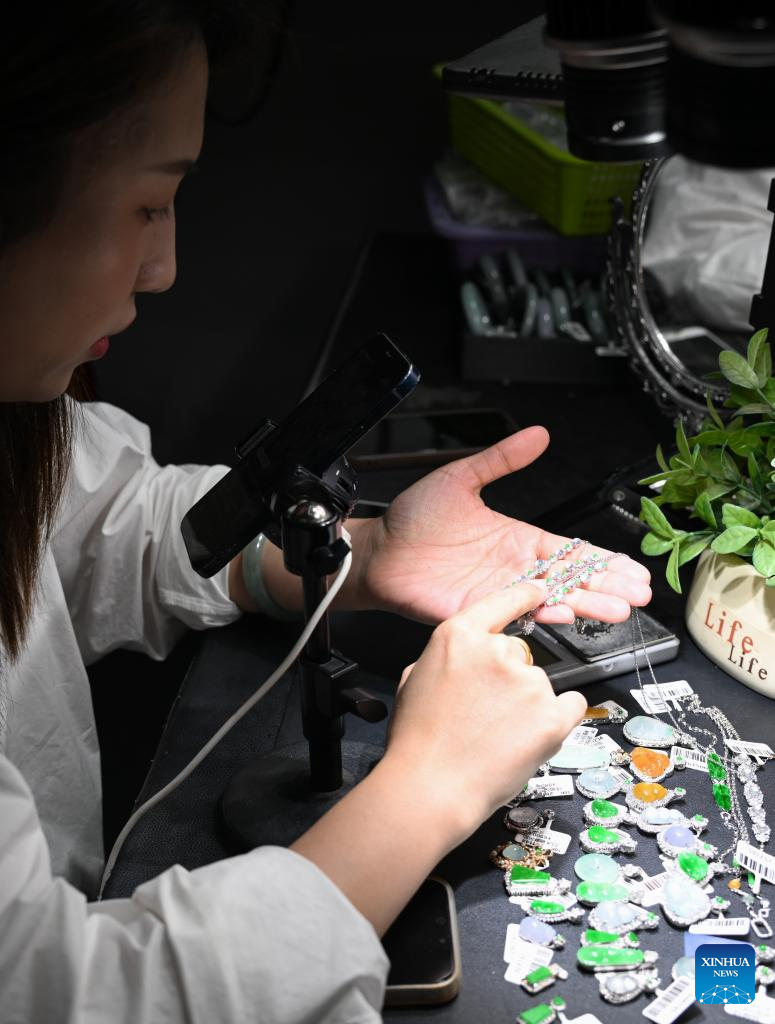
A staff member introduces jade jewelry via livestreaming in Jieyang City, south China's Guangdong Province, May 15, 2026. Jieyang has emerged as a major national base for the design, processing and trade of jadeite, although it does not produce jade locally.
The jade industry of Jieyang originated in Yangmei Village of Pandong Subdistrict, with jadeite as the dominant produce type. The jade carving craft, known as "Yangmei jadeite carving," was inscribed onto the second batch of China's national intangible cultural heritage list in 2008. Over 100,000 people are engaged in the jade sector in Jieyang, which encompasses nearly 5,000 merchants and hosts more than 500 jade design and carving studios. A complete industrial chain has taken shape at present, integrating rough jade auction, jade design, processing, trade, exhibition, appreciation, tourism and convention events. (Xinhua/Deng Hua)
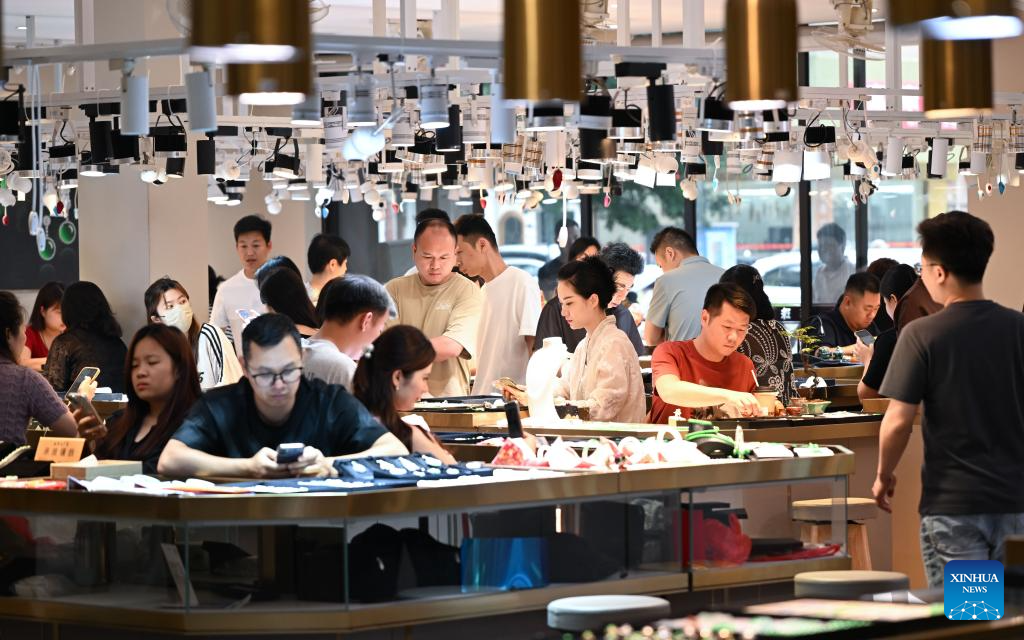
This photo taken on May 15, 2026 shows a scene at a jade shopping mall in Jieyang City, south China's Guangdong Province. Jieyang has emerged as a major national base for the design, processing and trade of jadeite, although it does not produce jade locally.
The jade industry of Jieyang originated in Yangmei Village of Pandong Subdistrict, with jadeite as the dominant produce type. The jade carving craft, known as "Yangmei jadeite carving," was inscribed onto the second batch of China's national intangible cultural heritage list in 2008. Over 100,000 people are engaged in the jade sector in Jieyang, which encompasses nearly 5,000 merchants and hosts more than 500 jade design and carving studios. A complete industrial chain has taken shape at present, integrating rough jade auction, jade design, processing, trade, exhibition, appreciation, tourism and convention events. (Xinhua/Deng Hua)
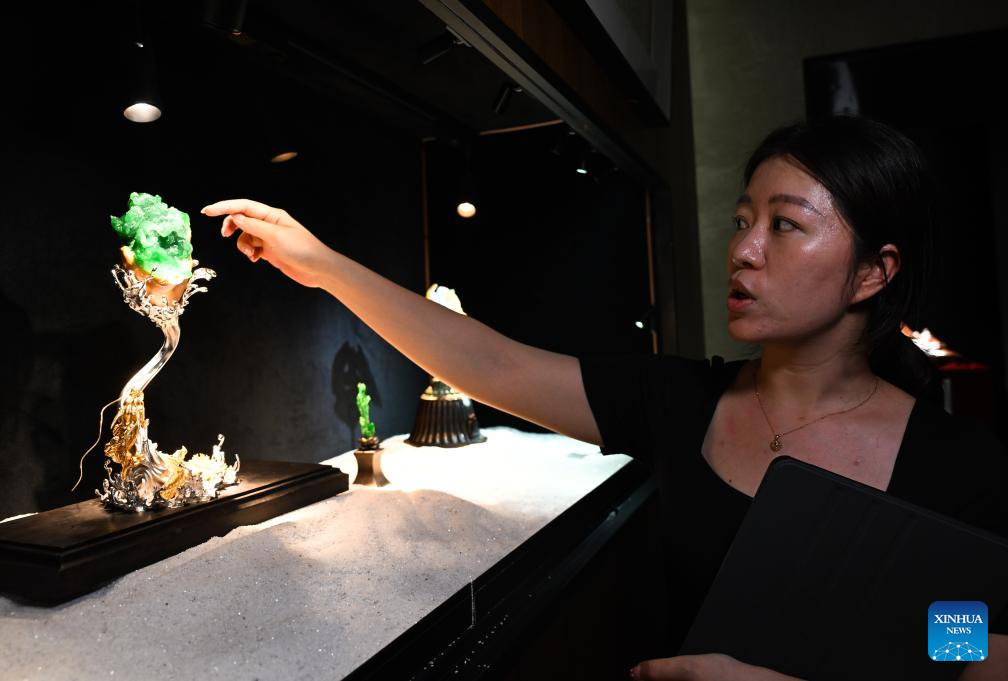
A staff member introduces a jade carving artifact at a jade carving studio in Jieyang City, south China's Guangdong Province, May 15, 2026. Jieyang has emerged as a major national base for the design, processing and trade of jadeite, although it does not produce jade locally.
The jade industry of Jieyang originated in Yangmei Village of Pandong Subdistrict, with jadeite as the dominant produce type. The jade carving craft, known as "Yangmei jadeite carving," was inscribed onto the second batch of China's national intangible cultural heritage list in 2008. Over 100,000 people are engaged in the jade sector in Jieyang, which encompasses nearly 5,000 merchants and hosts more than 500 jade design and carving studios. A complete industrial chain has taken shape at present, integrating rough jade auction, jade design, processing, trade, exhibition, appreciation, tourism and convention events. (Xinhua/Deng Hua)
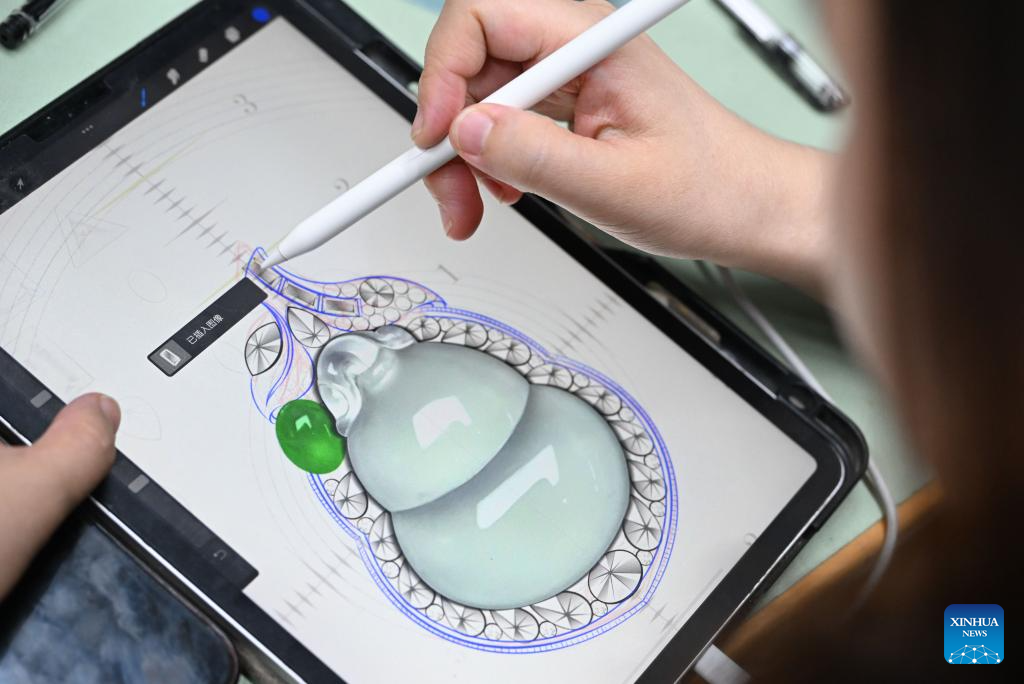
A staff member paints patterns for a piece of jade jewelry at a jade carving studio in Jieyang City, south China's Guangdong Province, May 15, 2026. Jieyang has emerged as a major national base for the design, processing and trade of jadeite, although it does not produce jade locally.
The jade industry of Jieyang originated in Yangmei Village of Pandong Subdistrict, with jadeite as the dominant produce type. The jade carving craft, known as "Yangmei jadeite carving," was inscribed onto the second batch of China's national intangible cultural heritage list in 2008. Over 100,000 people are engaged in the jade sector in Jieyang, which encompasses nearly 5,000 merchants and hosts more than 500 jade design and carving studios. A complete industrial chain has taken shape at present, integrating rough jade auction, jade design, processing, trade, exhibition, appreciation, tourism and convention events. (Xinhua/Deng Hua)
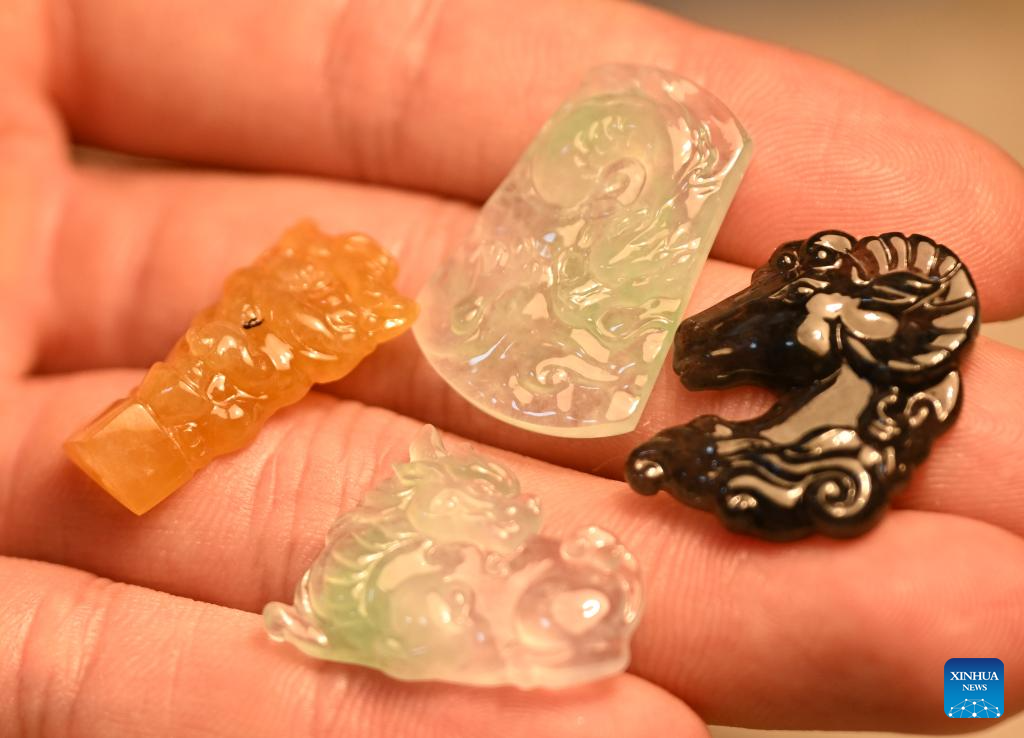
A staff member displays the freshly carved jade products at a jade carving studio in Jieyang City, south China's Guangdong Province, May 15, 2026. Jieyang has emerged as a major national base for the design, processing and trade of jadeite, although it does not produce jade locally.
The jade industry of Jieyang originated in Yangmei Village of Pandong Subdistrict, with jadeite as the dominant produce type. The jade carving craft, known as "Yangmei jadeite carving," was inscribed onto the second batch of China's national intangible cultural heritage list in 2008. Over 100,000 people are engaged in the jade sector in Jieyang, which encompasses nearly 5,000 merchants and hosts more than 500 jade design and carving studios. A complete industrial chain has taken shape at present, integrating rough jade auction, jade design, processing, trade, exhibition, appreciation, tourism and convention events. (Xinhua/Deng Hua)
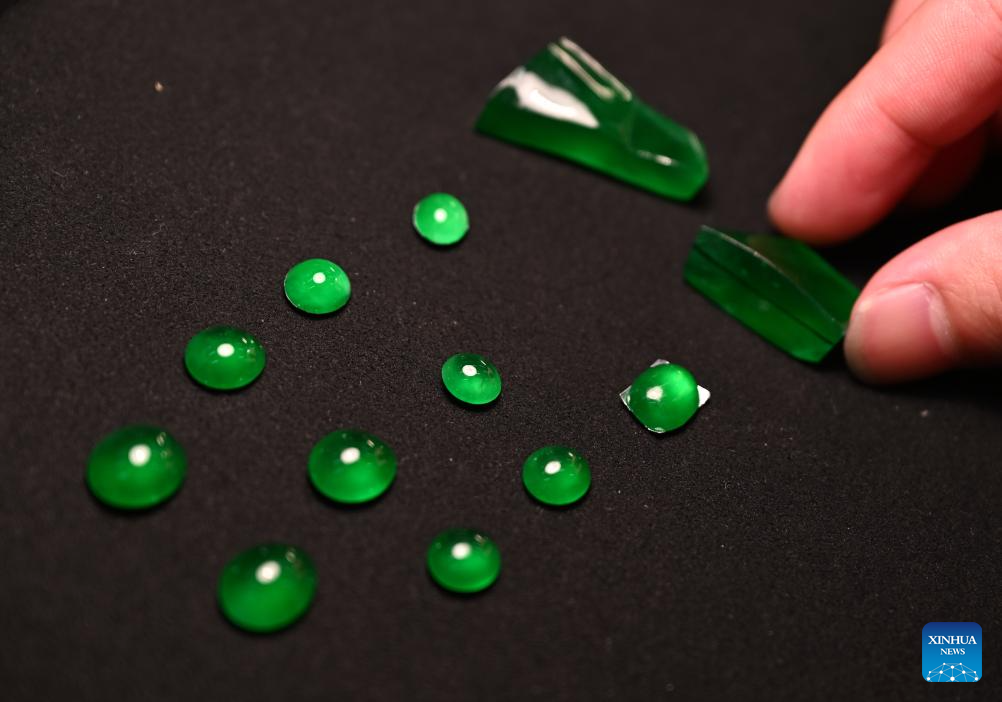
This photo taken on May 15, 2026 shows the finished products and raw materials of jadeite ring surface at a jade carving studio in Jieyang City, south China's Guangdong Province. Jieyang has emerged as a major national base for the design, processing and trade of jadeite, although it does not produce jade locally.
The jade industry of Jieyang originated in Yangmei Village of Pandong Subdistrict, with jadeite as the dominant produce type. The jade carving craft, known as "Yangmei jadeite carving," was inscribed onto the second batch of China's national intangible cultural heritage list in 2008. Over 100,000 people are engaged in the jade sector in Jieyang, which encompasses nearly 5,000 merchants and hosts more than 500 jade design and carving studios. A complete industrial chain has taken shape at present, integrating rough jade auction, jade design, processing, trade, exhibition, appreciation, tourism and convention events. (Xinhua/Deng Hua)
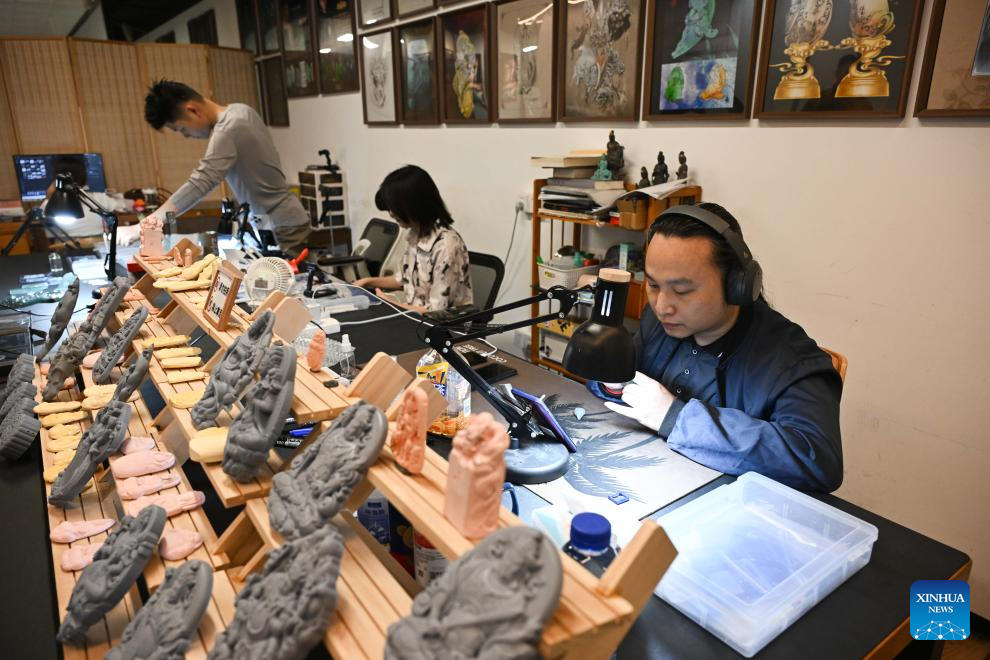
Staff members conceive creations for jade carving at a jade carving studio in Jieyang City, south China's Guangdong Province, May 15, 2026. Jieyang has emerged as a major national base for the design, processing and trade of jadeite, although it does not produce jade locally.
The jade industry of Jieyang originated in Yangmei Village of Pandong Subdistrict, with jadeite as the dominant produce type. The jade carving craft, known as "Yangmei jadeite carving," was inscribed onto the second batch of China's national intangible cultural heritage list in 2008. Over 100,000 people are engaged in the jade sector in Jieyang, which encompasses nearly 5,000 merchants and hosts more than 500 jade design and carving studios. A complete industrial chain has taken shape at present, integrating rough jade auction, jade design, processing, trade, exhibition, appreciation, tourism and convention events. (Xinhua/Deng Hua)
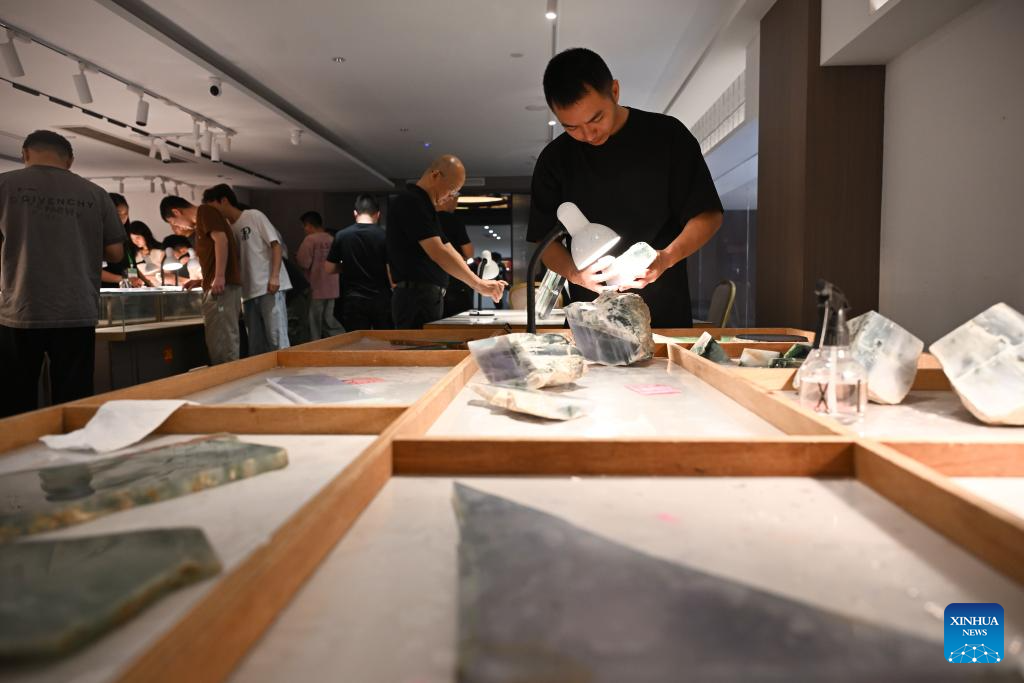
A customer views the jade materials at a jade material exchange fair in Jieyang City, south China's Guangdong Province, May 15, 2026. Jieyang has emerged as a major national base for the design, processing and trade of jadeite, although it does not produce jade locally.
The jade industry of Jieyang originated in Yangmei Village of Pandong Subdistrict, with jadeite as the dominant produce type. The jade carving craft, known as "Yangmei jadeite carving," was inscribed onto the second batch of China's national intangible cultural heritage list in 2008. Over 100,000 people are engaged in the jade sector in Jieyang, which encompasses nearly 5,000 merchants and hosts more than 500 jade design and carving studios. A complete industrial chain has taken shape at present, integrating rough jade auction, jade design, processing, trade, exhibition, appreciation, tourism and convention events. (Xinhua/Deng Hua)
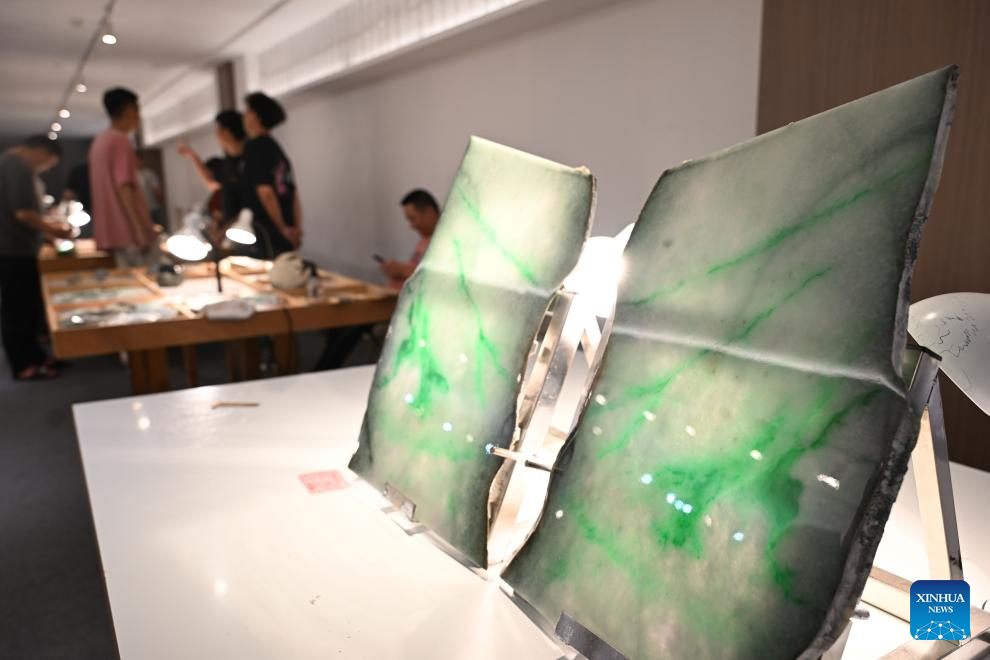
This photo taken on May 15, 2026 shows jade materials displayed at a jade material exchange fair in Jieyang City, south China's Guangdong Province. Jieyang has emerged as a major national base for the design, processing and trade of jadeite, although it does not produce jade locally.
The jade industry of Jieyang originated in Yangmei Village of Pandong Subdistrict, with jadeite as the dominant produce type. The jade carving craft, known as "Yangmei jadeite carving," was inscribed onto the second batch of China's national intangible cultural heritage list in 2008. Over 100,000 people are engaged in the jade sector in Jieyang, which encompasses nearly 5,000 merchants and hosts more than 500 jade design and carving studios. A complete industrial chain has taken shape at present, integrating rough jade auction, jade design, processing, trade, exhibition, appreciation, tourism and convention events. (Xinhua/Deng Hua)
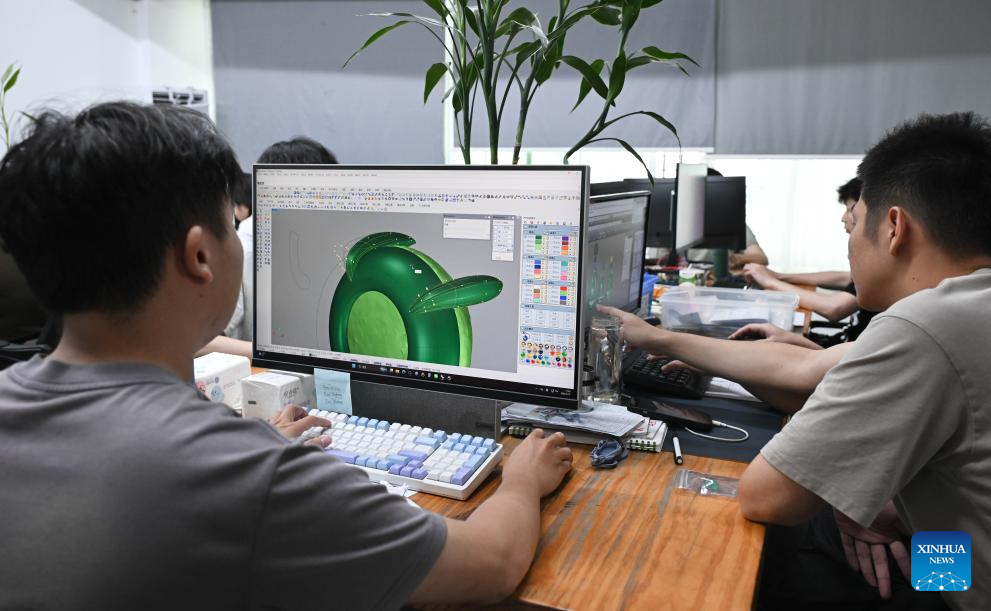
A staff member conducts 3D modeling for design at a jade carving studio in Jieyang City, south China's Guangdong Province, May 15, 2026. Jieyang has emerged as a major national base for the design, processing and trade of jadeite, although it does not produce jade locally.
The jade industry of Jieyang originated in Yangmei Village of Pandong Subdistrict, with jadeite as the dominant produce type. The jade carving craft, known as "Yangmei jadeite carving," was inscribed onto the second batch of China's national intangible cultural heritage list in 2008. Over 100,000 people are engaged in the jade sector in Jieyang, which encompasses nearly 5,000 merchants and hosts more than 500 jade design and carving studios. A complete industrial chain has taken shape at present, integrating rough jade auction, jade design, processing, trade, exhibition, appreciation, tourism and convention events. (Xinhua/Deng Hua)
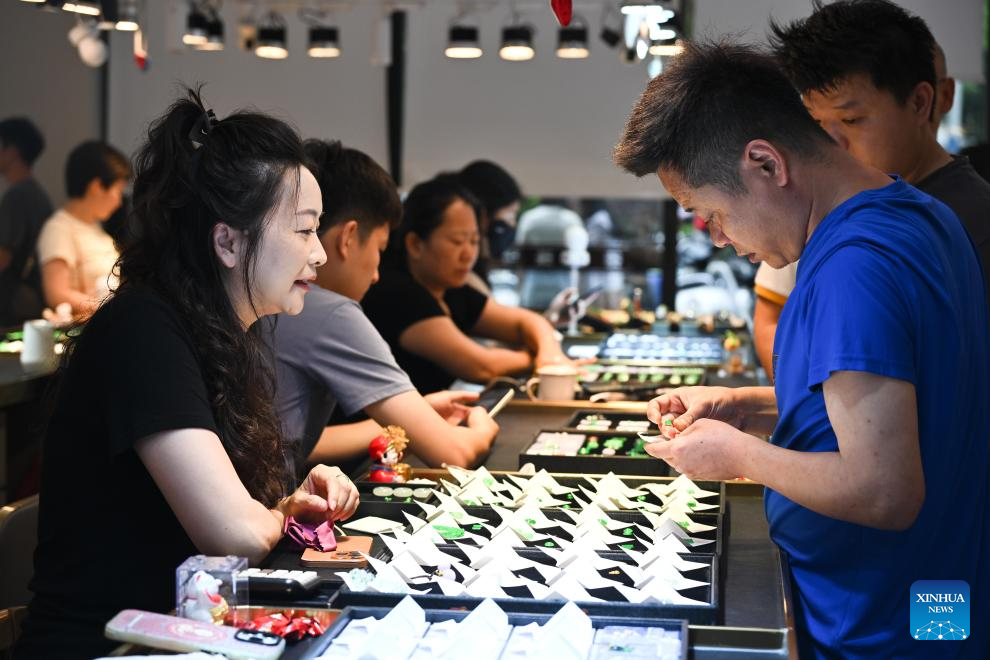
A customer selects jade products at a jade shopping mall in Jieyang City, south China's Guangdong Province, May 15, 2026. Jieyang has emerged as a major national base for the design, processing and trade of jadeite, although it does not produce jade locally.
The jade industry of Jieyang originated in Yangmei Village of Pandong Subdistrict, with jadeite as the dominant produce type. The jade carving craft, known as "Yangmei jadeite carving," was inscribed onto the second batch of China's national intangible cultural heritage list in 2008. Over 100,000 people are engaged in the jade sector in Jieyang, which encompasses nearly 5,000 merchants and hosts more than 500 jade design and carving studios. A complete industrial chain has taken shape at present, integrating rough jade auction, jade design, processing, trade, exhibition, appreciation, tourism and convention events. (Xinhua/Deng Hua)
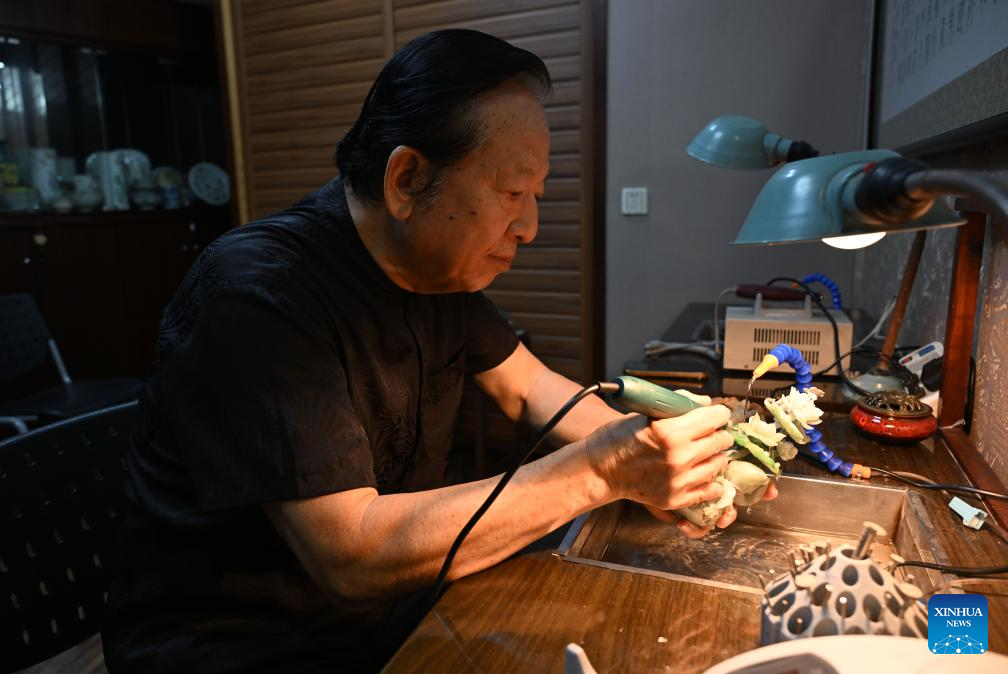
Hong Ronghui, a representative inheritor of the national intangible cultural heritage of "Yangmei jadeite carving," is engaged in jade carving creation at a jewelry hall in Jieyang City, south China's Guangdong Province, May 15, 2026. Jieyang has emerged as a major national base for the design, processing and trade of jadeite, although it does not produce jade locally.
The jade industry of Jieyang originated in Yangmei Village of Pandong Subdistrict, with jadeite as the dominant produce type. The jade carving craft, known as "Yangmei jadeite carving," was inscribed onto the second batch of China's national intangible cultural heritage list in 2008. Over 100,000 people are engaged in the jade sector in Jieyang, which encompasses nearly 5,000 merchants and hosts more than 500 jade design and carving studios. A complete industrial chain has taken shape at present, integrating rough jade auction, jade design, processing, trade, exhibition, appreciation, tourism and convention events. (Xinhua/Wang Ruiping)
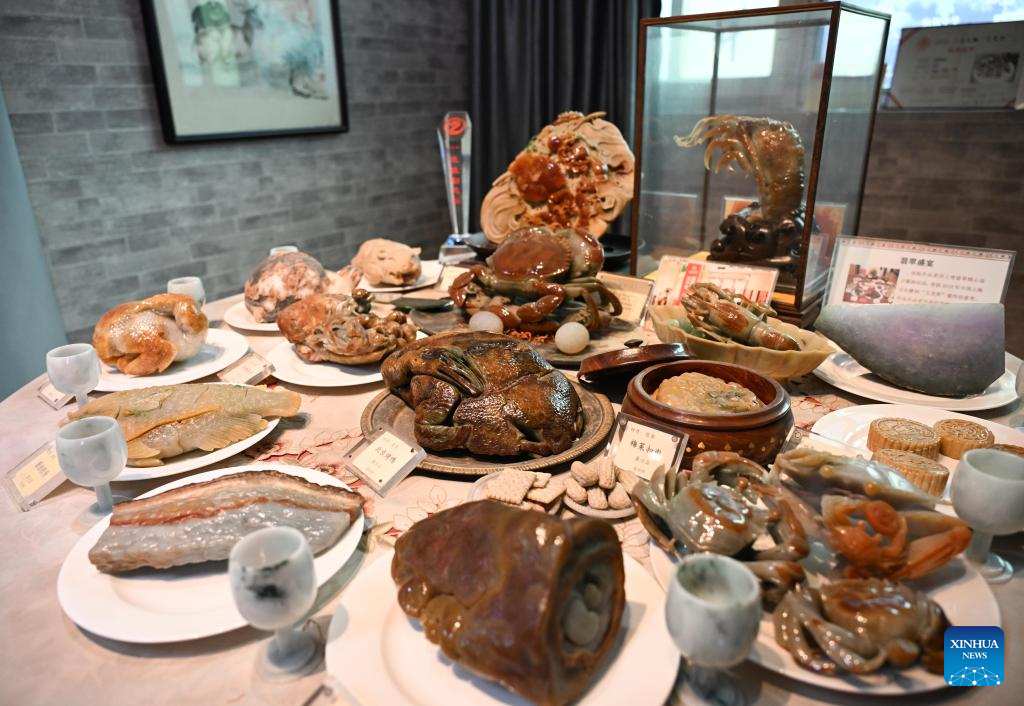
This photo taken on May 15, 2026 shows a "banquet" of jadeite artifacts at a jewelry hall in Jieyang City, south China's Guangdong Province. Jieyang has emerged as a major national base for the design, processing and trade of jadeite, although it does not produce jade locally.
The jade industry of Jieyang originated in Yangmei Village of Pandong Subdistrict, with jadeite as the dominant produce type. The jade carving craft, known as "Yangmei jadeite carving," was inscribed onto the second batch of China's national intangible cultural heritage list in 2008. Over 100,000 people are engaged in the jade sector in Jieyang, which encompasses nearly 5,000 merchants and hosts more than 500 jade design and carving studios. A complete industrial chain has taken shape at present, integrating rough jade auction, jade design, processing, trade, exhibition, appreciation, tourism and convention events. (Xinhua/Wang Ruiping)
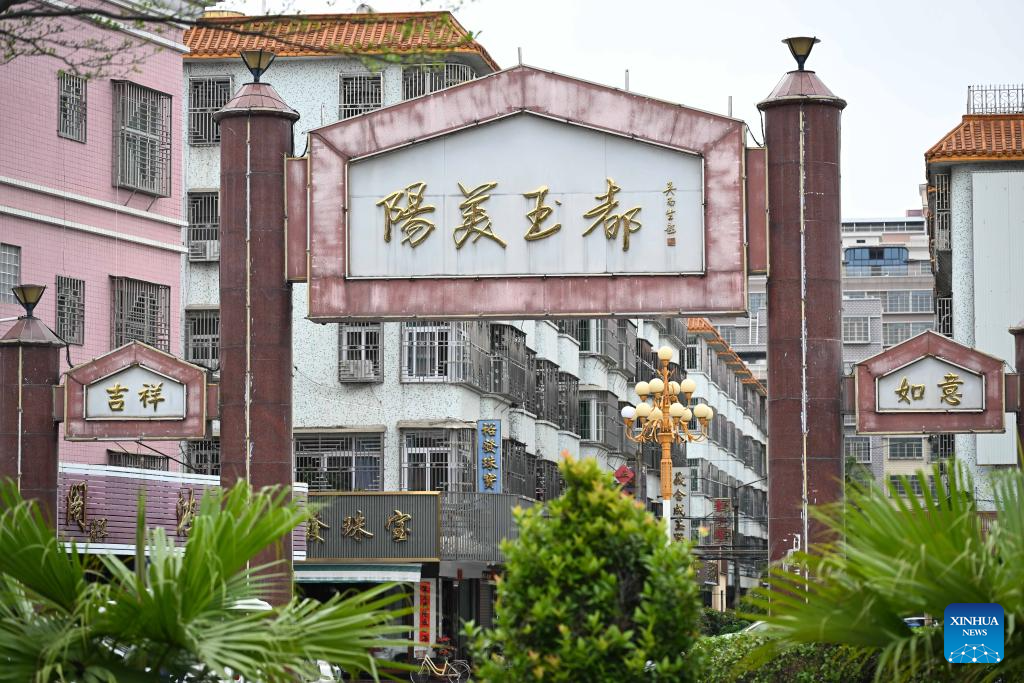
This photo taken on May 15, 2026 shows an archway bearing the characters "Yangmei Jade Capital" in Jieyang City, south China's Guangdong Province. Jieyang has emerged as a major national base for the design, processing and trade of jadeite, although it does not produce jade locally.
The jade industry of Jieyang originated in Yangmei Village of Pandong Subdistrict, with jadeite as the dominant produce type. The jade carving craft, known as "Yangmei jadeite carving," was inscribed onto the second batch of China's national intangible cultural heritage list in 2008. Over 100,000 people are engaged in the jade sector in Jieyang, which encompasses nearly 5,000 merchants and hosts more than 500 jade design and carving studios. A complete industrial chain has taken shape at present, integrating rough jade auction, jade design, processing, trade, exhibition, appreciation, tourism and convention events. (Xinhua/Deng Hua)


