
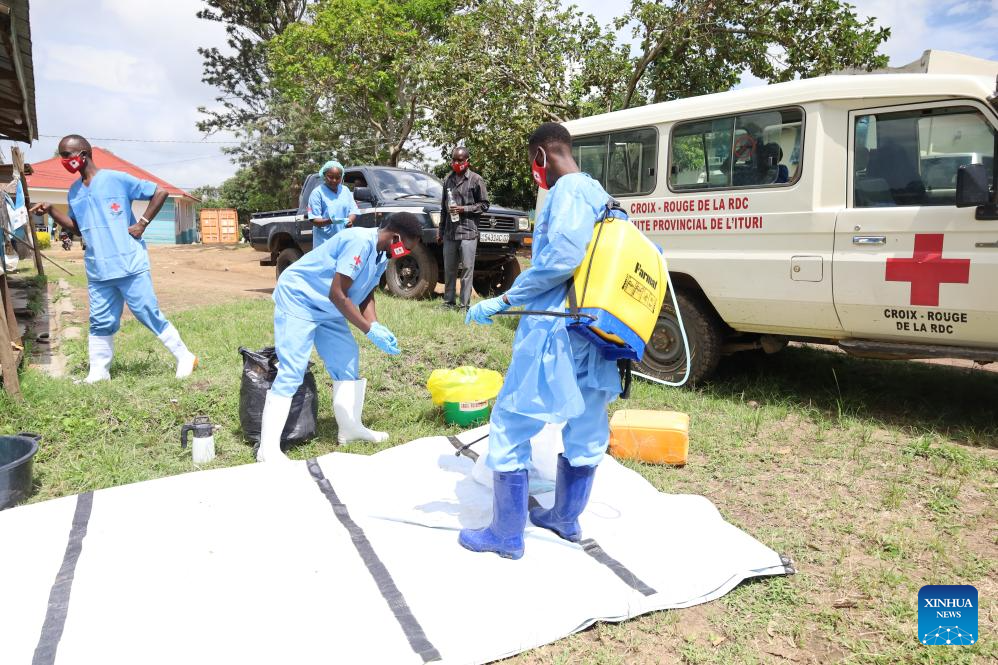
Medical worker disinfect equipments before the burial of a suspected Ebola victim in Bunia, Ituri Province, the Democratic Republic of the Congo, on May 21, 2026. The outbreak, initially reported in Ituri Province, has now affected North Kivu and South Kivu, while two confirmed cases have also been reported in the neighboring country of Uganda. (Str/Xinhua)
KINSHASA, May 21 (Xinhua) -- The latest Ebola outbreak has spread to the Democratic Republic of the Congo (DRC)'s South Kivu Province, with fresh concern surfacing over wider transmission in the volatile eastern region.
On Thursday, the March 23 Movement (M23) rebel group confirmed a new case in Bukavu, the capital of South Kivu.
The group, which has been capturing the city since February 2025, said that a 28-year-old man had traveled from Kisangani, the capital of Tshopo Province, and died before his diagnosis was confirmed.
Though Tshopo has not seen any cases to date, Kisangani -- one of the DRC's busiest transport hubs -- has emerged as a new area of concern, as authorities race to determine how far the virus may have already spread before detection.
CASELOAD CLIMBS
The outbreak, initially reported in Ituri Province, has now affected North Kivu and South Kivu, while two confirmed cases have also been reported in the neighboring country of Uganda.
According to the figures released Thursday by DRC Health Minister Roger Kamba, 626 suspected cases and 159 probable deaths have been recorded since the country declared its 17th outbreak on May 15.
In areas under its control, the M23 said that more than 200 samples from suspected cases had been sent to Goma, the capital of North Kivu, for laboratory analysis. In Goma, one confirmed case remains under strict medical supervision, while identified contacts have been isolated, it added.
World Health Organization (WHO) Director-General Tedros Adhanom Ghebreyesus has warned that the number of cases is expected to keep rising, given the length of time the virus appeared to have circulated before the outbreak was detected.
"So far, 51 cases have been confirmed in the DRC, in the northern provinces of Ituri and North Kivu, including in the cities of Bunia and Goma, although we know the scale of the epidemic in DRC is much larger," he said on Wednesday.
DELAYED DETECTION OF RARE STRAIN
According to WHO officials, investigations are still underway to determine exactly when and where the outbreak began, but the scale of the epidemic suggests the virus may have been circulating for some time before being confirmed.
"We are thinking that it has started probably a couple of months ago," Anais Legand, a WHO technical officer on viral hemorrhagic fevers, said Wednesday, stressing an immediate priority to cut transmission through contact tracing, isolation, and care for suspected and confirmed cases.
Abdirahman Mahmoud, director of WHO's alert and response operations, said preliminary information pointed to a suspected index case in late April, followed by a possible superspreading event linked to funeral practices and community transmission.
Meanwhile, Tedros said that rapid field tests commonly used in previous Ebola responses were optimized for the Zaire strain, while the current outbreak involves the Bundibugyo strain, a less common strain first detected in 2007 in Uganda with a fatality rate from 30 to 50 percent.
This is one of the rare outbreaks caused by the Bundibugyo strain, for which there is currently no approved vaccine or specific treatment. Existing Ebola vaccines are mainly designed against the Zaire strain, which has caused several previous outbreaks in the DRC.
WHO research officials said several candidate vaccines are being considered. However, they cautioned that doses are still months away at the earliest.
Legand said that while preparations for possible trials continue, the priority is to set up safe and optimized treatment centers, establish patient referral pathways, and ensure that every suspected case is detected and cared for early.
COMMUNITY RESISTANCE
Community resistance has become another obstacle to the response.
DRC Health Minister Roger Kamba said Tuesday that the alert had been delayed within affected communities, as some residents believed the illness was "mystical."
Jean-Jacques Muyembe, head of the National Institute of Biomedical Research, also told Xinhua that distrust of outsiders could weaken the Ebola response.
"When people see that instructions and measures are announced by people from their own area, they believe them. If it is someone from Kinshasa, they doubt," Muyembe said, stressing that the primary task is to build trust between health workers and people.
On Thursday, in Rwampara, the outbreak's epicenter in Ituri, Xinhua reporters saw an Ebola isolation site set on fire after clashes at the facility.
According to witnesses, relatives of several people who died while in isolation voiced anger over the handling of the response. The situation escalated into conflict, and one isolation tent with about 10 beds was burned before military and police forces intervened.
On-site medical workers declined interview requests, expressing anger over the incident.
Former New Zealand Prime Minister Helen Clark, co-chair of the Independent Panel for Pandemic Preparedness and Response, noted that the outbreak reflected a "perfect storm" of delayed detection, fragile health systems, conflict, and declining global health funding.
The WHO said more than 35 experts and first responders from the organization and the DRC Ministry of Health have been deployed to the field, with additional teams being sent to reinforce surveillance, clinical care, infection prevention and control, community engagement, and safe burial measures.
Tedros said he had approved an additional 3.4 million U.S. dollars from the WHO Contingency Fund for Emergencies, bringing the organization's total emergency allocation for the response to 3.9 million dollars.
The WHO made it clear that the risk from the outbreak was assessed as high at the national and regional levels, but low globally. ■
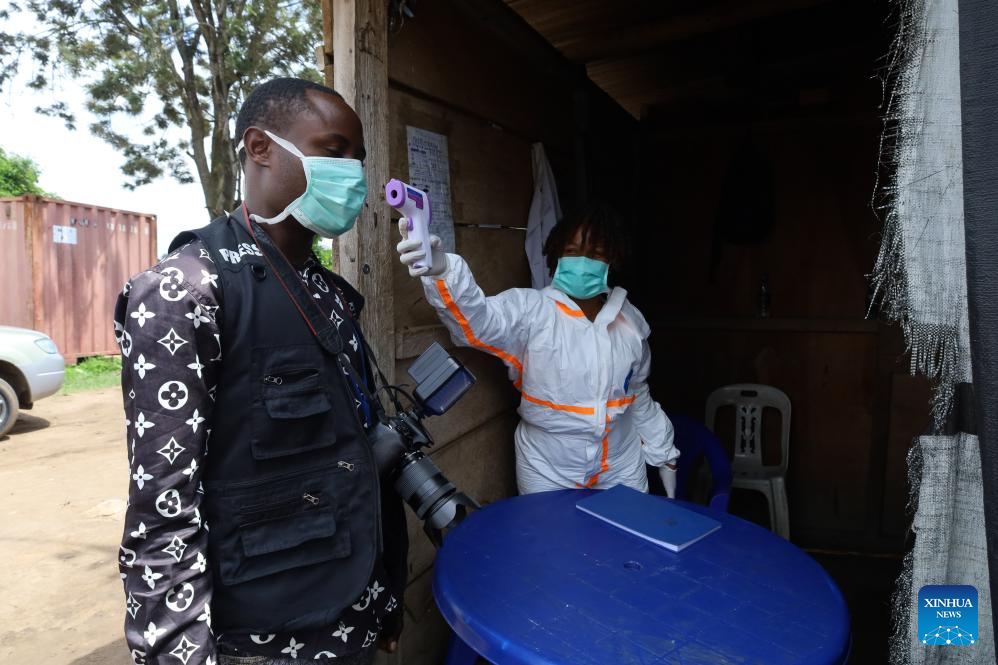
A medical worker checks temperature for a local journalist in Bunia, Ituri Province, the Democratic Republic of the Congo, on May 21, 2026. The outbreak, initially reported in Ituri Province, has now affected North Kivu and South Kivu, while two confirmed cases have also been reported in the neighboring country of Uganda. (Str/Xinhua)
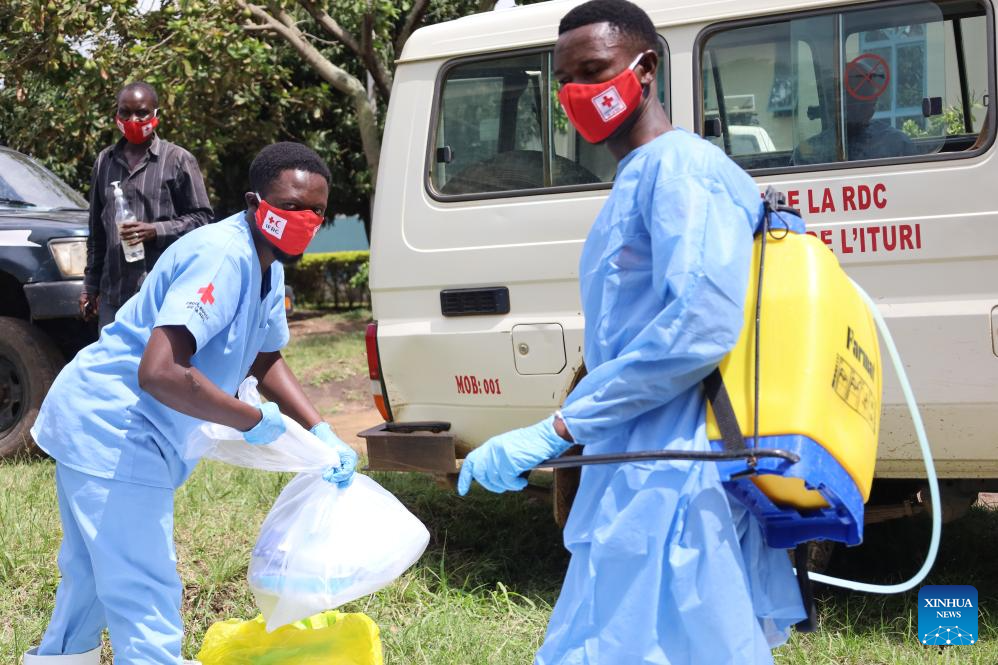
Medical worker disinfect equipments before the burial of a suspected Ebola victim in Bunia, Ituri Province, the Democratic Republic of the Congo, on May 21, 2026. The outbreak, initially reported in Ituri Province, has now affected North Kivu and South Kivu, while two confirmed cases have also been reported in the neighboring country of Uganda. (Str/Xinhua)
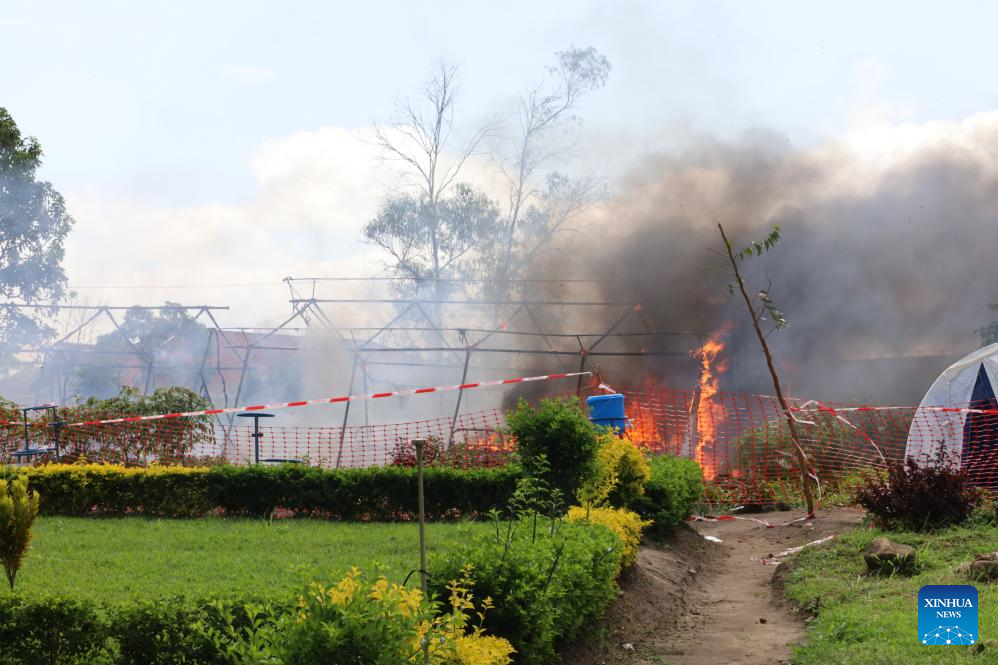
An Ebola isolation site is set on fire in Rwampara town, near Bunia of Ituri Province, the Democratic Republic of the Congo, on May 21, 2026. The outbreak, initially reported in Ituri Province, has now affected North Kivu and South Kivu, while two confirmed cases have also been reported in the neighboring country of Uganda. (Str/Xinhua)
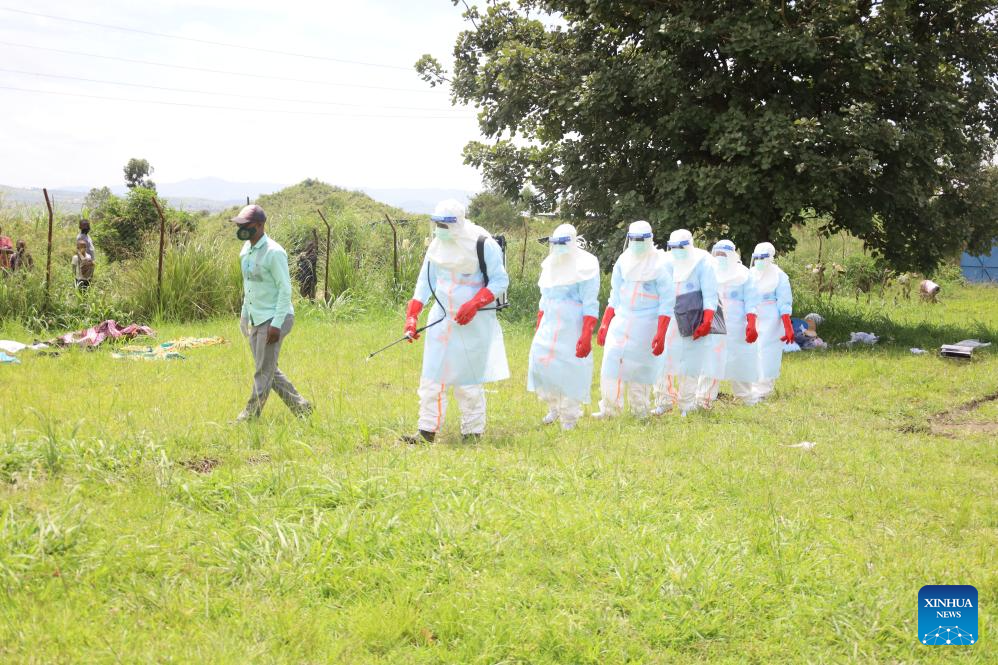
Medical workers conduct disinfection before the burial of a suspected Ebola victim in Rwampara town, near Bunia of Ituri Province, the Democratic Republic of the Congo, on May 21, 2026. The outbreak, initially reported in Ituri Province, has now affected North Kivu and South Kivu, while two confirmed cases have also been reported in the neighboring country of Uganda. (Str/Xinhua)
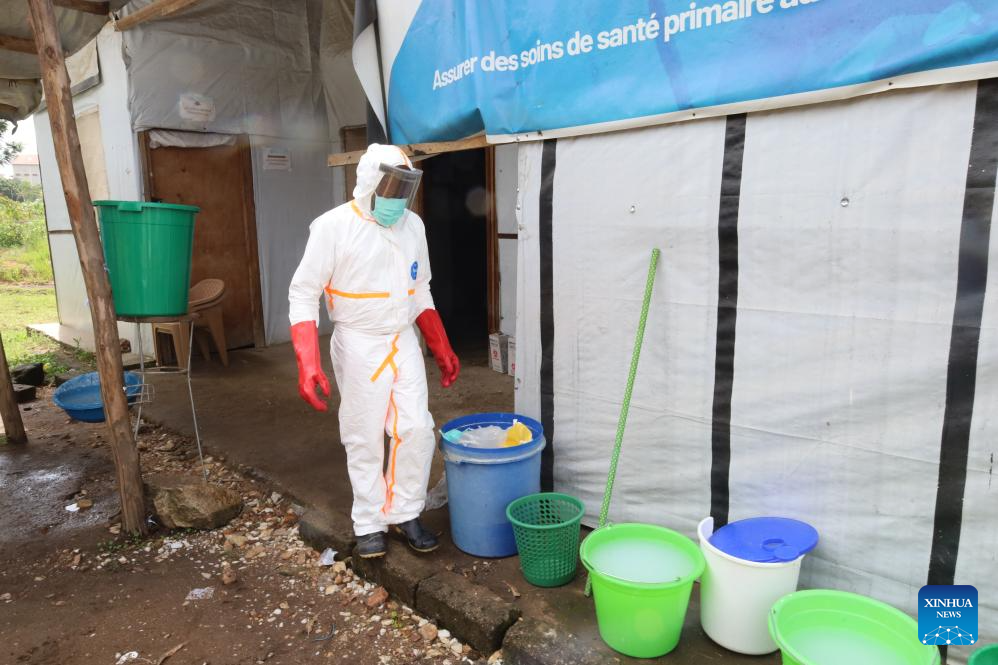
A medical staff disinfects a quarantine room in an Ebola treatment center in Bunia, Ituri province, Democratic Republic of the Congo, on May 21, 2026. The outbreak, initially reported in Ituri Province, has now affected North Kivu and South Kivu, while two confirmed cases have also been reported in the neighboring country of Uganda. (Str/Xinhua)
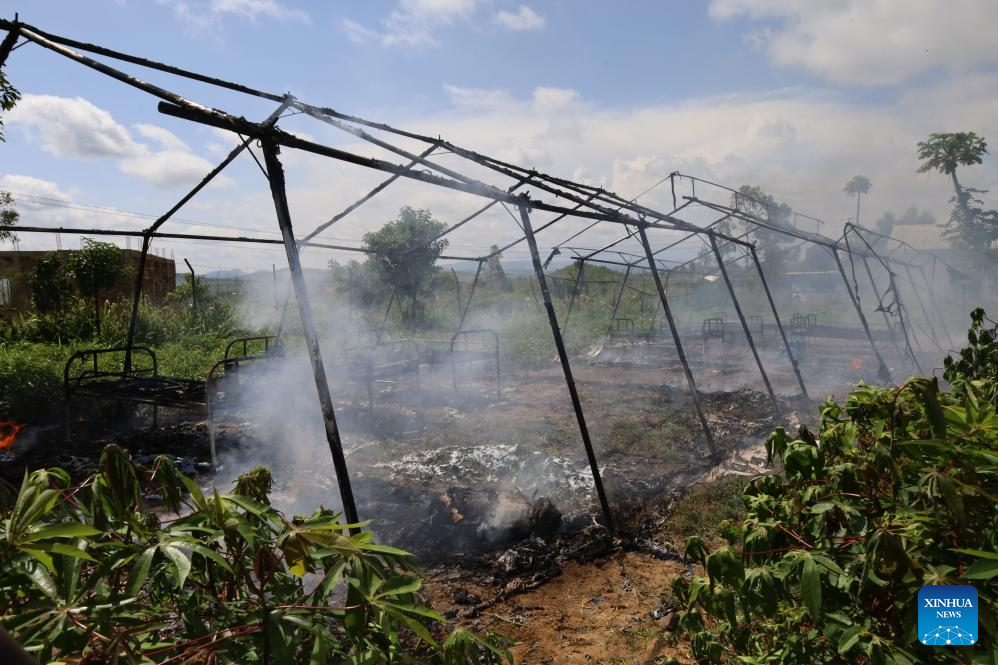
An Ebola isolation site is burned in Rwampara town, near Bunia of Ituri Province, the Democratic Republic of the Congo, on May 21, 2026. The outbreak, initially reported in Ituri Province, has now affected North Kivu and South Kivu, while two confirmed cases have also been reported in the neighboring country of Uganda. (Str/Xinhua)


