
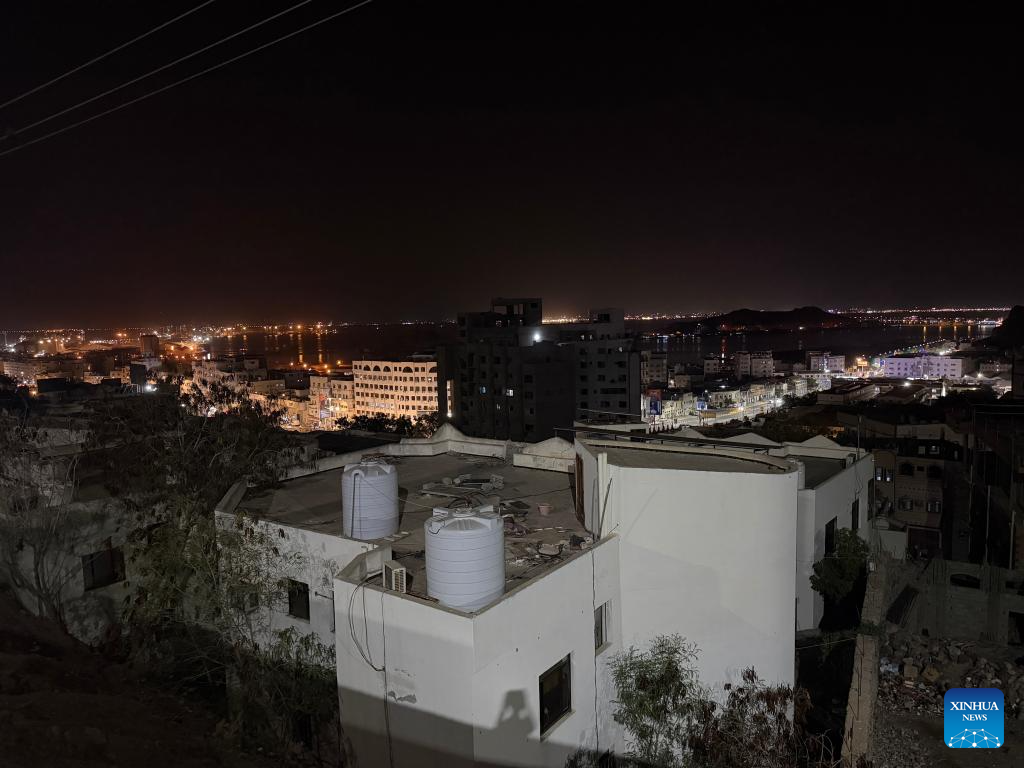
This photo taken on May 19, 2026 shows part of the city remain dark at night due to electricity outage in Aden, Yemen.(Photo by Murad/Xinhua)
by Murad Abdo
ADEN, Yemen, May 21 (Xinhua) -- In Yemen's southern port city of Aden, most families no longer wait for nightfall to go to sleep. They wait for it to become survivable.
As evening falls across the city, rooftops quietly fill with exhausted families carrying pillows, thin mattresses and bottles of water up narrow staircases in search of air.
Beneath them, apartments remain trapped in darkness and summer heat after electricity cuts that now stretch for more than 16 hours a day.
The concrete rooftops offer little comfort. But for many residents, they are still easier to endure than the suffocating rooms below.
Every night, Ali Saleh and his family repeat the same journey.
Shortly before midnight, the 48-year-old father lifted mattresses onto his shoulders and guided his sleepy children one by one toward the rooftop of their apartment building in Aden's Mansourah district.
"The rooms become like graves," he complained, sweat covering his exhausted face. "You sit there unable to breathe, unable to sleep, waiting for morning to save you."
On Saleh's rooftop, his youngest son lay asleep near the edge of the building on a thin mattress stained with dust and dampness. Mosquitoes swarmed relentlessly around his face, drawn by the stagnant sewage nearby, while his mother waved a piece of cloth over him through the suffocating night.
"Every week, someone falls sick," Saleh said as he brushed insects away from the child's forehead. "Dengue fever, malaria, high fever ... people no longer even know what illness is spreading anymore."
"The war taught us how to survive fear and hunger," he said. "But this heat ... this endless exhaustion ... it destroys people slowly."
The rooftops allow locals to escape the sweltering heat for a while, but they also harbor another deadly threat.
During summer nights in Aden, bursts of celebratory gunfire from weddings and gatherings often echo across the city. Stray bullets, fired recklessly into the air, sometimes land on rooftops where families sleep.
Saleh pointed toward a nearby building where a stray bullet had reportedly pierced a solar panel only weeks earlier.
"When the shooting starts, my children wake up terrified," he said. "Imagine escaping your room searching for air, only to fear death from the sky."
On a nearby rooftop, 39-year-old taxi driver Nasser Ahmed sat awake with his two daughters through another night without electricity. His youngest child kept asking him when the electricity would return.
For a moment, he forced a tired smile. Then he fell silent.
"I don't know what to tell her anymore," he said.
For Aden's residents, nights no longer bring rest. They bring mosquitoes, sweat, darkness, and waiting. The relentless heat often lingers throughout the night, and it is only in the early hours, when a slight breeze finally stirs, that most people are able to fall asleep.
The exhaustion reaches far beyond sleep.
Hospitals struggle during outages. Water pumps stop working in many neighborhoods. Food spoils quickly inside powerless refrigerators. Families spend much of their shrinking income buying ice, batteries and fuel simply to survive another day.
Residents say this year's electricity collapse is among the worst in Aden's modern history.
Local authorities say that operating Aden's electricity system now costs around 55 million U.S. dollars per month, nearly 1.8 million dollars a day, while its monthly revenues are not enough to cover even a single day of operating expenses.
The government is taking measures: Yemen's Supreme Energy Council has approved emergency steps to secure fuel supplies, increase generating capacity, and ensure more stable operations at Aden's power stations during the peak summer season.
But for many residents still enduring long nights of heat and darkness, such efforts offer only a cautious hope that the city may one day break free from its cycle of blackouts and exhaustion.
"We hope that one day we too can sleep soundly through the night in our own home," Saleh said dejectedly, his eyes bloodshot from sleepless nights. "But for now, it remains a luxury that seems almost unattainable for us."
Shortly before sunrise, a weak breeze finally crossed Saleh's rooftop. One by one, his exhausted children drifted off to sleep.
Below them, most of the city remained largely swallowed by darkness. ■


