
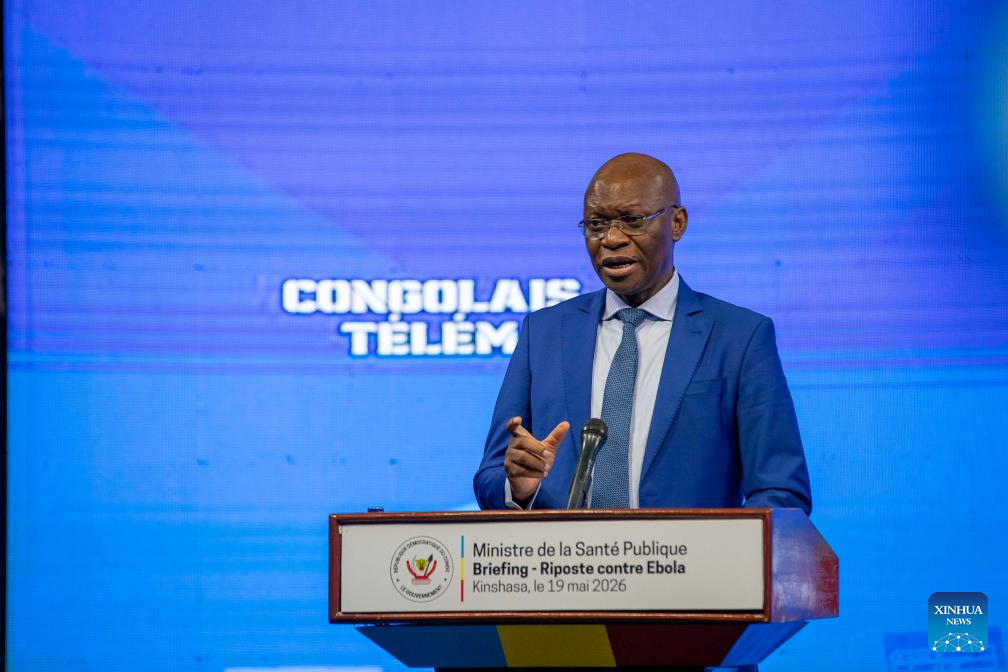
Roger Kamba, Health Minister of the Democratic Republic of the Congo (DRC), speaks at a press briefing on the Ebola outbreak in Kinshasa, DRC capital, on May 19, 2026. During a media briefing on Tuesday, DRC Health Minister Roger Kamba said that 543 suspected cases were recorded, including 32 laboratory-confirmed cases, while the death toll reached 136. (Str/Xinhua)
KINSHASA, May 19 (Xinhua) -- The Democratic Republic of the Congo (DRC) is racing to contain its latest Ebola outbreak, after it was declared on May 15 in the eastern province of Ituri.
During a media briefing on Tuesday, DRC Health Minister Roger Kamba said that 543 suspected cases were recorded, including 32 laboratory-confirmed cases, while the death toll reached 136.
Kamba said the deaths are probable cases suspected to be linked to Ebola, with investigations underway to determine those directly attributable to the virus.
ORIGIN STILL UNCLEAR
In Bunia, capital of Ituri province, World Health Organization official Adelheid Marschang Ancia said on Tuesday that health authorities had not yet identified "patient zero."
"What we know for now is that on May 5, there was ... a person who died in Bunia," she said, adding that the body was later brought to Mongbwalu, where funeral-related exposure may have contributed to transmission.
Earlier, Africa Centers for Disease Control and Prevention (Africa CDC) Director General Jean Kaseya said the true index case had not yet been identified. "This outbreak started in April. So far, we don't know the index case. It means we don't know how far the magnitude of this outbreak is," Kaseya said on May 16.
According to Kamba, sequencing results suggested the currently circulating virus "came from the forest," describing it as a new forest-origin contamination rather than the resurgence of an older viral chain.
The DRC minister also acknowledged community resistance in some affected areas, as some families initially believed the illness was caused by a "curse" or "mystical force" rather than a virus, delaying alerts and contributing to the spread of the disease.
Such rumors have declined since the government officially declared the outbreak and held public briefings, said Kamba.
VACCINE GAP
The outbreak is caused by the Bundibugyo strain of Ebola virus, a less common strain first identified in Uganda in 2007, and then caused an outbreak in DRC's Isiro region in 2012.
According to Jean-Jacques Muyembe, director general of the National Institute of Biomedical Research, genome sequencing showed that the virus currently circulating is a variant of the Bundibugyo Ebola virus, distinct from the variants detected in Uganda in 2007 and in the DRC in 2012.
Kamba said the lack of a specific vaccine and treatment is a source of concern, but the DRC has extensive experience in fighting Ebola. He said the response would focus on rapid detection, patient isolation, protection of health workers and safe burials.
A WHO technical advisory group was scheduled to meet on Tuesday for discussions on potential vaccine candidates. Ancia said that Ervebo, a vaccine against the Zaire Ebola virus, is under consideration, but it could take about two months before it becomes available.
Meanwhile, speaking in Kinshasa on Tuesday, Africa CDC's Kaseya specified that three candidate vaccines were under review, including Ervebo.
For now, Ervebo might provide a degree of "cross-protection" against the Bundibugyo strain, but further studies are needed to confirm its effectiveness, said Muyembe.
He said some vaccine candidates were already in the research pipeline, but their development would take time. "By the time the epidemic is over, we may find a vaccine," he added.
FRAGILE SETTING
The outbreak has emerged in an area already strained by conflict, displacement and weak healthcare capacity.
The United Nations Refugee Agency said Tuesday that 11,000 South Sudanese refugees in Ituri require preventive assistance, while more than 2,000 Rwandan and Burundian refugees in Goma need sanitary supplies.
Confirmed cases have been registered in Butembo and Goma in North Kivu province. Goma is one of the largest urban centers in eastern DRC and a key border city with Rwanda, which has remained under the control of the March 23 Movement (M23) rebel group since early 2025.
Government spokesperson Patrick Muyaya said Tuesday that the rebel group's control of Goma, home to one of the country's best-equipped laboratories, is hampering epidemiological surveillance, contact tracing and the transport of samples.
Uganda has also confirmed two imported cases in Kampala, including one death, according to the World Health Organization.
On Sunday, WHO Director-General Tedros Adhanom Ghebreyesus declared the outbreak in the DRC and Uganda a Public Health Emergency of International Concern, citing concern over the "scale and speed" of the epidemic.
The Africa Centers for Disease Control and Prevention later declared the outbreak a Public Health Emergency of Continental Security, saying the move would strengthen regional coordination and speed up resource mobilization.
Neighboring countries, including Rwanda, Burundi and Tanzania, have stepped up surveillance, border screening and emergency preparedness measures.
Rwanda has suspended movement through key crossings linking Goma and the Rwandan border city of Gisenyi, allowing only nationals returning to their respective countries to cross, according to local sources.
RESPONSE UNDER PRESSURE
Kamba said emergency supplies are being sent to affected areas to set up treatment centers in Mungbwalu, Rwampara and Bunia, epicenters of the outbreak, and the government is expanding a nationwide laboratory network to detect viruses more quickly.
He said he had visited the field on Sunday with the WHO, which had already delivered about five tonnes of supplies. UNICEF, he added, was unloading several tonnes of equipment at Bunia airport as the briefing was taking place.
The minister acknowledged that declining international health funding is hampering the response, saying an outbreak of this scale required significant support. He called on the international community to help strengthen the Congolese health system.
The DRC has faced repeated Ebola outbreaks since the virus was first identified near the Ebola River in 1976. Its largest outbreak, caused by the Zaire strain, hit eastern DRC from 2018 to 2020, killing more than 2,200 people. ■


