
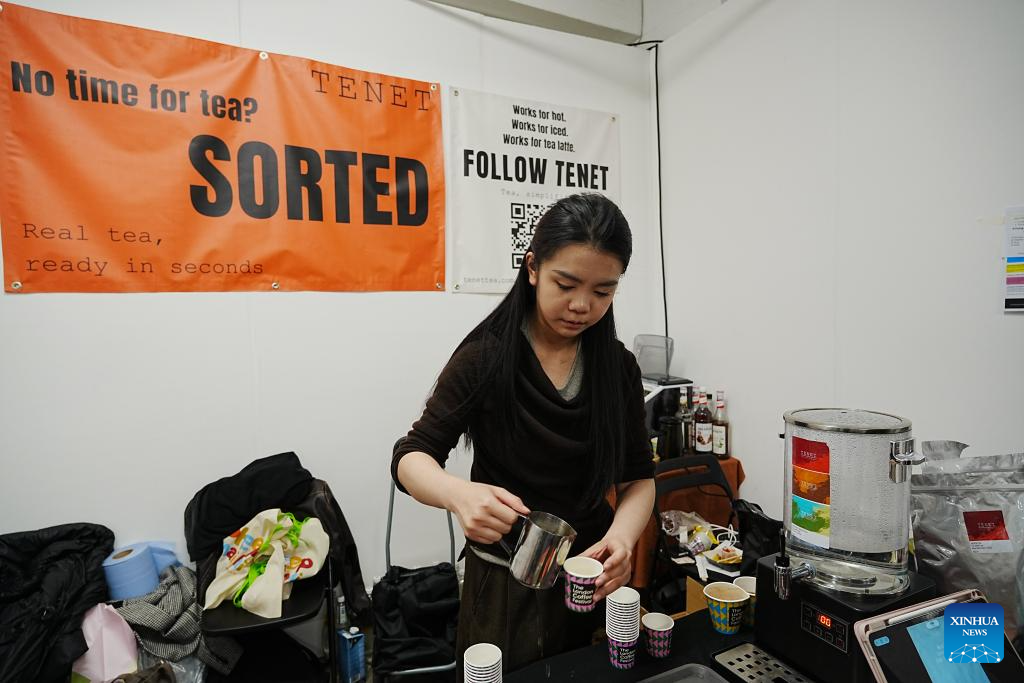
Jin Lusha, TENETtea's chief financial officer, pours a cup of tea at the exhibition stall during the London Coffee Festival in London, Britain, May 17, 2026. The aroma of freshly brewed coffee filled the Truman Brewery in east London, where the London Coffee Festival ran from Thursday to Sunday, bringing together roasters, baristas, cafe owners, equipment makers and packaging suppliers from across the industry. Amid the busy booths and tasting counters, Chinese exhibitors stood out not only for their coffee beans, but also for their tea drinks, sustainable packaging and coffee machines. Their presence highlighted how Chinese companies are moving beyond single-product offerings and becoming involved in more segments of Europe's coffee consumption chain. (Xinhua/Zhao Jiasong)
by Xinhua writer Zhao Jiasong
LONDON, May 19 (Xinhua) -- The aroma of freshly brewed coffee filled the Truman Brewery in east London, where the London Coffee Festival ran from Thursday to Sunday, bringing together roasters, baristas, cafe owners, equipment makers and packaging suppliers from across the industry.
Amid the busy booths and tasting counters, Chinese exhibitors stood out not only for their coffee beans, but also for their tea drinks, sustainable packaging and coffee machines. Their presence highlighted how Chinese companies are moving beyond single-product offerings and becoming involved in more segments of Europe's coffee consumption chain.
CHINESE COFFEE ROASTERS GOING OVERSEAS
At the festival, specialty coffee roasters from China also attracted attention. Ji Hengtao, founder and roaster of Shanghai-based Terraform Coffee Roaster, told Xinhua that as China's domestic specialty coffee market has grown rapidly and matured, some Chinese roasters have begun looking overseas.
"In the past, it was mostly overseas brands entering the Chinese market. Now we also want to prove that Chinese brands can be competitive overseas," he said.
Ji said the competitiveness of Chinese specialty coffee roasters lies not only in their use of Chinese-grown coffee beans, but also, more importantly, in their improving ability to source beans, refine roasting techniques and bring out a wider range of flavors.
In his view, China's long-standing tea culture has also helped foster consumers' appreciation of specialty coffee.
"The concentration of specialty coffee is relatively close to that of tea. Chinese consumers are naturally sensitive to layers of flavor, differences in ingredients and brewing methods," he said, noting that such traditions have pushed domestic roasters to sharpen their ability to source, roast and develop distinct flavors, helping fuel their overseas expansion.
Liu Yujia, a representative of Chinese coffee roaster Coffee Buff, said China's fast-growing specialty coffee industry has not only brought more overseas attention to Yunnan Province -- China's well-known coffee-growing region -- but also encouraged Chinese roasters to look globally for high-quality green beans.
"I am very happy to see Chinese roasters here," Jennifer Brown, a British visitor, said after tasting coffee at a Chinese booth. "It is not just about Chinese coffee beans. The roasting is very refined, and the flavors are bright and interesting."
Zhao Lu, founder of Mobydick Coffee Roasters, another company based in Shanghai, said China can be seen not only as a coffee-growing origin, but also as a country with its own roasting styles, roasters and coffee shops. More international exchanges, competitions and collaborations are needed to help Chinese specialty coffee become a more visible part of global coffee culture.
MATCHA AND NEW TEA TRENDS
In recent years, matcha drinks have become more visible on London's streets, especially among young consumers. At the London Coffee Festival, matcha was also a popular category.
Raphael Chow, founder of British tea brand brut tea, told Xinhua that matcha has gained momentum rapidly in the British market. "Two years ago, many cafes were still discussing whether to add matcha to their menus. Now, people are more concerned about how to find better matcha," he said.
British consumers mostly drink matcha in milk-based forms such as matcha latte, Chow said. For that reason, his brand pays close attention to how matcha works with milk and oat milk, while trying to avoid excessive bitterness or an overly grassy taste.
The Financial Times reported in April that matcha drinks in British cafes were on average about one-fifth more expensive than regular lattes. Several coffee chains attributed sales growth to matcha products and expanded their menus with new offerings inspired by matcha's color and perceived health benefits, including purple sweet potato drinks.
Chow said Chinese matcha producers are improving quality and exploring the distinctive features of China's tea-producing regions and tea varieties. A Zhejiang matcha showcased by brut tea, for example, blends China's Longjing 43 tea cultivar with Japan's Yabukita cultivar, creating more layered aroma and flavor.
According to a report released by the China Tea Marketing Association, China's matcha output reached 12,000 tonnes in 2025, with the domestic market continuing to expand. China has become the world's largest producer and consumer of matcha.
"China not only has advantages in output and supply chains, but can also provide distinctive, high-quality matcha products," Chow said.
Apart from matcha, some Chinese pure-tea products are also trying to reach young British consumers in more convenient forms.
Chen Zhiliang, chief executive officer of Chinese tea brand TENETtea, said the brand currently focuses on three types of Chinese tea, including oolong, jasmine and lapsang souchong.
The brand uses freeze-drying technology to preserve the flavor of loose-leaf tea and make the products suitable for cold-water brewing. Consumers can also mix the tea powder with tonic water, milk or sparkling water to create different drinks.
Chen said Britain has a deep tea-drinking tradition, but many local consumers still associate Chinese tea with traditional teahouses or high-sugar bubble tea.
"For Chinese tea to further enter everyday consumption scenarios overseas, it has to retain the characteristics of its tea-growing regions, traditional processing techniques and Oriental aesthetic elements, while also adapting to young local consumers' preferences for iced drinks, portability and personalized mixing," said Jin Lusha, TENETtea's chief financial officer. ■
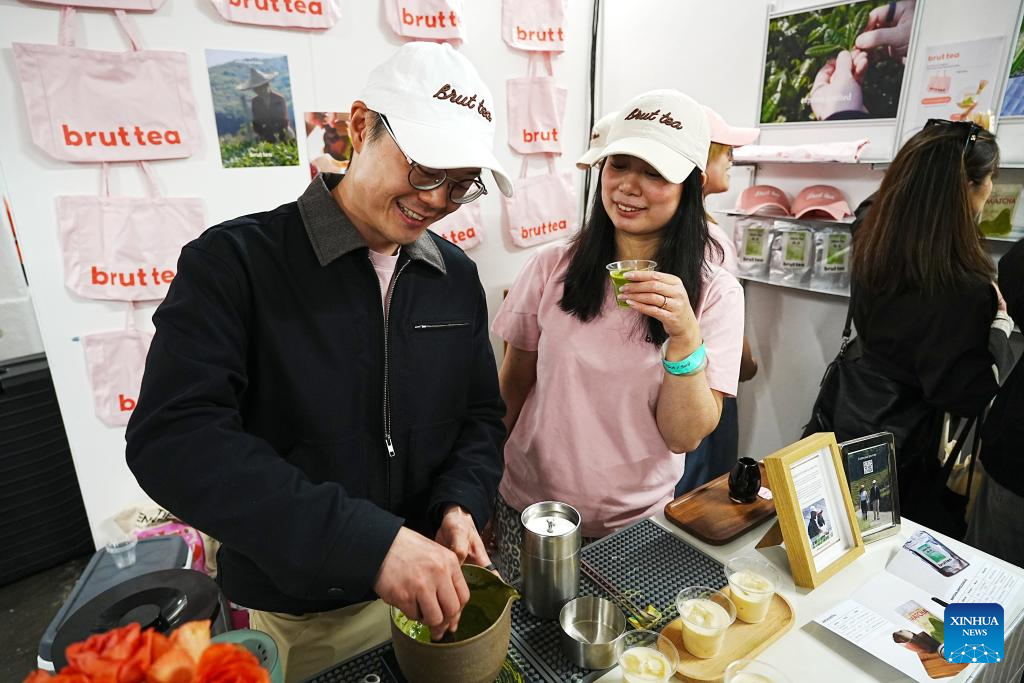
Founders of British tea brand brut tea make matcha during the London Coffee Festival in London, Britain, May 17, 2026. The aroma of freshly brewed coffee filled the Truman Brewery in east London, where the London Coffee Festival ran from Thursday to Sunday, bringing together roasters, baristas, cafe owners, equipment makers and packaging suppliers from across the industry.
Amid the busy booths and tasting counters, Chinese exhibitors stood out not only for their coffee beans, but also for their tea drinks, sustainable packaging and coffee machines. Their presence highlighted how Chinese companies are moving beyond single-product offerings and becoming involved in more segments of Europe's coffee consumption chain. (Xinhua/Zhao Jiasong)
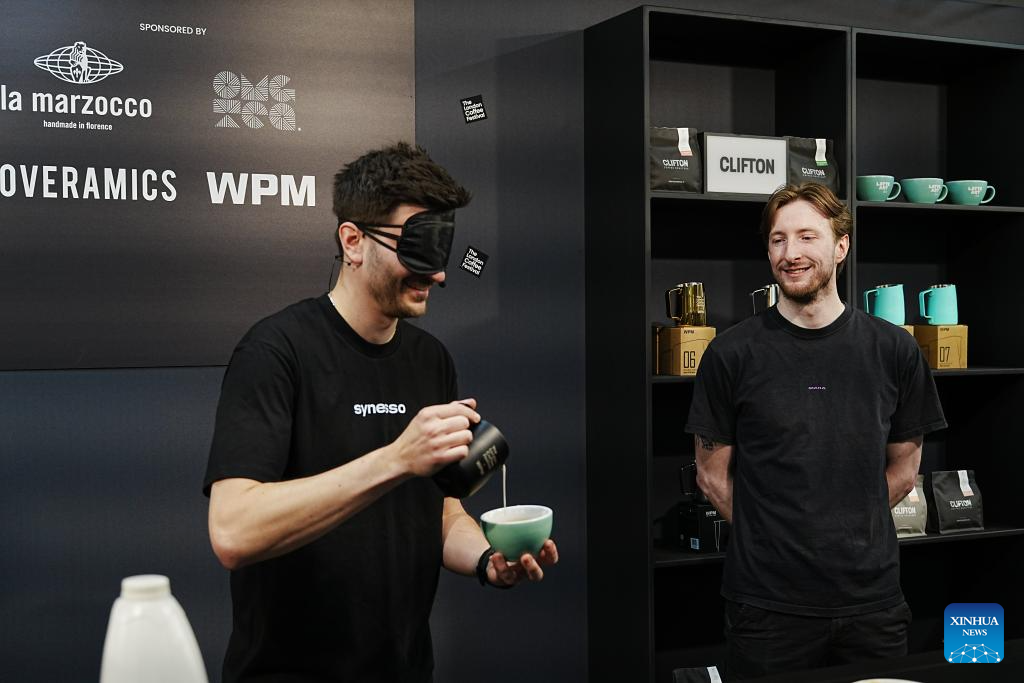
A blindfolded barista demonstrates latte art during the London Coffee Festival in London, Britain, May 17, 2026. The aroma of freshly brewed coffee filled the Truman Brewery in east London, where the London Coffee Festival ran from Thursday to Sunday, bringing together roasters, baristas, cafe owners, equipment makers and packaging suppliers from across the industry.
Amid the busy booths and tasting counters, Chinese exhibitors stood out not only for their coffee beans, but also for their tea drinks, sustainable packaging and coffee machines. Their presence highlighted how Chinese companies are moving beyond single-product offerings and becoming involved in more segments of Europe's coffee consumption chain. (Xinhua/Zhao Jiasong)


