
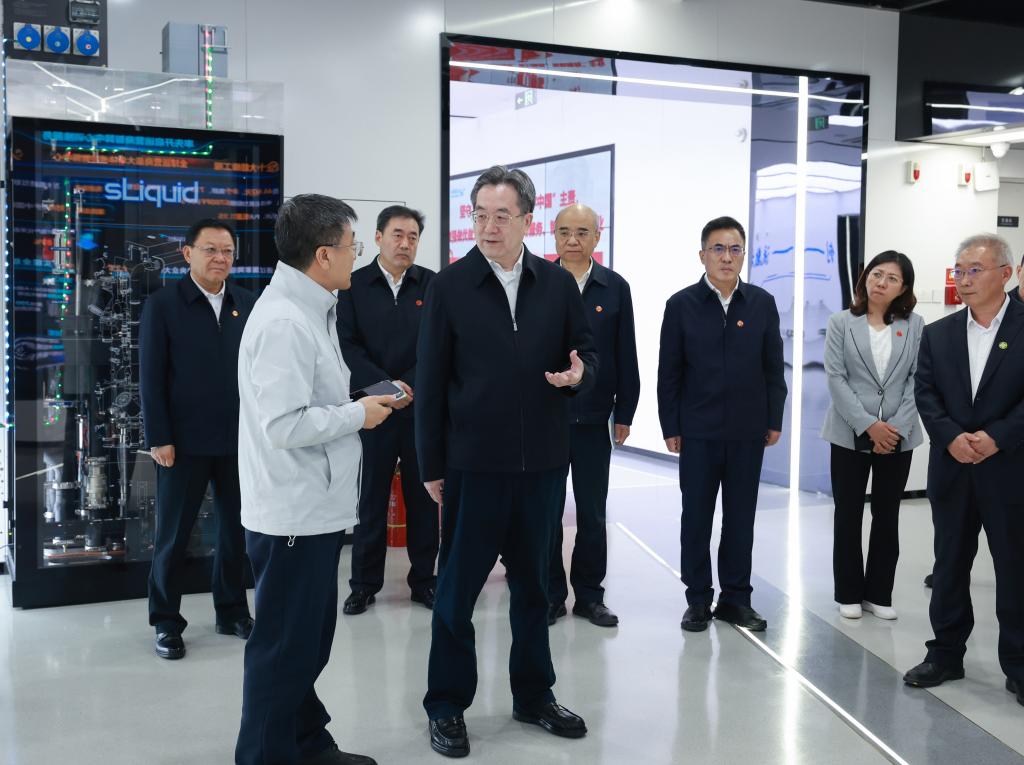
Chinese Vice Premier Ding Xuexiang, also a member of the Standing Committee of the Political Bureau of the Communist Party of China (CPC) Central Committee, visits an intelligent computing facility operated by a leading telecom firm in Hohhot, north China's Inner Mongolia Autonomous Region, May 17, 2026. Ding has called for stronger top-level design and strategic planning to build a national integrated computing power network and ensure its intensive, efficient use, so as to empower high-quality development during recent inspection tours in Beijing, Hebei Province and the Inner Mongolia Autonomous Region. (Xinhua/Wang Ye)
HOHHOT, May 18 (Xinhua) -- Chinese Vice Premier Ding Xuexiang has called for stronger top-level design and strategic planning to build a national integrated computing power network and ensure its intensive, efficient use, so as to empower high-quality development.
Ding, also a member of the Standing Committee of the Political Bureau of the Communist Party of China (CPC) Central Committee, made the remarks during recent inspection tours in Beijing, Hebei Province and the Inner Mongolia Autonomous Region.
During his visits to a key computing hub in Beijing and a resource scheduling platform in Inner Mongolia, Ding stated that computing power is an important indicator of a nation's comprehensive strength.
He called for coordinated planning and orderly development, emphasizing the synergy between computing supply and demand as well as between computing and power systems, to accelerate the formation of a unified national computing network.
He stressed the need to strengthen monitoring and scheduling capabilities to improve computing access and precision matching, integrating dispersed resources to effectively meet diverse demands.
Amid a complex landscape of interwoven traditional and emerging risks, he highlighted the importance of bolstering security across infrastructure, models, data, and networks, thereby enhancing the overall resilience of computing systems.
At a major data center and two intelligent computing facilities operated by leading telecom and tech firms in Hebei Province and Inner Mongolia, Ding noted that China boasts abundant data resources and vast application scenarios. He called for leveraging these advantages by coordinating the development of computing infrastructure, model algorithms, and data supply to solidify the foundation of digital and intelligent growth.
Emphasizing the need for stronger collaboration among industry, academia, research, and application, he called for accelerating breakthroughs in key technologies, refining standards and regulations, and driving domestic hardware and software to transition from merely "usable" to "highly effective" as soon as possible.
He also called for a market-oriented, application-driven approach to innovate service models and make computing power more efficient, accessible and user-friendly.
Visiting a regional power operator and a zero-carbon computing base in Inner Mongolia, a region with abundant wind and solar resources and a high share of green electricity, Ding emphasized that surging energy demands from computing require better coordination between energy allocation and infrastructure development.
He called for a mutually reinforcing relationship between power supply and computing capacity. He encouraged exploring new power system models to enhance smart energy management and promote direct green power supply and energy-saving technologies.
Addressing recent volatility in international energy markets, he stressed the importance of stabilizing domestic energy supply and prices to meet production and daily needs, ensuring steady economic and social operations. ■
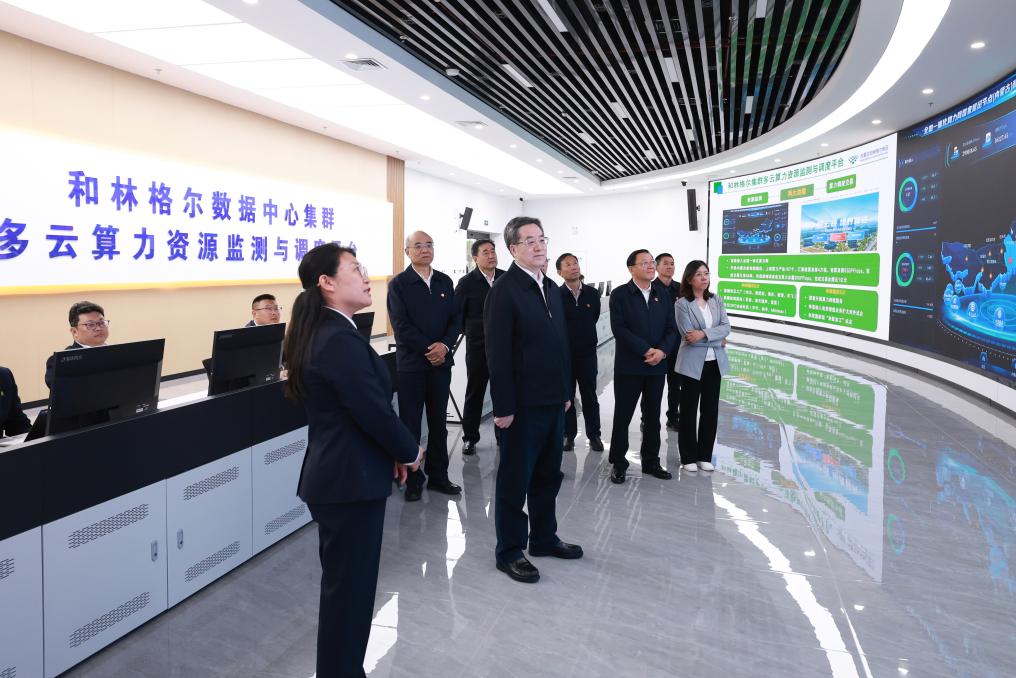
Chinese Vice Premier Ding Xuexiang, also a member of the Standing Committee of the Political Bureau of the Communist Party of China (CPC) Central Committee, visits a resource scheduling platform in north China's Inner Mongolia Autonomous Region, May 17, 2026. Ding has called for stronger top-level design and strategic planning to build a national integrated computing power network and ensure its intensive, efficient use, so as to empower high-quality development during recent inspection tours in Beijing, Hebei Province and the Inner Mongolia Autonomous Region. (Xinhua/Wang Ye)


