
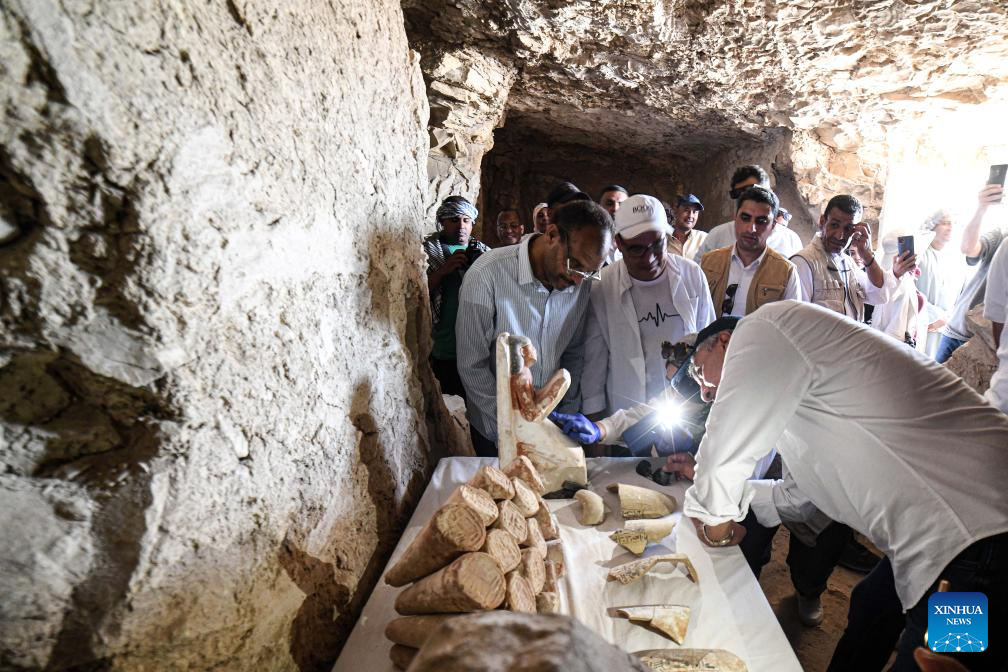
Archaeological staff work in the Draa Abul Naga necropolis on the West Bank of Upper Egypt's Luxor, Egypt on May 14, 2026. (Xinhua/Ahmed Gomaa)
LUXOR, Egypt, May 14 (Xinhua) -- Egyptian Ministry of Tourism and Antiquities announced on Thursday significant new archaeological discoveries made by an Egyptian mission in the Draa Abul Naga necropolis on the West Bank of Upper Egypt's Luxor.
Hisham Elleithy, secretary-general of Egypt's Supreme Council of Antiquities, told Xinhua that the mission discovered a collection of wooden coffins dating back to various historical periods.
Inside a burial shaft in the courtyard of the tomb of Baki, a senior statesman, archaeologists unearthed 10 well-preserved wooden coffins adorned with diverse scenes and texts, he said.
The official added that preliminary studies indicated that four of these coffins date to the 18th Dynasty in the New Kingdom (1550-1069 BC), including one belonging to "Merit," a "Singer of Amun."
Another coffin from the Ramesside period of the New Kingdom belongs to "Padi-Amun," a priest of the Temple of Amun, while the remaining coffins date to the Late Period of Ancient Egypt (747-332 BC), he revealed.
Elleithy noted that the shaft was used as a cachette to protect these coffins after they were moved from original burial sites, pointing out that the mummies inside were found in a poor state of preservation.
Meanwhile, the ministry said in a statement that the mission also uncovered the tomb of Aa-Shefi-Nakhtu, a purification priest of the Temple of Amun.
Located in the southern corner of the Baki tomb courtyard, the tomb of Aa-Shefi-Nakhtu features a small courtyard, a rectangular shaft, and an entrance decorated with offering scenes and funerary texts.
Inscriptions on the facade mention the owner's two wives, Isis and Ta-Kaft, both of whom served as Singers at the Temple of Amun.
Furthermore, the mission discovered a sandstone pyramidion inside a small tomb, bearing the name of Benji, titled the Scribe and Noble, the ministry said, adding that the artifact features recurring scenes of the owner in a devotional pose, though his original tomb has yet to be located.
South of the Baki tomb, the mission also found a cache of more than 30 mummies of wild and domestic cats wrapped in linen, which likely dates back to the Ptolemaic era (332-30 BC), it added. ■
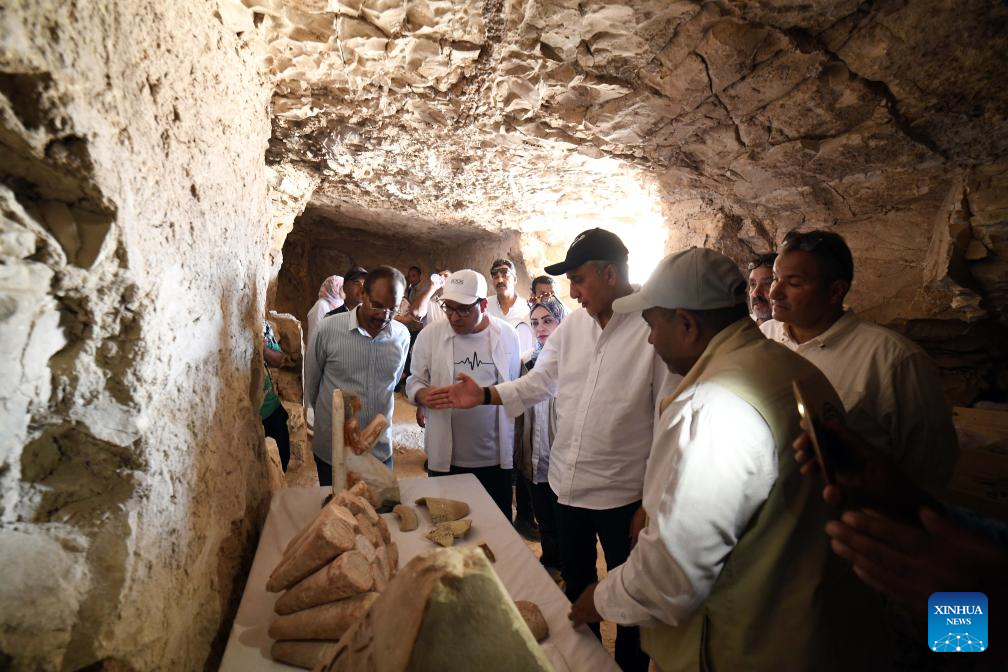
Archaeological staff work in the Draa Abul Naga necropolis on the West Bank of Upper Egypt's Luxor, Egypt on May 14, 2026. (Xinhua/Ahmed Gomaa)


