
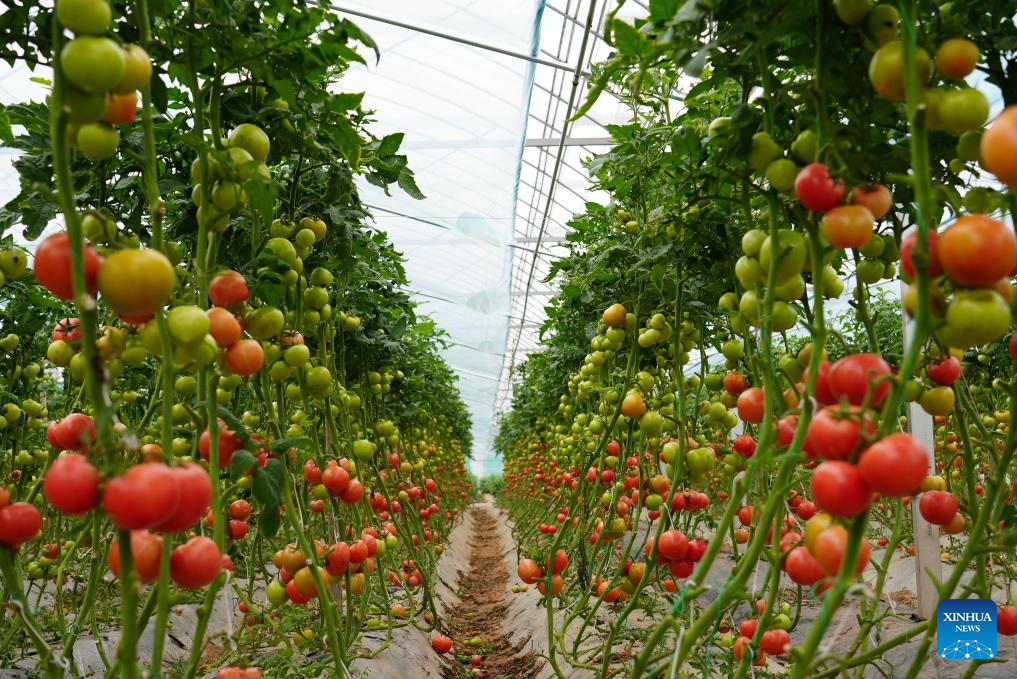
This photo taken on March 11, 2025 shows selenium-rich tomatoes growing at Yudu County, east China's Jiangxi Province. (Xinhua)
NANCHANG, May 9 (Xinhua) -- Inside a glass greenhouse nestled among the mountains of eastern China, clusters of cherry-sized tomatoes hang from sprawling vines like ornaments, with some glowing bright red while others appear green or deep purple.
The plants here grow not in soil, but on elevated racks about 80 cm above the ground. Inside the greenhouse, which covers an area roughly the size of two soccer fields, more than 160 rows of vines stretch into the distance. Automated shades adjust to changing sunlight, while precision irrigation systems deliver water and nutrients directly to the plants. Temperature, humidity and carbon dioxide levels can all be monitored in real time through a smartphone.
The facility is part of a selenium-rich vegetable industrial park in Yudu County, Jiangxi Province, a place best known as the starting point of the Long March, the historic military maneuver in modern Chinese history. Over the past two years, a research team that includes a plant genomics scientist from the Chinese Academy of Sciences has developed more than 60 tomato varieties there using soilless cultivation techniques.
Some of the tomatoes have reached a sweetness level above 14 on the Brix scale, a measure of sugar content. Conventional tomatoes are usually around 7.
"Tomatoes are highly sensitive to water. With smart systems, we can better control growing conditions, reduce pesticide use and improve flavor," said Huang Hai, a technician at the farm. "Our goal is to grow the sweetest tomatoes."
Smart agriculture has helped extend the harvest season and boost selling prices, as consumers show growing demand for sweeter tomato varieties. Researchers say the sweetness comes mainly from fructose, which has a relatively low impact on blood sugar when consumed in moderation.
In Yudu, the tomato farms are part of a broader transformation. The county is remembered as the place where the Central Red Army began the Long March in October 1934. More than 80,000 Red Army soldiers crossed the Yudu River before setting out on the arduous trek that would become one of the defining episodes in the history of the Communist Party of China.
"The Long March is sui generis," the Pulitzer Prize-winning journalist Harrison Salisbury wrote in his book after retracing the route. "Its heroism has fired the dreams of a nation of 1.1 billion people and set China moving toward a destiny no man can yet divine."
For much of its recent history, however, Yudu remained poor, constrained by weak transport links, fragmented farmland and a limited industrial base. The county was officially lifted out of poverty in 2020 as part of China's nationwide poverty alleviation campaign.
Today, local officials are trying to turn geography into an advantage. Yudu has selenium-rich agricultural resources, a favorable climate and relatively quick access to the Guangdong-Hong Kong-Macao Greater Bay Area, one of China's most affluent consumer markets. Tomatoes picked in the morning can reach Shenzhen and Hong Kong the same day. Premium varieties can fetch up to 60 yuan, or about 8.8 U.S. dollars, per kg.
The shift also reflects a wider push in China to modernize agriculture and strengthen domestically bred crop varieties. According to the Ministry of Agriculture and Rural Affairs, domestically bred crop varieties now account for more than 95 percent of the country's total planting area.
This year marks the 90th anniversary of the victory of the Long March, a milestone often invoked in official discourse as China pursues what leaders describe as a "new Long March" toward modernization.
In Chesheng Village, Guo Weiyong, a descendant of a Red Army soldier, has joined the tomato business. He grows nearly 7 mu, or about 0.47 hectare, of tomatoes and earns about 150,000 yuan a year. Demand, he said, is still outpacing supply.
The new farms have also drawn visitors. Tourists come to Yudu to learn about the Long March and, increasingly, to see modern agriculture. In 2025, the county's agricultural tourism revenue exceeded 500 million yuan.
Yudu plans to introduce more than 20 new tomato varieties for trial planting, said Xie Yunhua, the deputy head of the county. The goal is to raise yields by about 15 percent while expanding production of higher-quality produce, Xie noted.
For a county long defined by a historic departure, the emerging industry signals a different kind of journey, from revolutionary memory to glasshouse farming, and from subsistence agriculture to tomatoes sweet enough to compete in some of China's most demanding urban markets. ■


