
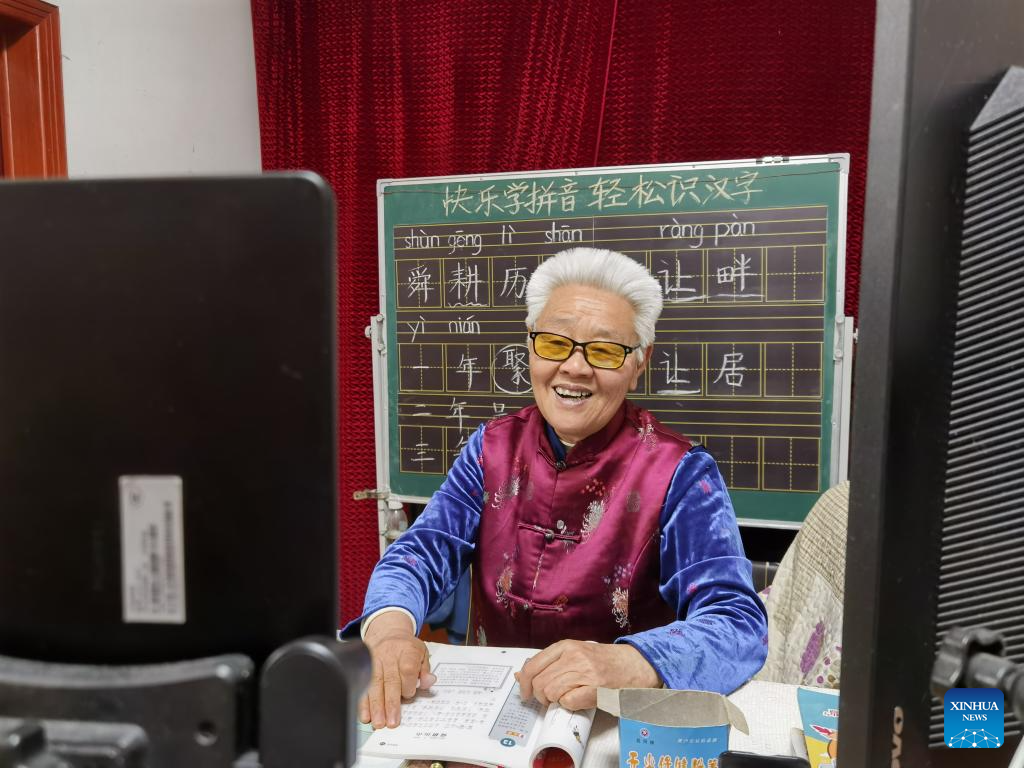
Yang Weiyun, a retired Chinese primary school teacher, gives live-streamed classes at home in Huainan, east China's Anhui Province, April 16, 2026. (Xinhua/Zhu Qing)
HEFEI, May 8 (Xinhua) -- The first language used in Yang Weiyun's live-stream is not always Chinese. Sometimes it is a thumb. Sometimes it is a heart. Sometimes it is a crying face.
In the small room where she teaches, in an old residential building in Huainan, a former coal-mining city in east China's Anhui Province, these icons have become a kind of classroom code. A thumbs-up means, roughly: "I understand." A heart means: "Thank you, teacher." A crying face translates as: "I still don't get it."
Yang, 76, understands the grammar of these signs. Many of the people watching her cannot yet type the words they want to say. Some are adults who have lived much of their lives without being able to read fluently. Some have bits of foundation, such as a few characters and some pinyin, but still struggle to put sounds and words together. Others can read but want to improve their Mandarin, enough to travel, speak with customers, or join ordinary conversations more easily.
So Yang leans toward the old mobile phone that serves as her camera, opens her mouth wide, and turns each vowel into a performance. "A," she says. Then again. And again. Her lips exaggerate the shape of the sound so that someone watching from a field, a warehouse, a truck cab or a wheelchair can follow.
A single syllable may take 20 minutes. The lesson moves slowly, at a pace that seems almost defiant on a platform built for speed.
There is little in the room to suggest the machinery of the modern internet. No music, no filters, no theatrical lighting or merchandise stacked off-screen. Yang has a worn blackboard, a phone and the voice of someone who spent most of her life addressing children who were just beginning to read. At half past four each afternoon, she begins her class, regardless of whether the number of viewers is large or small. Some days, fewer than 10 people are there, while on other occasions the class has proved very popular.
"I never imagined, that after teaching for more than 50 years, I would have my largest number of students after 70," she said.
Yang did not go online in search of adults. When she first opened her live-stream in May 2021, she thought she would teach pinyin and basic characters to children preparing for primary school. That was the world she knew. In 1971, at 21, this daughter of a coal miner had stepped onto a classroom platform for the first time as a primary school Chinese teacher. She remembered being so nervous that she sweated through the lesson. Teaching, she believed then, was "the most sacred job in the world."
She taught for three decades, retired in 2000, and still could not quite stop. After returning to Huainan, she continued working in kindergartens. Only in early 2021, when illness forced her to rest, did she find herself suddenly idle. The stillness felt, to her, like punishment.
Then came Douyin, one of China's most popular short-video and streaming platforms. Watching others teach singing, dancing, calligraphy and painting on live-stream, Yang had an almost mischievous thought, asking herself: "Why can't I teach pinyin?" Her children worried about her health, so she learned in secret.
She entered other people's live-stream rooms and asked how to connect with viewers, how to adjust the lighting, how to keep a session running. Her instructors, she likes to say, were not education specialists. They were vendors of cosmetics, clothes, chickens and fish. Sometimes she bought things simply so a host would answer her technical questions.
The first night, only family members watched her live-stream teaching efforts. Yang, nevertheless, taught for more than two hours.
The online environment rewarded her, briefly, in the way it rewards many things: by making numbers rise. After a month or so, her live-stream room had at times drawn more than 10,000 viewers. But the more important event came not as a surge of traffic, but as a question.
On the night of the Dragon Boat Festival in 2021, after Yang had been teaching for hours, a viewer connected with her and asked: "Teacher, I'm 50. Is it too late for me to learn to read?"
The question changed the room. Yang asked how many other adults wanted to learn characters. The comments began to fill with "raised hands" emojis. What she had mistaken for a children's class revealed itself as something stranger and more urgent: a school for people who had already lived much of their lives while standing at the edge of written language.
For a truck driver named Liu Xianzhi, from Baotou in north China's Inner Mongolia Autonomous Region, that edge had practical consequences. Unable to read cargo forms or road signs, he had often taken wrong turns and driven dozens of extra kilometers. After studying with Yang for three years, he learned more than a thousand commonly used Chinese characters. When he managed to help his son complete university enrollment procedures, he told Yang he was happy and then began to cry.
Another student, Tenzin, who does business in Xizang Autonomous Region in southwest China, studied characters and Mandarin with Yang and later told her that speaking with customers had become easier as a result of these classes. Fang Meizhang, a 75-year-old woman from Jiangxi Province, east China, already knew characters but had long been embarrassed by her inability to speak standard Mandarin. After four years of practice, she told Yang that she had become a host at a local cultural performance.
These stories invite sentiment, but Yang's method remains plain: repetition, correction and the slow work of basics. Beginners start with pinyin. Those with some foundation practice spelling out sounds and recognizing characters. Others move on to simple poems and elementary texts.
In her classroom, literacy is not an abstract virtue. It is a cargo form, a road sign, a conversation with a customer, a university enrollment document for a son, a name written without help.
One of Yang's students, Jiang Yan, a girl with cerebral palsy living in Jiangsu Province in east China, once used her nose to tap likes for the teacher. She had felt that studying was pointless because she could not stand. Yang told her that learning words could at least help others know what she needed and how to help her. Jiang has since learned several hundred common characters and can sound out some words clearly.
Yang's refusal to monetize the room is part of what makes it unusual. She has turned off tipping. She does not sell goods, charge tuition or offer paid study materials. In a live-stream economy where attention is often treated as a source of revenue, Yang uses traffic differently: not to sell, but to teach a class. What might elsewhere be a stage for performance has become, in her hands, a room for correction, repetition and waiting.
In 2023, Yang was recognized as one of China's "silver-haired edu-streamers," a group of elderly online educators that also included academicians, professors and retired teachers. Some explained the depths of the universe or the mysteries of the sea. Yang taught initials and finals.
The pairing was revealing. Knowledge does not begin only at the frontier of science. Sometimes it begins when a person can finally read a road sign, fill out a form, or tell another person, in writing, what they need.
The traffic has not always stayed. Some days, Yang's audience falls back to single digits. But the class continues. A comment appears: "Teacher Yang, I'm late. I was weeding in the field." Another reads: "Teacher Yang, today I learned to write my name."
Yang squints at the screen and reads each one aloud. Then she smiles, as if the student were not far away at all, but seated in the first row, directly in front of her. ■
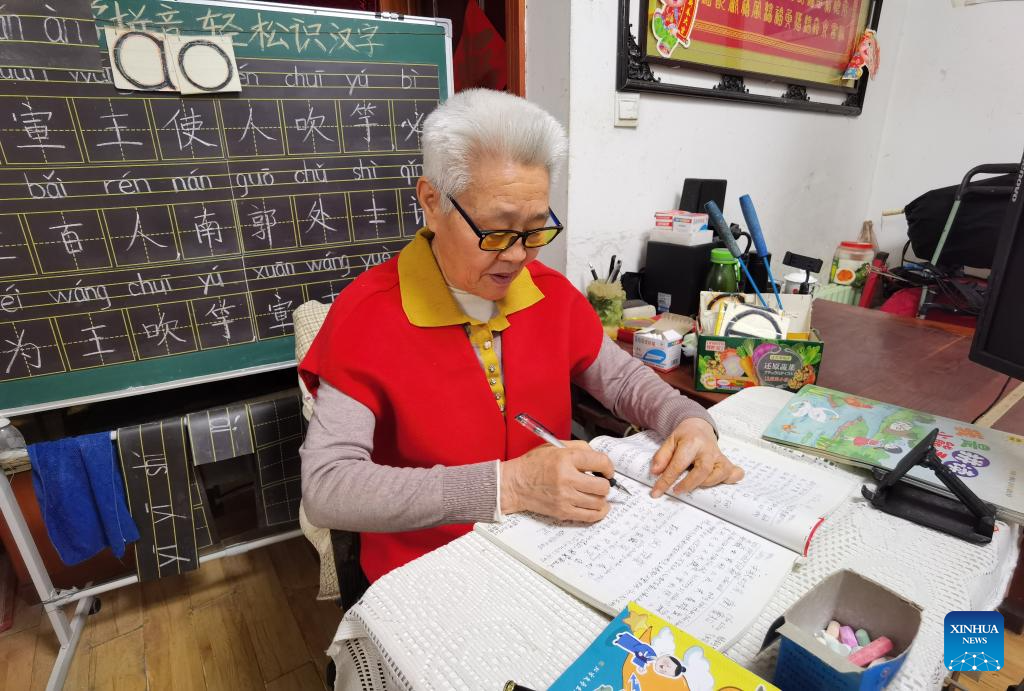
Yang Weiyun, a retired Chinese primary school teacher, prepares her lessons at home in Huainan, east China's Anhui Province, April 16, 2026. (Xinhua/Zhu Qing)
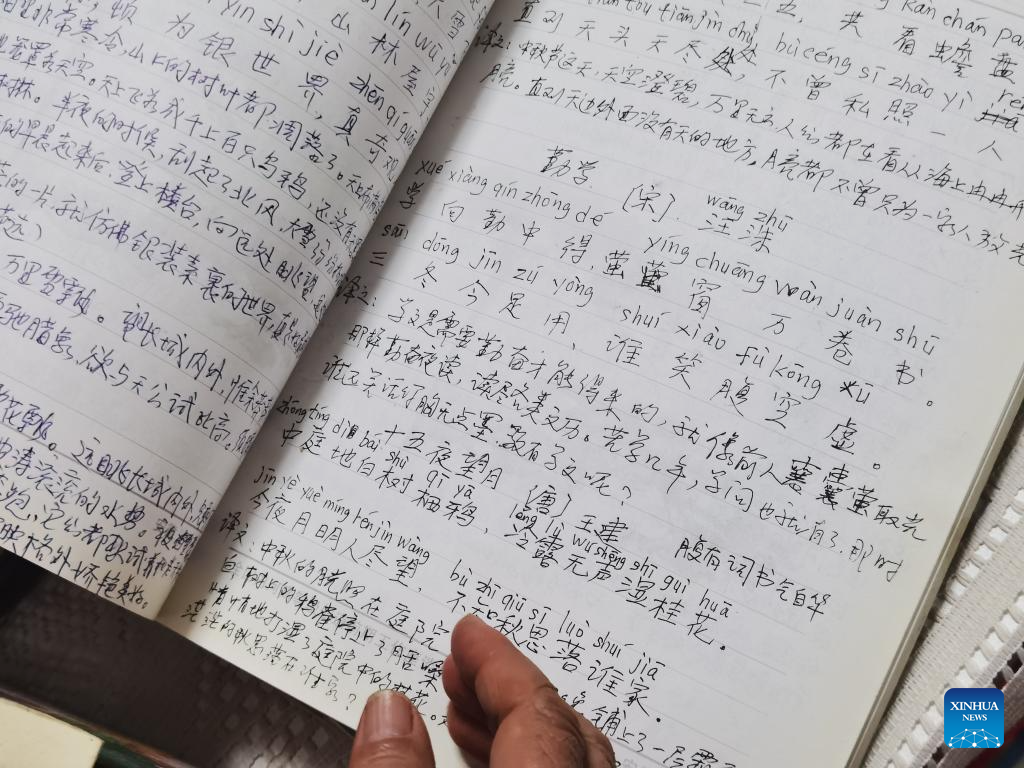
This photo taken on April 16, 2026 shows the lesson plans written by Yang Weiyun, a retired Chinese primary school teacher, in Huainan, east China's Anhui Province. (Xinhua/Zhu Qing)


