
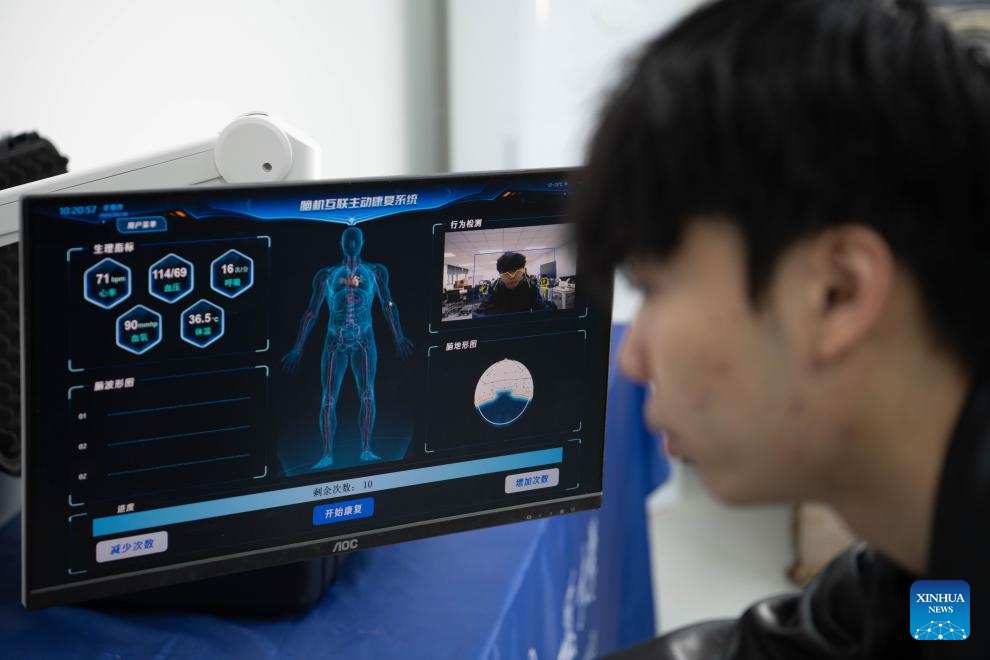
Anhui University's doctoral student Meng Weiyan conducts brain-computer interface (BCI) research experiments at Anhui University in Hefei, east China's Anhui Province, April 30, 2026.
Brain-computer interface (BCI) technology is an emerging frontier that enables direct communication between the brain and external devices by recording and decoding neural signals.
In recent years, a BCI research team of faculty and students at Anhui University has developed minimally invasive electrodes for signal acquisition and built related datasets and integrated hardware-software platforms. These technologies are undergoing application tests in areas such as clinical interaction and embodied intelligence.
Students form a key part of the team. Graduate students majoring in computer science and artificial intelligence are involved in tasks including electroencephalogram (EEG) data collection and model training, while undergraduates participate in experimental research, improving their research and innovation capabilities. (Xinhua/Zhang Duan)
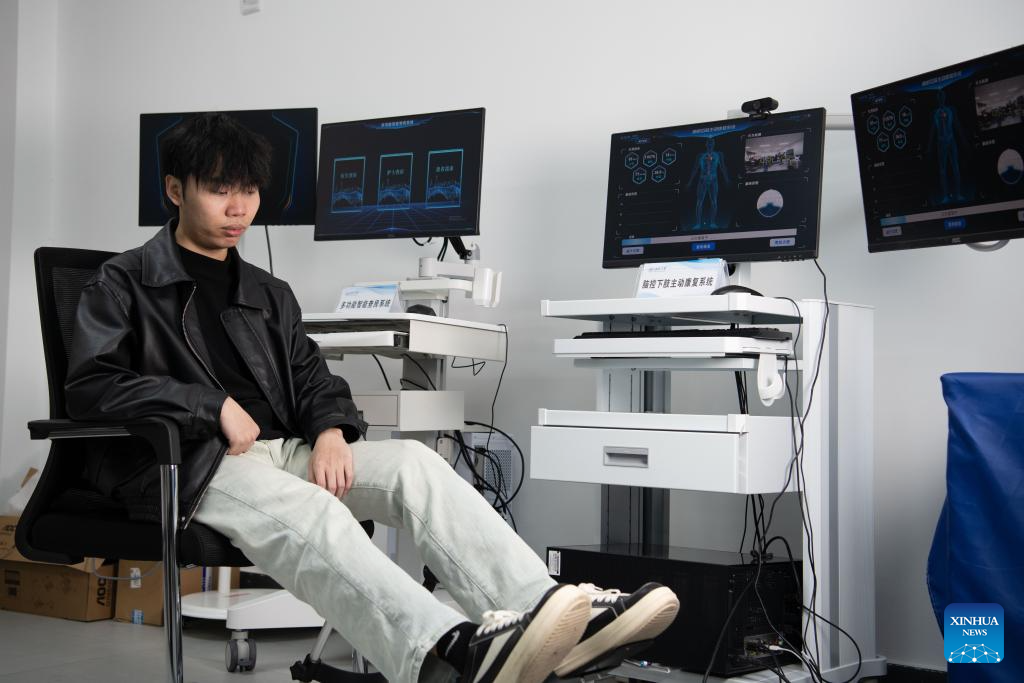
Anhui University's doctoral student Meng Weiyan demonstrates a brain-controlled lower-limb rehabilitation system at Anhui University in Hefei, east China's Anhui Province, April 30, 2026.
Brain-computer interface (BCI) technology is an emerging frontier that enables direct communication between the brain and external devices by recording and decoding neural signals.
In recent years, a BCI research team of faculty and students at Anhui University has developed minimally invasive electrodes for signal acquisition and built related datasets and integrated hardware-software platforms. These technologies are undergoing application tests in areas such as clinical interaction and embodied intelligence.
Students form a key part of the team. Graduate students majoring in computer science and artificial intelligence are involved in tasks including electroencephalogram (EEG) data collection and model training, while undergraduates participate in experimental research, improving their research and innovation capabilities. (Xinhua/Zhang Duan)
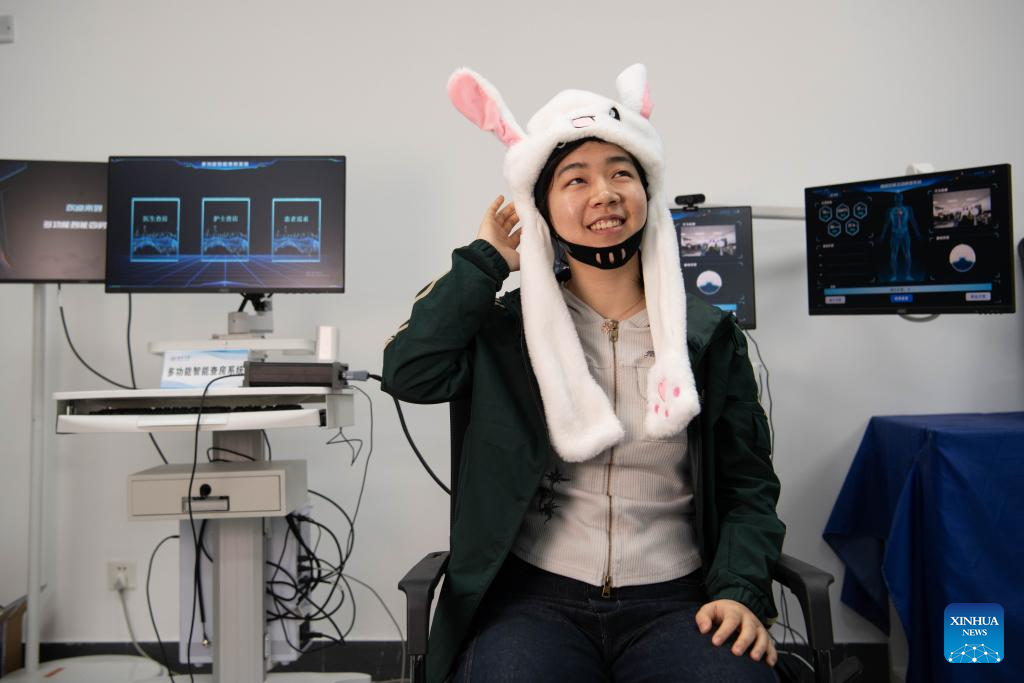
Anhui University's digital media technology undergraduate Si Yunjie demonstrates an EEG-based fatigue detection system at Anhui University in Hefei, east China's Anhui Province, April 30, 2026.
Brain-computer interface (BCI) technology is an emerging frontier that enables direct communication between the brain and external devices by recording and decoding neural signals.
In recent years, a BCI research team of faculty and students at Anhui University has developed minimally invasive electrodes for signal acquisition and built related datasets and integrated hardware-software platforms. These technologies are undergoing application tests in areas such as clinical interaction and embodied intelligence.
Students form a key part of the team. Graduate students majoring in computer science and artificial intelligence are involved in tasks including electroencephalogram (EEG) data collection and model training, while undergraduates participate in experimental research, improving their research and innovation capabilities. (Xinhua/Zhang Duan)
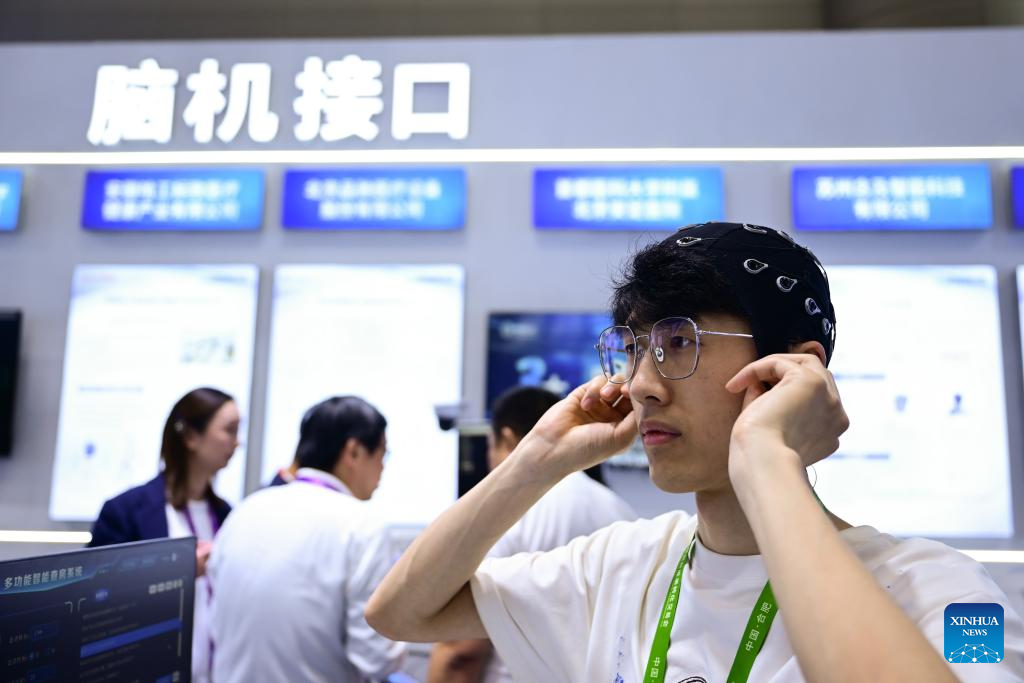
Anhui University's graduate student Wang Chang demonstrates technologies from the university's brain-computer interface (BCI) research team at the 4th China (Anhui) Scientific and Technological Innovation Achievements Transformation Fair in Hefei, east China's Anhui Province, April 26, 2026.
Brain-computer interface (BCI) technology is an emerging frontier that enables direct communication between the brain and external devices by recording and decoding neural signals.
In recent years, a BCI research team of faculty and students at Anhui University has developed minimally invasive electrodes for signal acquisition and built related datasets and integrated hardware-software platforms. These technologies are undergoing application tests in areas such as clinical interaction and embodied intelligence.
Students form a key part of the team. Graduate students majoring in computer science and artificial intelligence are involved in tasks including electroencephalogram (EEG) data collection and model training, while undergraduates participate in experimental research, improving their research and innovation capabilities. (Xinhua/Zhou Mu)
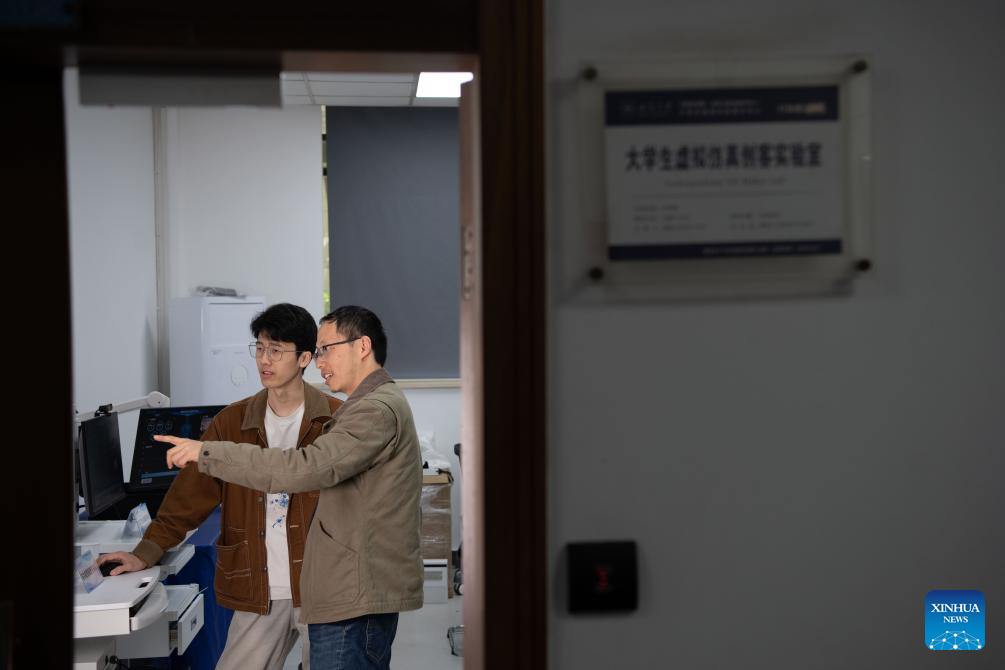
Associate Professor Zhang Chao (R) discusses brain-computer interface (BCI) technologies with graduate student Wang Chang at Anhui University in Hefei, east China's Anhui Province, April 30, 2026.
Brain-computer interface (BCI) technology is an emerging frontier that enables direct communication between the brain and external devices by recording and decoding neural signals.
In recent years, a BCI research team of faculty and students at Anhui University has developed minimally invasive electrodes for signal acquisition and built related datasets and integrated hardware-software platforms. These technologies are undergoing application tests in areas such as clinical interaction and embodied intelligence.
Students form a key part of the team. Graduate students majoring in computer science and artificial intelligence are involved in tasks including electroencephalogram (EEG) data collection and model training, while undergraduates participate in experimental research, improving their research and innovation capabilities. (Xinhua/Zhang Duan)
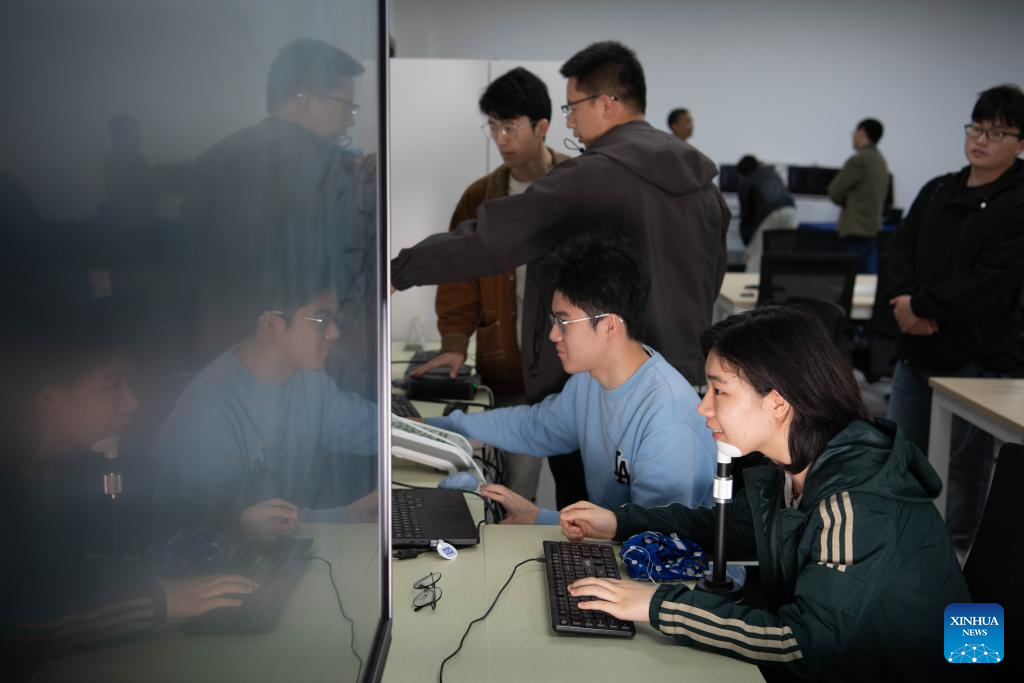
Si Yunjie (Front), a digital media technology undergraduate, operates an eye-tracking-based forgery detection system at Anhui University in Hefei, east China's Anhui Province, April 30, 2026.
Brain-computer interface (BCI) technology is an emerging frontier that enables direct communication between the brain and external devices by recording and decoding neural signals.
In recent years, a BCI research team of faculty and students at Anhui University has developed minimally invasive electrodes for signal acquisition and built related datasets and integrated hardware-software platforms. These technologies are undergoing application tests in areas such as clinical interaction and embodied intelligence.
Students form a key part of the team. Graduate students majoring in computer science and artificial intelligence are involved in tasks including electroencephalogram (EEG) data collection and model training, while undergraduates participate in experimental research, improving their research and innovation capabilities. (Xinhua/Zhang Duan)
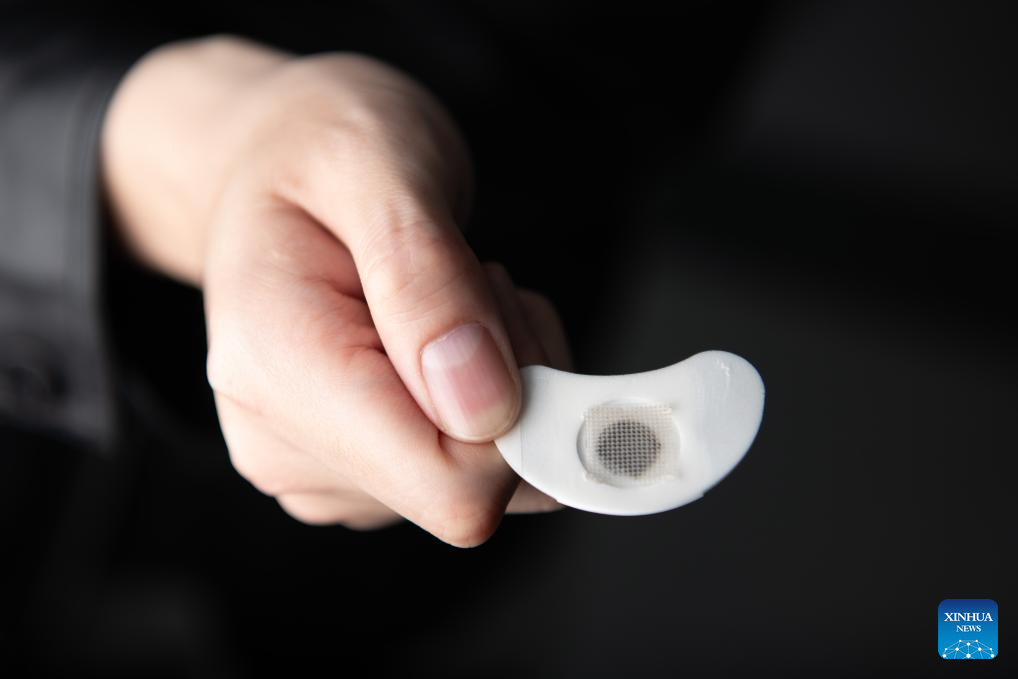
This photo taken on April 30, 2026 shows a minimally invasive signal acquisition electrode developed by Anhui University's brain-computer interface (BCI) research team at Anhui University in Hefei, east China's Anhui Province.
Brain-computer interface (BCI) technology is an emerging frontier that enables direct communication between the brain and external devices by recording and decoding neural signals.
In recent years, a BCI research team of faculty and students at Anhui University has developed minimally invasive electrodes for signal acquisition and built related datasets and integrated hardware-software platforms. These technologies are undergoing application tests in areas such as clinical interaction and embodied intelligence.
Students form a key part of the team. Graduate students majoring in computer science and artificial intelligence are involved in tasks including electroencephalogram (EEG) data collection and model training, while undergraduates participate in experimental research, improving their research and innovation capabilities. (Xinhua/Zhang Duan)
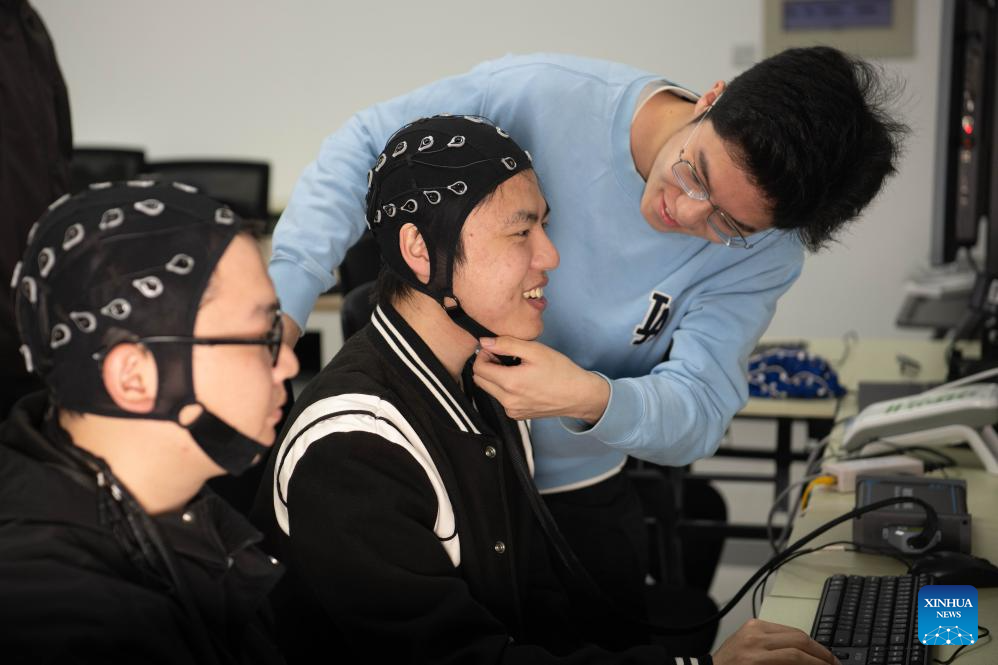
Anhui University's student Meng Renwei (C) wears an electrode cap to demonstrate an AIGC-based binary BCI forgery detection system at Anhui University in Hefei, east China's Anhui Province, April 30, 2026.
Brain-computer interface (BCI) technology is an emerging frontier that enables direct communication between the brain and external devices by recording and decoding neural signals.
In recent years, a BCI research team of faculty and students at Anhui University has developed minimally invasive electrodes for signal acquisition and built related datasets and integrated hardware-software platforms. These technologies are undergoing application tests in areas such as clinical interaction and embodied intelligence.
Students form a key part of the team. Graduate students majoring in computer science and artificial intelligence are involved in tasks including electroencephalogram (EEG) data collection and model training, while undergraduates participate in experimental research, improving their research and innovation capabilities. (Xinhua/Zhang Duan)


