
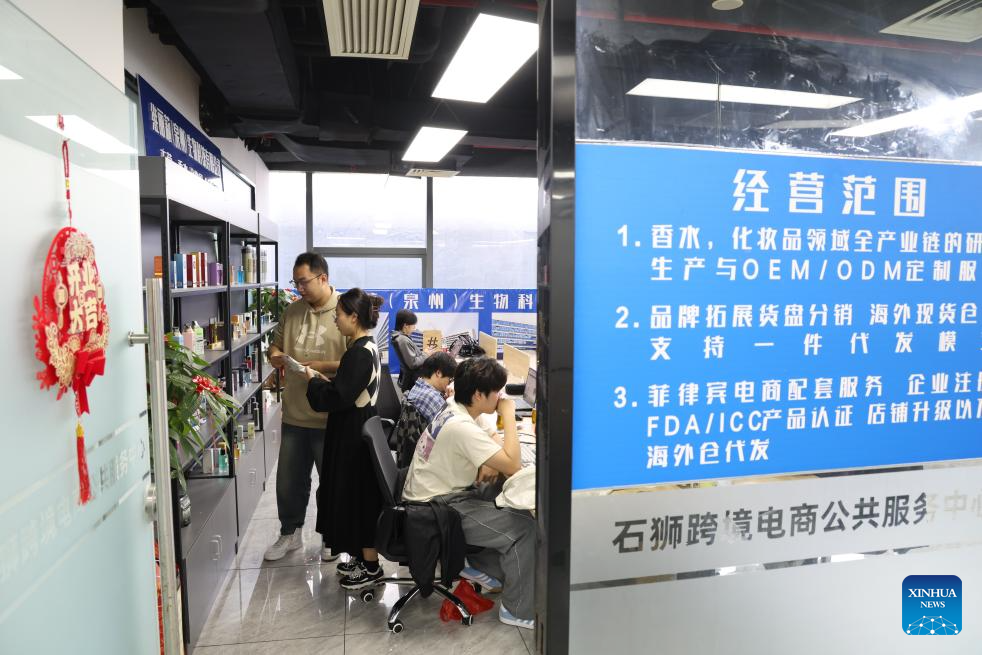
This photo taken on March 30, 2026 shows an enterprise at the Shishi Cross-border E-commerce Public Service Center in Shishi City, southeast China's Fujian Province. (Xinhua/Jiang Kehong)
FUZHOU, China, May 3 (Xinhua) -- Faced with international trade frictions, rising production costs and intensifying price competition, private enterprises in east China's Fujian Province are banking on one sector to bolster growth: cross-border e-commerce.
TANGIBLE REVENUE GROWTH
Quanzhou City Chelsearu Import and Export Co., Ltd., a company formerly engaged exclusively as a contract manufacturer for European brands, has embraced cross-border e-commerce and launched its own brand.
"Cross-border e-commerce helps us secure greater pricing in overseas markets," said Zhu Weixiang, general manager of Chelsearu.
According to Zhu, a professional sports suit set designed for pump track use was previously sold at approximately 30 U.S. dollars per unit through traditional export channels, while a similar product can be sold for over 100 dollars on cross-border e-commerce platforms.
Chelsearu is located in Shishi, a port city under the administration of Quanzhou. As a historic starting point on the ancient Maritime Silk Road, Shishi is home to numerous private enterprises specializing in textiles and apparel, whose products enjoy widespread recognition both domestically and internationally.
In recent years, a growing number of enterprises have adopted cross-border e-commerce. Chelsearu leverages social media platforms such as TikTok for live-streaming marketing, successfully elevating the international profile of its racing-cycling apparel brand.
"It fits great. This is exactly what a BMX racer wants," said American consumer Andre.
PROFESSIONAL GUIDANCE AND SUPPORT
Chelsearu has undergone a marketing transformation. Zhu said professional guidance and support provided by the Shishi Cross-border E-commerce Public Service Center played a pivotal role.
The center was established in 2023 and has since provided a range of services, including cross-border e-commerce platform training, digital marketing support, and regulatory compliance assistance, to traditional manufacturing enterprises, export-oriented businesses, and individual online sellers.
"We support enterprises in navigating international markets efficiently and mitigating common entry-related risks," said Fang Xiang, project director of the center.
Leveraging in-depth analysis of product profiles, the center helps enterprises identify optimal target markets, recommends suitable cross-border e-commerce platforms, and provides data-driven pricing guidance.
Between January 2023 and February of this year, the center supported Shishi-based enterprises in launching 326 online storefronts across leading cross-border e-commerce platforms.
Wang Jingwei, general manager of Shishi Yuande Shoes Co., Ltd., noted that the company initially pursued cross-border e-commerce on its own but made little progress over past four to five years. With support from the center, the company launched its own textile brand and has seen growth.
Likewise, many other private enterprises in Shishi have become increasingly confident in their export operations despite market risks.
Wang said that the center offers comprehensive, one-stop services, including logistics coordination, customs clearance, overseas warehousing, and after-sales customer support.
"In the past, a few overseas clients frequently defaulted on payments, leaving us with little choice," he said. "Moreover, we now possess pricing in overseas markets."
CROSS-BORDER E-COMMERCE BOOMS
Shishi serves as a microcosm of Fujian's economy. As a coastal province with a dynamic private sector, Fujian manufactures a diverse array of products, including textiles, footwear and apparel, household goods, construction materials, photovoltaic modules, lithium-ion batteries, and components for new energy vehicles, many of which have penetrated global markets.
In the first quarter of this year, Shishi's foreign trade container throughput reached 44,700 twenty-foot equivalent units, up 52.55 percent from the same period last year.
Confronted with rising costs, intensifying price competition, and escalating international trade frictions, traditional industries are actively pursuing innovation-driven transformation and upgrading. Meanwhile, Fujian has leveraged its advantages, particularly strong ties with overseas Chinese communities, to expand cross-border e-commerce business.
In Fujian, the total number of foreign trade entities has surpassed 100,000. Private enterprises account for 70 percent of the province's export volume and have contributed more than 90 percent to its export growth. Fujian has emerged as one of the nation's top three cross-border e-commerce supply hubs.
In 2023, Fujian inaugurated China's first dedicated BRICS cross-border e-commerce freight route, connecting Xiamen with Sao Paulo in Brazil. Through the corridor, logistics, trade and e-commerce companies from China and Brazil have become increasingly interconnected over the past three years.
Fujian has held the China Cross-border E-commerce Trade Fair for six consecutive years. The sixth edition was held in the provincial capital Fuzhou in mid-March, with enterprises from Indonesia, South Korea and Japan participating. Overseas merchants attending the fair came from 18 countries, including Australia, Spain and Egypt.
Conrad from South Africa came to the fair looking for products in the electric vehicle sector. "I have been welcomed with open arms. There's been a lot of buy-in and interest in doing business with South Africans. I'm excited," he said.
"It's been great to be here, we could find a lot of suppliers for many demands that our clients have in Brazil," said Thulio Robatine Dias, representative of the China-Brazil Chamber of Commerce in southern China.
Miao Zhiyuan, vice president of the World Fujian Youth Federation, told Xinhua that after returning to his hometown north of Fuzhou, following a stint in Silicon Valley, he launched an initiative integrating artificial intelligence with cross-border service solutions.
"By leveraging technological innovation, this initiative seeks to reduce market-entry barriers for small and medium-sized enterprises pursuing global expansion," said Miao. ■

A merchant introduces products at Shishi Cross-border E-commerce Public Service Center in Shishi City, southeast China's Fujian Province, March 30, 2026. (Xinhua/Jiang Kehong)


