
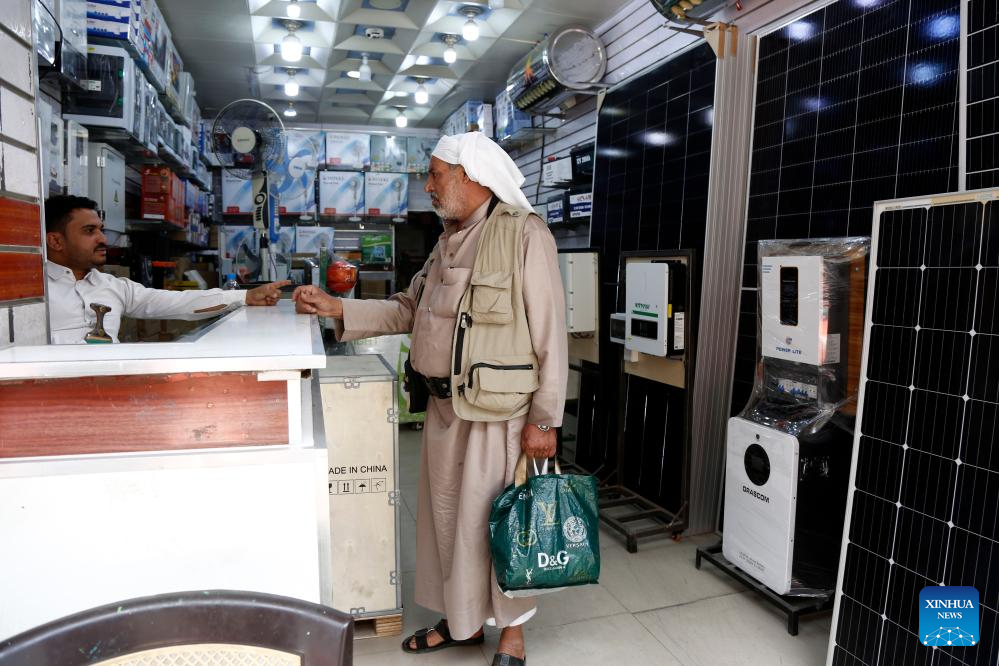
A customer (R) talks to a vendor at a shop selling solar equipment amid prolonged energy shortages in Sanaa, Yemen, on May 2, 2026.(Photo by Mohammed Mohammed/Xinhua)
By Mohammed Mohammed
SANAA, May 1 (Xinhua) -- In the Yemeni capital of Sanaa, solar panels have become a major source of electricity, helping residents power their homes amid prolonged energy shortages.
Many in Sanaa have turned to renewable energy after a decade-long conflict crippled most of the country's sectors, including the electricity.
A striking presence of dark blue glass are seen across the rooftops as a reliable source of electricity for residents, who are keen to keep the UNESCO-listed Old City of Sanaa from drowning in darkness.
"I have three solar panels installed on the roof of my house, and residents try to keep both their homes and surrounding streets lit at night," said Mohammed Al-Lawzi, a resident of the Old City.
The shift has brought practical changes to daily routines in a city that once relied on noisy and costly diesel generators. For residents like Ahmed Naser, 45, a daily wage worker, solar energy has provided a much-needed lifeline.
"My 6-member family and I spent months with total darkness after I stopped paying commercial generator bills that consumed a significant portion of my income," Naser told Xinhua. "Now, my children can study and we can have light at night."
A robust local solar market, featuring diverse and affordable products like Chinese-made panels, batteries, and inverters, is enabling this shift, according to technical experts.
"The diversity of renewable energy options has allowed even those with limited income to acquire small-scale systems," said Khleel Khaled, a local technical expert. "These systems play a key role in meeting essential needs such as lighting and charging mobile devices."
The demand for renewable energy has spurred growth in the local economy. In major commercial areas such as Sakhr and Haddah streets, many shops have transitioned into showrooms dedicated to solar equipment.
Abu Ahmed, a local vendor at Sakhr Street, said solar energy has become a standard requirement for many households and business centers.
"The demand for this renewable energy system has increased from all classes of people who come to buy, everyone according to their condition and need," he noted.
Beyond residential use, solar equipment is increasingly utilized in other sectors, such as in hospitals, businesses, shops, cafes, and mosques.
Abdullah Al-Sulwi, an employee at Al-Jeraf restaurant in Sanaa, said: "We operate around the clock and were spending close to 900,000 Yemeni rial (about 1,700 U.S. dollars) monthly for the private generator."
"Six months ago, we invested in a renewable energy system that cost nearly nine million Yemeni rials (roughly 16,800 dollars), and since then, we have been able to run hundreds of lamps, seven refrigerators, and various other equipment."
The adoption of renewable energy has also extended to peri-urban areas, providing a sustainable irrigation solution for cultivators, like Mohammed Omar in the Hamdan district, northwest of Sanaa.
"Previously, we faced the difficult choice of paying inflated diesel prices or losing our crops," Omar explained. "Now, we have a reliable energy source that has solved long-standing logistical and financial hurdles, leading to long-term stability".
As evening falls, solar lights in Sanaa's windows signal local adaptation amid an ongoing humanitarian crisis and crippled infrastructure.
Yemen has been mired in conflict since 2014, when the Houthis seized the capital Sanaa. The United Nations has warned that more than 22 million people in Yemen are expected to need assistance in 2026, an indicator of the cumulative impact of prolonged clashes, economic collapse, and political instability. ■
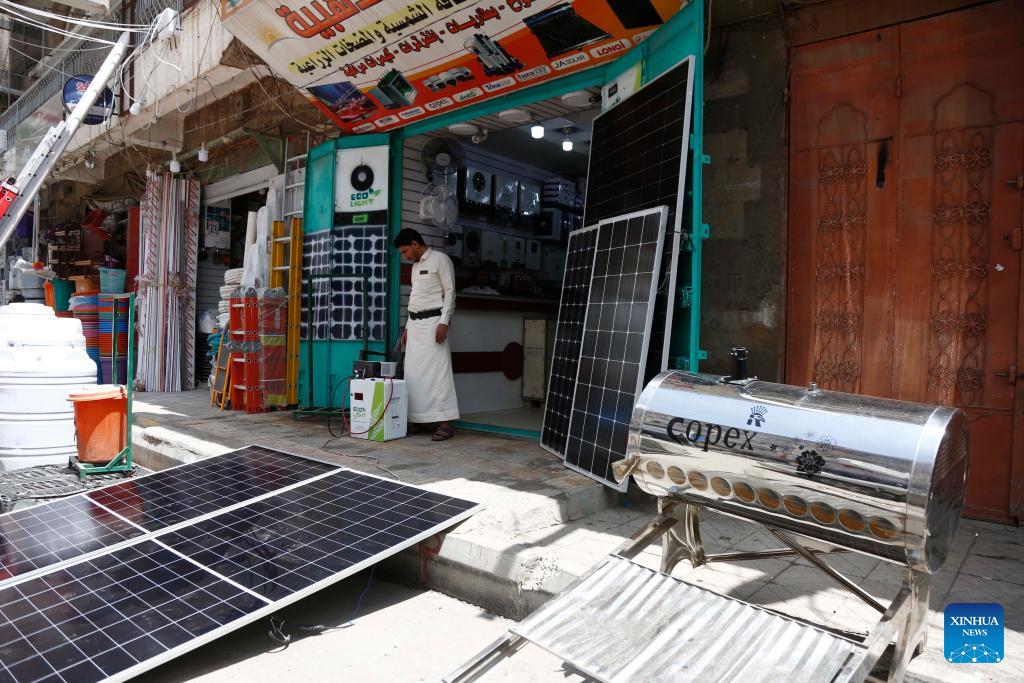
A vendor stands near solar equipment displayed for sale amid prolonged energy shortages at a market in Sanaa, Yemen, on May 2, 2026.(Photo by Mohammed Mohammed/Xinhua)
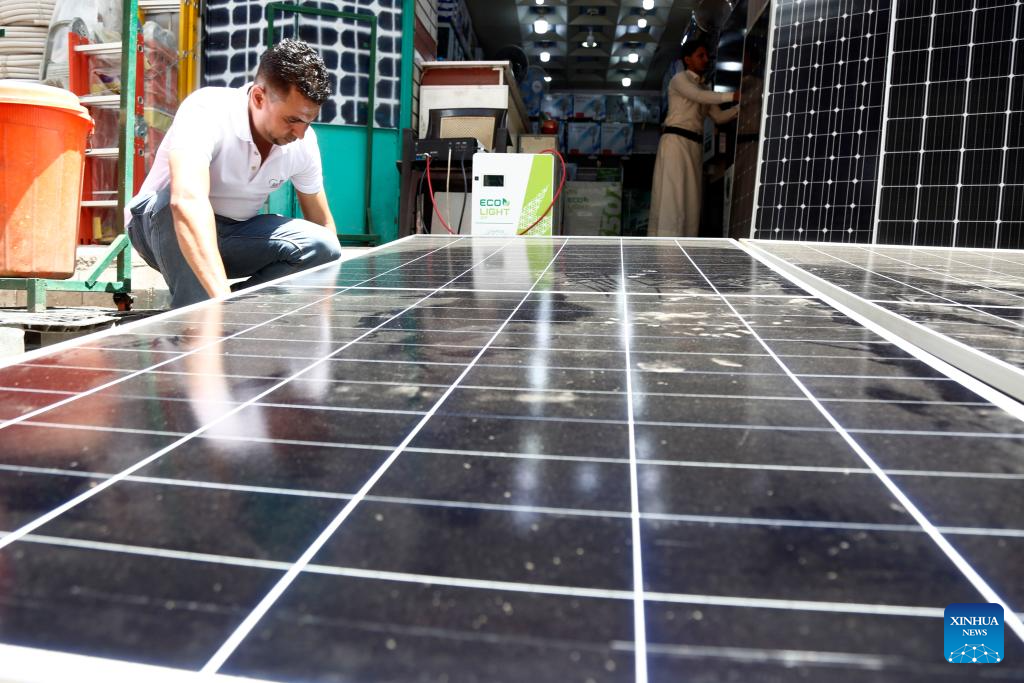
A technician prepares a new solar panel for a customer amid prolonged energy shortages at a market in Sanaa, Yemen, on May 2, 2026.(Photo by Mohammed Mohammed/Xinhua)


