BEIJING, May 1 (Xinhua) -- On a rooftop in Shenzhen, the tech hub in south China's Guangdong Province, 24-year-old Xue Haoran watched as drones carrying packages took off one after another, weaving through the city skyline along invisible threads.
He is the person behind those routes. Xue is a drone route planner at SF Express, one of China's largest delivery companies. He spends his days walking the streets with surveying equipment, mapping terrain and plotting flight paths for low-altitude logistics.
"Unlike traditional logistics, we have to pay much closer attention to air traffic control requirements," said Xue, as he found himself in the midst of a much larger shift in China.
From autonomous drones to embodied artificial intelligence (AI), new technologies are creating entirely new occupations for the world's largest labor market.
KALEIDOSCOPE OF OPPORTUNITIES
According to an analysis of spring recruitment data released by governments and organizations, job postings in robotics and advanced materials in China rose by over 30 percent year on year in the first quarter of 2026, while those in optoelectronics and AI-related industries increased by nearly 20 percent.
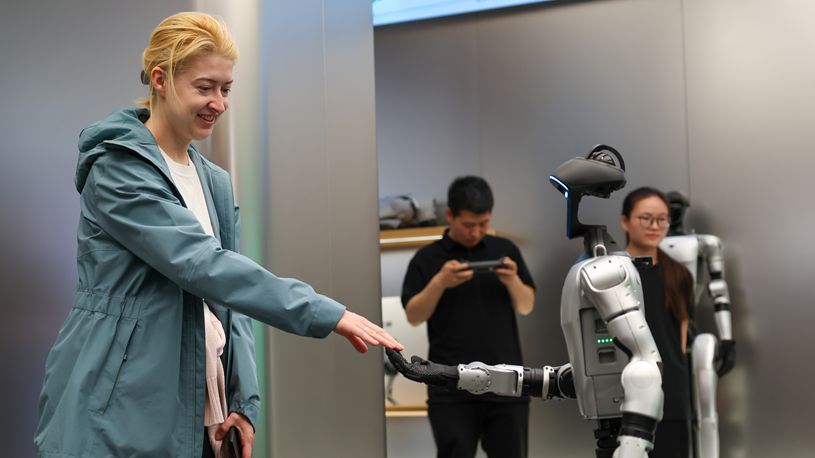
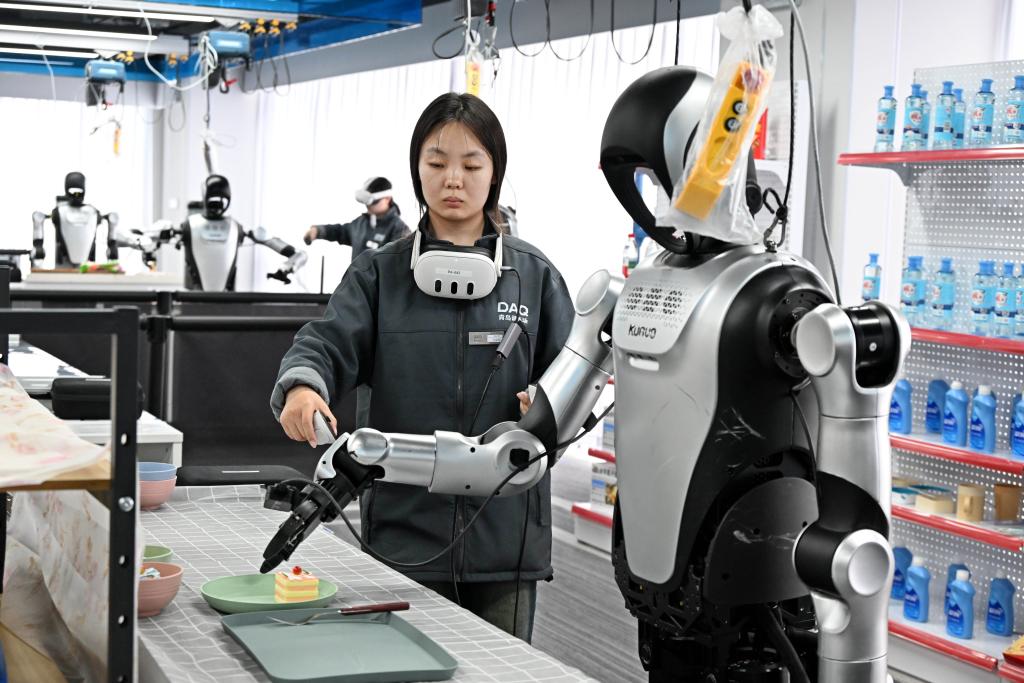
For many young Chinese people, these emerging opportunities are like a magnet. Qu Hongtao, a humanoid robot data collector in Beijing, is one such person who has been attracted to them.
"When I see a robot complete a task using the data I collected, the sense of achievement is indescribable. I feel like taking part in an experiment about the future," he said, having just turned his part-time engagement into a serious career.
He finds it a very interesting form of creative work to translate abstract algorithmic requirements to concrete data-collection movements, which, for him, "requires a strong capacity for empathy -- not only toward humans, but also toward robots."
Jade Wu, a millennial AIGC artist, believes that amid the wave of technological innovation, ambitious Chinese youth with vision and creativity are embracing their best era possible.
Wu's first commercial AI project came when Chinese AI video tools advanced significantly in 2024. From storyboard to final edit, he completed a promotional video for a major gaming IP in just one week.
As his work gained traction on social media, opportunities began to pour in for him from major domestic media outlets and global brands. "I realized that with AI, I alone can do what used to require an entire team," Wu said.
"The workflow is similar to traditional production, but AI dramatically shortens the middle steps," he explained, adding that about 70 to 80 percent of the work is now done by AI, allowing him to focus on the big ideas and the final look.
AI RIDING THE WAVE
According to the Ministry of Human Resources and Social Security, of the 72 new occupations identified by the country over the past five years, more than 20 are tied directly to AI. Each new occupation is expected to generate jobs for 300,000 to 500,000 people in its early stages.
Meanwhile, China's AI core industry is approaching a scale of 600 billion yuan (around 85.58 billion U.S. dollars), according to Ding Zhuang, a research fellow at Chongyang Institute for Financial Studies at the Renmin University of China.
"From breakthroughs in large language models and algorithms to the deep integration of AI with manufacturing, services and biotech, demand for talent is surging," he said.
This March in Beijing, a job fair focused on high-tech positions attracted more than 300,000 job seekers online and offline, with long lines snaking outside the venue even before the fair opened.
At the job fair, one trend was clear: the rapid rise of AI is driving businesses across nearly every industry in China to rethink their workforce and join the race for tech talent.
This aligns with the broader vision of Chinese policymakers. In August 2025, China rolled out guidelines for the "AI Plus" initiative, calling for broader use of AI to create new jobs and upgrade existing ones, while steering innovation resources toward sectors with strong employment potential.
To prepare the workforce for these emerging high-tech roles, the country has made AI-empowered education a national priority. According to an action plan released by Chinese authorities earlier last month, China expects to fully integrate AI into its education system and significantly boost both the scale and quality of AI talent training by 2030.
At a job fair in Ningxia Hui Autonomous Region, Lu Xiaofeng, an HR manager, said that this year her company has hired some graduates majoring in AI, whose theoretical knowledge and project experience well match the job requirements. She believes that universities have taken note of this trend and are responding by offering relevant programs and keeping pace with technological developments.
"AI is the big trend now. I already use AI tools to polish writing and edit videos. I hope to find a job related to this field," said a girl at a job fair in Hangzhou, Zhejiang Province, who had just returned to China after graduating from a university in the Republic of Korea. She was very interested in positions at tech companies and internet platforms.
The push has also extended beyond campus. In 2026, China will subsidize vocational training for more than 10 million people, targeting fast-growing sectors such as the low-altitude economy, new energy vehicles and AI.
TRADITIONAL INDUSTRIES EVOLVE
While new jobs emerge in cutting-edge areas, changes are also unfolding across traditional industries, giving rise to many roles that combine industry-specific expertise with new skills.
In northwest China's Qinghai Province, road maintenance workers have learned to operate inspection drones, transforming highway patrol from a purely manual task into an intelligent one.
In Taiyuan, capital of north China's Shanxi Province, pipeline maintenance has been modernized through the introduction of sensors, inspection robots and other equipment. Recruitment is now focused on graduates in relevant disciplines, while experienced employees are receiving training in updated techniques.
"In response to this shift, workers must transition from merely relying on physical labor to skill-oriented roles that demand technical expertise," said Su Lifeng, a researcher at the Academy of China Open Economy Studies, University of International Business and Economics.
For Ma Zhigang, an electrician-turned-engineer of a steel manufacturer in northeast China's Liaoning Province, embracing new technologies has long been a constant in his work.
During his years leading an innovation workshop at the company, Ma learned to write code, conducted experiments and completed more than 60 intelligent upgrade projects with his team.
"What I want to say to my fellow workers is this: start with the breakdowns that give you the biggest headache. Start there to embrace new technology. Every time you solve a real problem, you've stepped over a digital divide," Ma said.
This March, China approved a long-term national development plan, which outlined more than 100 major projects for the next five years. This is likely to create yet another wave of job opportunities.
Across China, from high-tech hubs to traditional industries, technology is rewriting the rules of work. New jobs are emerging, and old ones are evolving. For those willing to learn, the future is already here. ■