
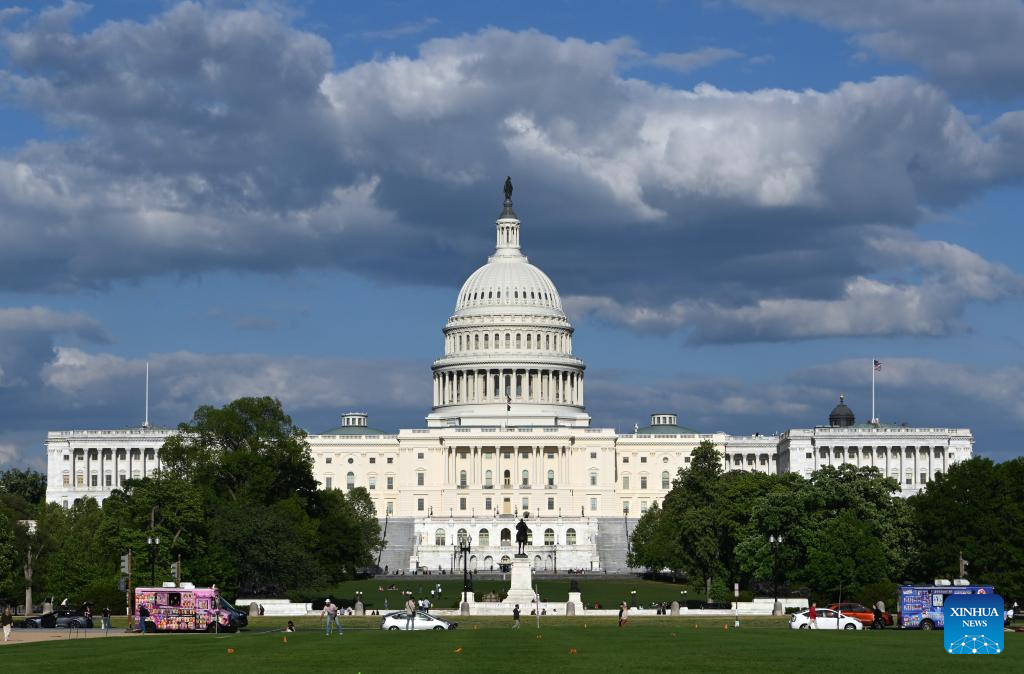
This photo taken on April 30, 2026 shows the U.S. Capitol building in Washington, D.C., the United States. U.S. Defense Secretary Pete Hegseth said on Thursday he believes the ceasefire with Iran "pauses" a 60-day clock on congressional authorization for war. Hegseth made the remarks when asked by Democratic Senator Tim Kaine at a congressional hearing about whether the Trump administration would seek authorization from Congress for the war with Iran on the 60-day mark of the war as required by law. U.S. President Donald Trump notified Congress of the military campaign against Iran on March 2, making May 1 the 60-day milestone at which point the U.S. War Powers Act requires the president to start winding down a war unless he receives congressional authorization, according to media reports. (Xinhua/Li Rui)
WASHINGTON, April 30 (Xinhua) -- U.S. Defense Secretary Pete Hegseth said on Thursday he believes the ceasefire with Iran "pauses" a 60-day clock on congressional authorization for war.
Hegseth made the remarks when asked by Democratic Senator Tim Kaine at a congressional hearing about whether the Trump administration would seek authorization from Congress for the war with Iran on the 60-day mark of the war as required by law.
"Ultimately, I would defer to the White House and White House counsel on that. However, we are in a ceasefire right now, which our understanding means the 60-day clock pauses or stops in a ceasefire," Hegseth said.
"I do not believe the statute would support that," Kaine said. "I think the 60 days runs (out) maybe tomorrow, and that's going to pose a really important legal question for the administration there."
On Feb. 28, Israel and the United States launched joint attacks on Tehran and other Iranian cities, killing Iran's then Supreme Leader Ali Khamenei, senior commanders, and civilians.
U.S. President Donald Trump notified Congress of the military campaign against Iran on March 2, making May 1 the 60-day milestone at which point the U.S. War Powers Act requires the president to start winding down a war unless he receives congressional authorization, according to media reports. ■


