
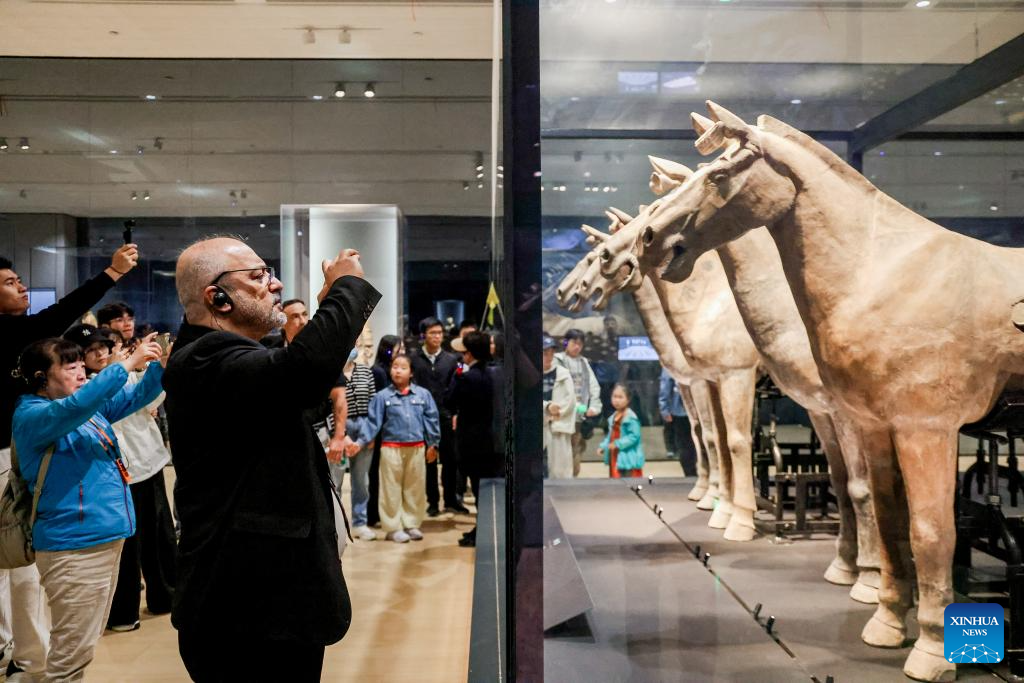
Participants of the Global Mayors Dialogue event visit the Emperor Qinshihuang's Mausoleum Site Museum in Xi'an, northwest China's Shaanxi Province, April 29, 2026. (Xinhua)
XI'AN, April 30 (Xinhua) -- Around 2,000 years ago, Xi'an in northwest China served as the starting point of the ancient Silk Road, witnessing exchanges between Eastern and Western civilizations. Two millennia later, a Silk Road dialogue has brought together mayors from various countries to share insights on cultural heritage preservation and technological innovation, offering a fresh example of mutual learning among civilizations.
Themed "Starting Point of the Ancient Silk Road & Harmonious Coexistence: Empowering High-Quality Urban Development through Technology and Culture," the Global Mayors Dialogue event was held in Xi'an from Monday to Wednesday.
Mayors and representatives from countries including New Zealand, Oman, Jordan, Egypt, Iraq and Tunisia visited Xi'an's cultural heritage sites, smart city operations and high-tech manufacturing lines, exchanging views on sustainable urban development and green transformation.
After touring the world-famous Terracotta Warriors, built by Emperor Qinshihuang of the Qin Dynasty (221 B.C.-207 B.C.), Hussain Al Lawati, a member of Oman's Shura Council and representative of Muttrah, expressed admiration for the digital technologies used in artifact protection and restoration.
Lawati said that technology has enabled people to discover the colors and the original facial features of the Terracotta Warriors and even the correct ranks of these officers. "Using that technology is definitely going to help us understand what was our history so we can build our future upon it," he added.
Xi'an, known as a "natural history museum," is home to over 3,200 immovable cultural relic sites. The city has integrated heritage preservation into its entire urban planning process, using artificial intelligence (AI) and extended reality to create night tours and digital cultural experiences.
During their visit, the guests shared local practices in heritage conservation and revitalization, learning from Xi'an's preventive and research-based protection methods.
Ye Niuping, mayor of Xi'an, noted that protecting cultural heritage while fostering innovation is a key challenge for all cities. He called for deeper international cooperation in preservation and mutual learning.
Technology and innovation took center stage when they discussed urban industries. At the Geely Auto manufacturing base in Xi'an, main processes such as stamping and painting are 100 percent automated, with a new energy vehicle (NEV) rolling off the line every minute on average.
Tania Tapsell, mayor of Rotorua, New Zealand, showed strong interest in the NEV production lines. She noted that Rotorua's geothermal resources could support green energy cooperation with China for more resilient urban development.
"I think what's really inspiring me here is seeing how you have been resilient through your sustainable use of energy. So we look forward to learning about the technology innovation and incorporating more AI," she told Chinese reporters.
Jamal Abu Obeid, chairman of the Al-Ramtha New Municipality in Jordan, said Chinese solar panels and NEVs are exactly what his country needs to address energy shortages and support green transition.
Late Wednesday, participants at the dialogue jointly released a consensus on Silk Road urban development, vowing to reinforce trust in cultural inheritance, technology empowerment, green transition, and people-to-people exchanges. They expected the dialogue to turn the strategic consensus into concrete results. ■
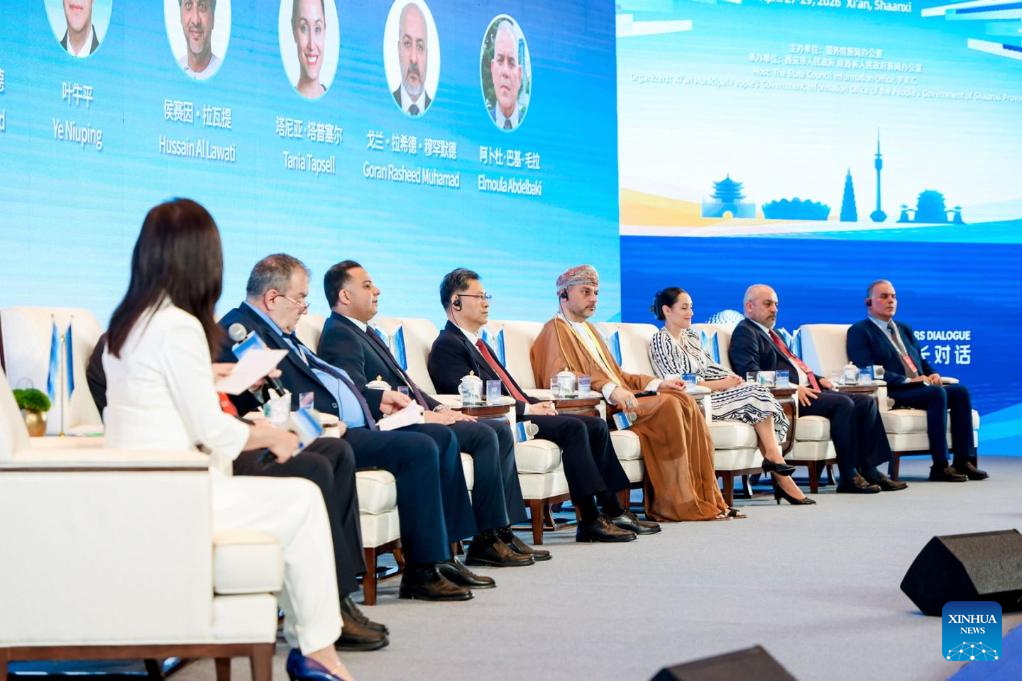
The Global Mayors Dialogue event is held in Xi'an, northwest China's Shaanxi Province, April 29, 2026. (Xinhua)


