
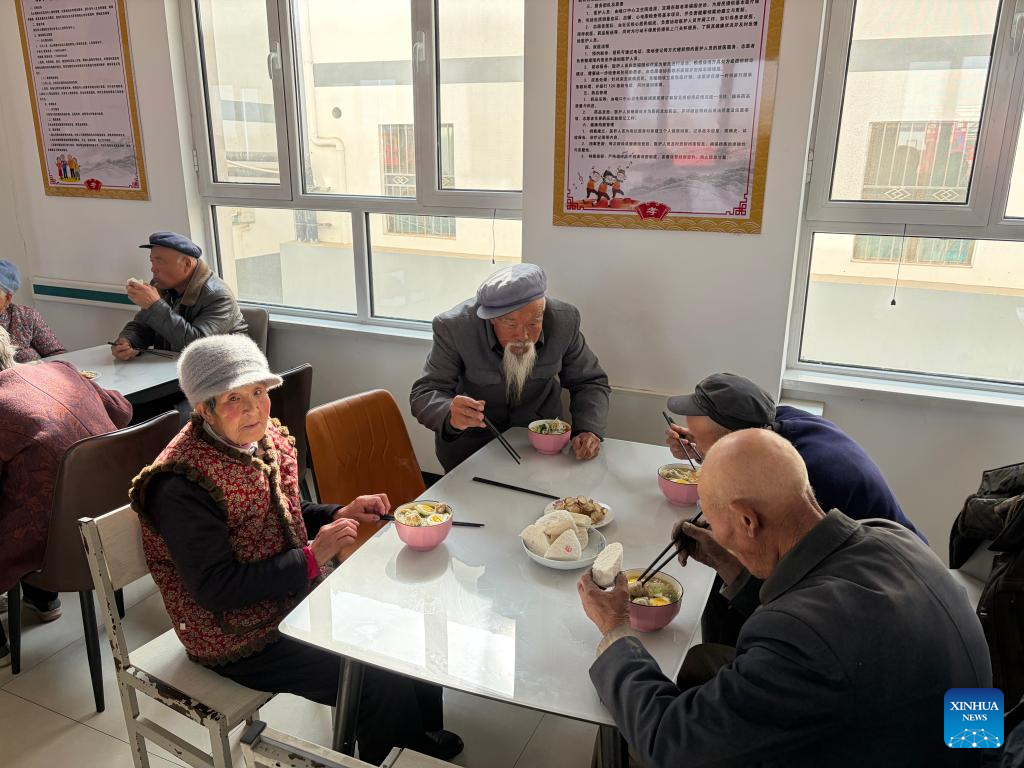
Senior residents have meals at an elderly service center in Shanhai Xincun Community in Chankou Town of Dingxi City, northwest China's Gansu Province, Feb. 3, 2026. (Xinhua/Cheng Nan)
LANZHOU, April 28 (Xinhua) -- From having affordable and nutritious lunches at a "Happiness Canteen" to attending weekly vocal music and dance classes, elderly residents in Zaolinxi Community in Lanzhou, capital of northwest China's Gansu Province, are enjoying fulfilling lives.
Around 11 a.m., the aroma of food wafted from the canteen in Zaolinxi Community. Yang Yongkui, a 78-year-old resident, slowly walked into the bright and tidy dining hall. After swiping his meal card, he enjoyed a balanced lunch of meat and vegetables for about 10 yuan (1.46 U.S. dollars), which is roughly half the market price.
"It's close to home, convenient and affordable. I can eat well," Yang said. In the past, with his children busy at work and unable to prepare his meals, Yang often made do with just some noodles.
The canteen where he now eats opened in 2024, providing seniors with hot meals.
Huang Lijuan, Party secretary of Zaolinxi Community, said the community has more than 3,200 residents aged 60 and above, accounting for one-third of its total population. The government-subsidized and community-operated canteen is popular among elderly residents. The menu is updated every three days, with a focus on low-salt and low-oil dishes that are soft and easy to chew. The canteen also delivers meals to seniors with mobility difficulties.
In recent years, an increasing number of grassroots communities across China have expanded elderly care services, providing neighborly care, hot meals on seniors' tables and health monitoring at their doorsteps.
"Happiness Canteen" is just one component of Zaolinxi Community's elderly care system.
Huang told reporters that the community has developed a new model, creating multipurpose activity spaces at a service center. Tailoring to elderly residents' needs, the community offers more than 10 practical courses, including photography, modeling, vocal coaching and traditional Chinese medicine, thereby enriching seniors' cultural and spiritual lives.
Huang said many elderly residents are particularly interested in photography and short-video courses. The community regularly organizes outings to parks, where volunteers provide on-site instruction. Choir and dance classes are also very popular.
Zhao Fengping, a 60-year-old resident, said she has enrolled in multiple courses, including dance and hulusi (a Chinese gourd flute). The classes have made her body lighter and her mindset younger, Zhao said.
Lanzhou has invested a total of 203 million yuan to address gaps in elderly care facilities, and has distributed over 45 million yuan in operating subsidies. The city has built and put into operation 113 community elderly meal assistance sites, with various elderly meal service institutions providing services for more than 7 million people in total.
This year, Lanzhou is planning to build 50 new "Happiness Canteens," prioritizing coverage of old residential areas and neighborhoods with prominent elderly care needs. The city will also promote smart cooking equipment and AI meal assistance systems to expand delivery services and address dining difficulties for seniors of advanced age, and those with disabilities or other special needs.
At an elderly service center in Shanhai Xincun Community, Chankou Town, located in the city of Dingxi, Gansu Province, seniors not only enjoy lunches but also receive free services such as laundry and haircuts.
Zhang Hongji, Party secretary of Chankou, said they have introduced a new elderly care service model consisting of home-style food, a laundry room, free haircuts by volunteers, physical examinations and cultural feasts, effectively addressing elderly care service issues in this rural community.
Zhang Xianbo, a resident of the Shanhai Xincun Community, said, "Here, we eat homemade meals, can do laundry whenever our clothes are dirty, and have someone help cut our hair. Life is comfortable."
National Bureau of Statistics data shows China's population aging is deepening. In 2025, the country's population aged 60 and above reached 323.38 million, an increase of 13.07 million from the previous year.
In response, localities across China are building 15-minute elderly care service circles centered on seniors' home-based care needs. Community canteens and elderly dining tables are becoming commonplace, with service networks for meal assistance, medical assistance and bathing assistance gradually improving. Aging-friendly renovations are notably being incorporated into urban renewal and old residential area upgrades.
Shenyang, capital of northeast China's Liaoning Province, purchases home-based elderly care services for seniors with special hardships and those aged 80 and above. Hohhot, capital city of north China's Inner Mongolia Autonomous Region, provides elderly residents with diversified services including "elderly dining halls, meal assistance and door-to-door delivery" while improving hardware facilities for them. Hexi District of Tianjin, also in north China, has built a 15-minute elderly care service circle meeting seniors' needs, allowing them to access basic services conveniently.
Zhu Qiantao, a professor at Lanzhou University of Finance and Economics in Gansu, said that from family to community, China is improving elderly residents' quality of life through continuous expansion of elderly care services. In the future, policy, market forces and society still need to work together to enable more seniors to live their later years with dignity. ■
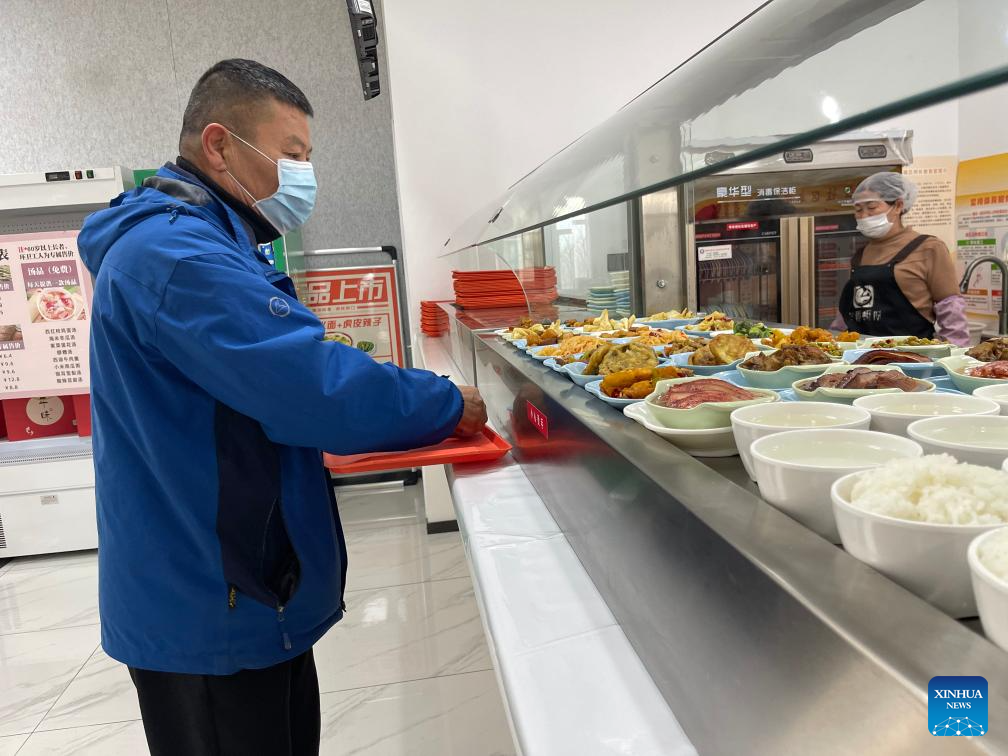
A resident selects dishes at a canteen in Zaolinxi Community in Lanzhou, capital of northwest China's Gansu Province, Jan. 23, 2026.(Xinhua/Cheng Nan)


