
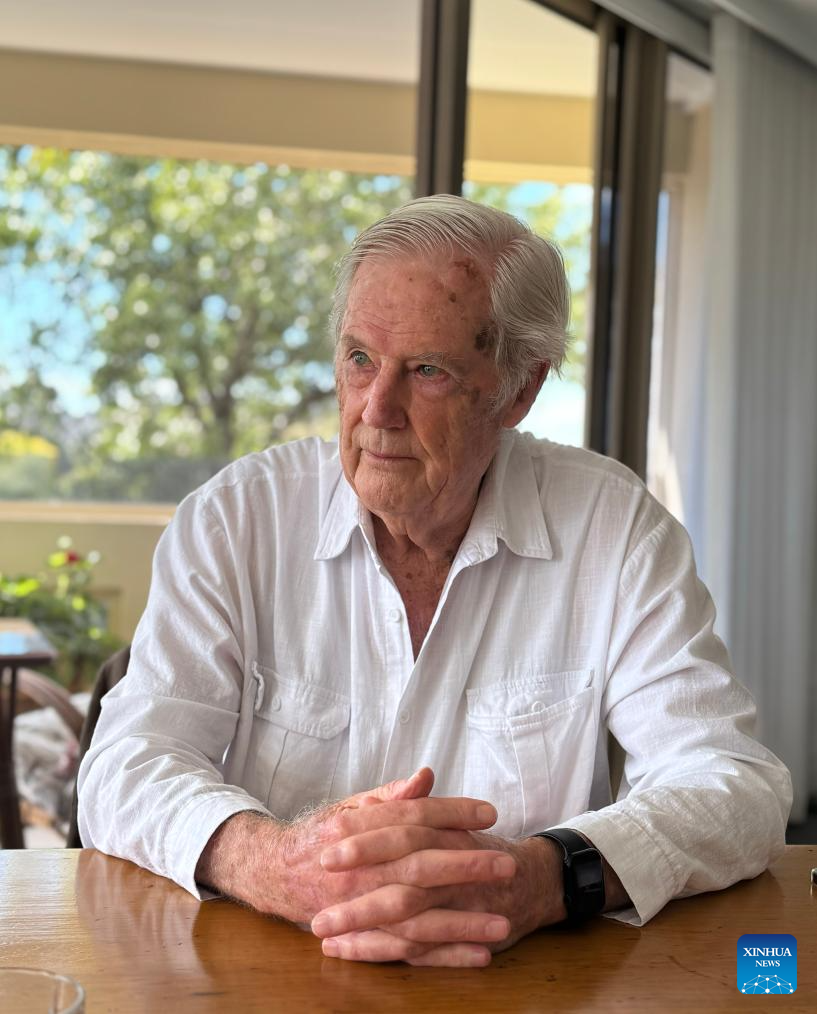
John Menadue, founder of the online journal Pearls and Irritations, is interviewed by Xinhua in Canberra, Australia, April 9, 2026.(Xinhua/Qi Zijian)
by Qi Zijian, Liang Youchang
SYDNEY, April 26 (Xinhua) -- Stronger business links in renewable energy, joint efforts to revive the global trading system, and expanded education exchanges are among the key factors in strengthening Australia-China ties, said John Menadue, an Australian media founder.
"I think the relationship between Australia and China is steady and improving," Menadue, founder of the online journal Pearls and Irritations, told Xinhua in a recent interview, adding that there is significant potential to further strengthen the ties.
He pointed to renewable energy as a promising area for enhanced cooperation.
"Closer business relations in renewable energy are important," he said. "Hopefully we can improve joint arrangements on renewable energy and in other areas as well."
Menadue started Pearls and Irritations in 2013, which is an Australian platform for the exchange of ideas and publishes informed analysis and commentary on issues that matter to Australians, with a focus on politics, public policy and foreign policy, among others.
Turning to broader economic issues, he said both countries share a strong interest in strengthening the global trading system. He noted that reforming and supporting global institutions such as the World Trade Organization would be beneficial to both sides.
"The international trading system is largely broken down, and Australia is a trading country like China," he said. "We both have a joint interest in improving multilateral trade."
"If we can make improvements in the international system to facilitate trade by helping to revive the World Trade Organization, that would be very important for both of our countries," he said.
Menadue was formerly secretary of the Department of the Prime Minister and Cabinet, ambassador to Japan, secretary of immigration and CEO of Qantas.
He has visited China on several occasions, including once in 1973 alongside Gough Whitlam, who was Australia's prime minister at the time. He has long observed and closely studied China's development and foreign policy.
He emphasized the importance of expanding university exchanges as a key foundation for long-term understanding between the two countries.
"University exchanges are very important, more Australian students going to China and more Chinese students coming here," he said. "That builds a much closer relationship."
Menadue also pointed out that the future of Australia is in Asia, saying he had Asia in mind when he started Pearls and Irritations.
He reflected on how studying alongside Asian students during his university years reshaped his understanding of Asia and marked a turning point for him.
"I came from sort of country towns of South Australia, and it was White Australia everywhere then," he said.
"When I went to university, Adelaide University, I was sharing a room with three Asian students. Two were Chinese descendants, one Sri Lankan descendant," he said. "They all came from Malaysia at that time, and they changed my life."
"And most of my public life since then has been about how we can learn to live in our own region, which includes, of course, China."
He added that the presence of international students played a wider social role in transforming attitudes among younger generations in Australia during that time.
"It was the presence of Asian students at our universities that changed the attitudes of younger people, and that led on to the abolition of the White Australia policy," he said.
And the abolition of the White Australia policy was one of the key issues Menadue worked on when he was working for Gough Whitlam.
Looking ahead, he stressed that building stronger regional understanding remains an ongoing task.
"We've still got a lot more to do in building relations with the region, developing language skills and understanding the histories of the countries of the region," he said.
"We're slowly growing up and finding that our future is in our own region, Asia," he said. ■


