
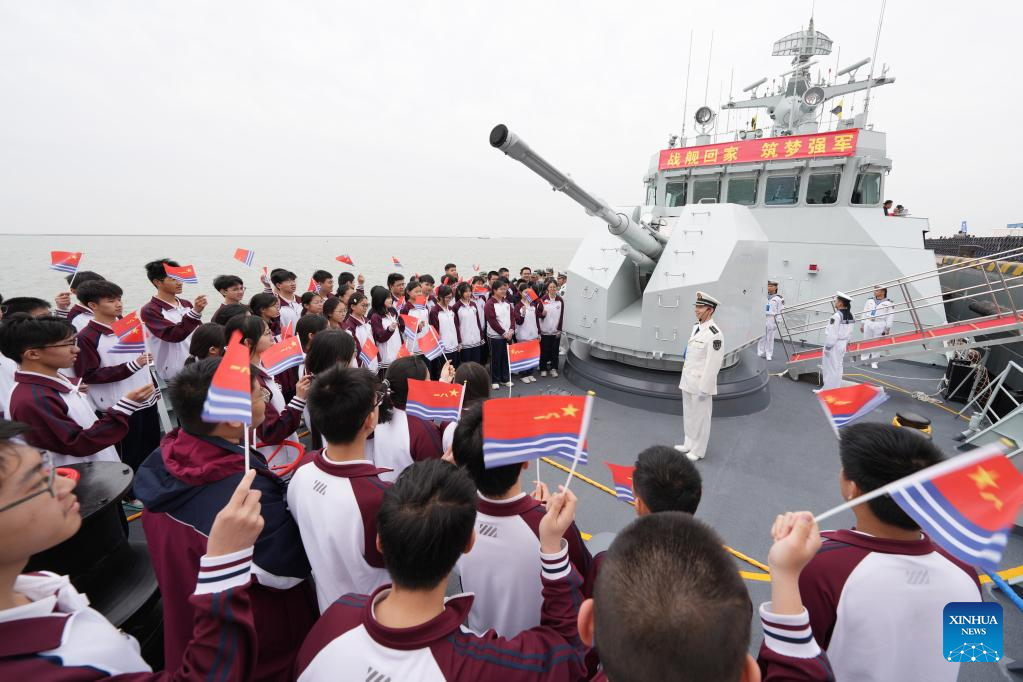
People participate in a navy open-day event in Dongying, east China's Shandong Province, April 21, 2026. (Photo by Wang Guangjie/Xinhua)
BEIJING, April 23 (Xinhua) -- China on Thursday celebrated the 77th anniversary of the founding of its navy, whose growing strength has become an important force for regional and global stability.
As part of these celebrations, the People's Liberation Army (PLA) Navy opened naval bases in more than 10 cities to the public, with dozens of active-duty vessels on display, according to the navy.
The lineup includes guided-missile destroyers, frigates and amphibious transport docks, along with support vessels such as replenishment ships and hospital ships. Many of the vessels have taken part in missions including escort operations in the Gulf of Aden, overseas visits and joint exercises.
To mark the occasion, the navy also released a short film, "Into the Deep," showing an aircraft carrier group operating alongside other naval forces, supported by carrier-based aircraft and shore-based missile systems in coordinated precision strikes.
China's drive to develop a capable navy has been tied to both its geography and its history. With more than 18,000 kilometers of coastline and a vast maritime domain, the country has increasingly emphasized safeguarding its waters, shaped in part by over 470 foreign naval incursions from 1840 to 1949.
Founded in 1949, the same year as the People's Republic of China, the PLA Navy has developed into a modern strategic service with a full range of naval branches and both conventional and nuclear capabilities.
In just over a decade, the navy has built a trio of aircraft carriers. The first, Liaoning, a refitted Soviet-made vessel, entered service in 2012, followed by Shandong in 2019, China's first domestically built aircraft carrier.
The third, Fujian, equipped with electromagnetic catapults, was commissioned in November 2025 and is now the largest vessel in the navy's active fleet by displacement. Work is ongoing on its carrier-based air wing, including fighter jets, early-warning aircraft and helicopters designed for carrier operations.
Beyond its carrier program, the navy has added new strategic nuclear submarines, 10,000-tonne-class destroyers, amphibious assault ships and integrated supply ships, in support of maritime operations and national security.
This rapid pace of modernization has also been visible to the public. Aboard a warship, Wang Zhifang, a 97-year-old veteran dressed in the old-style military uniform from his service days, recalled serving with only rifles.
"Now the weapons are automated, and the military operates with a much higher level of automation," the veteran said, expressing admiration for the navy's transformation.
Another visitor, a young military enthusiast, said the navy had made a qualitative leap over the past decade. He recalled buying military magazines each month in middle school, most of them focused on foreign equipment. "Back then, I kept wondering when I would see Chinese aircraft carriers," he said. "Now that day has finally come."
For Lin Yi-chen, a young woman from Taiwan attending the navy's open-day event, stepping onto a warship for the first time was a new experience, one that, she said, offered a different perspective. She hoped to share it with more young people in Taiwan.
The Chinese navy's growing capabilities have increasingly been put to use in international missions, from escort operations to humanitarian assistance initiatives.
Since 2008, the PLA Navy has sent dozens of fleets to the Gulf of Aden and the waters off Somali on escort missions to protect the international lane, escorting over 7,000 Chinese and foreign vessels.
In addition to escort missions, the navy has broadened its overseas medical operations. The hospital ship Peace Ark has treated more than 370,000 people worldwide since entering service, while a newer vessel, Silk Road Ark, has since 2025 extended such efforts to countries including Fiji, Tonga and Jamaica.
The navy has also become a regular responder to overseas crises, taking part in evacuations from Libya and Yemen, disaster relief in the Philippines, and emergency water deliveries to the Maldives during a local shortage.
"Such efforts reflect China's increasingly confident role in global and regional affairs, helping position the PLA Navy as a stabilizing force for peace worldwide," said Teng Jianqun, an international affairs expert. ■
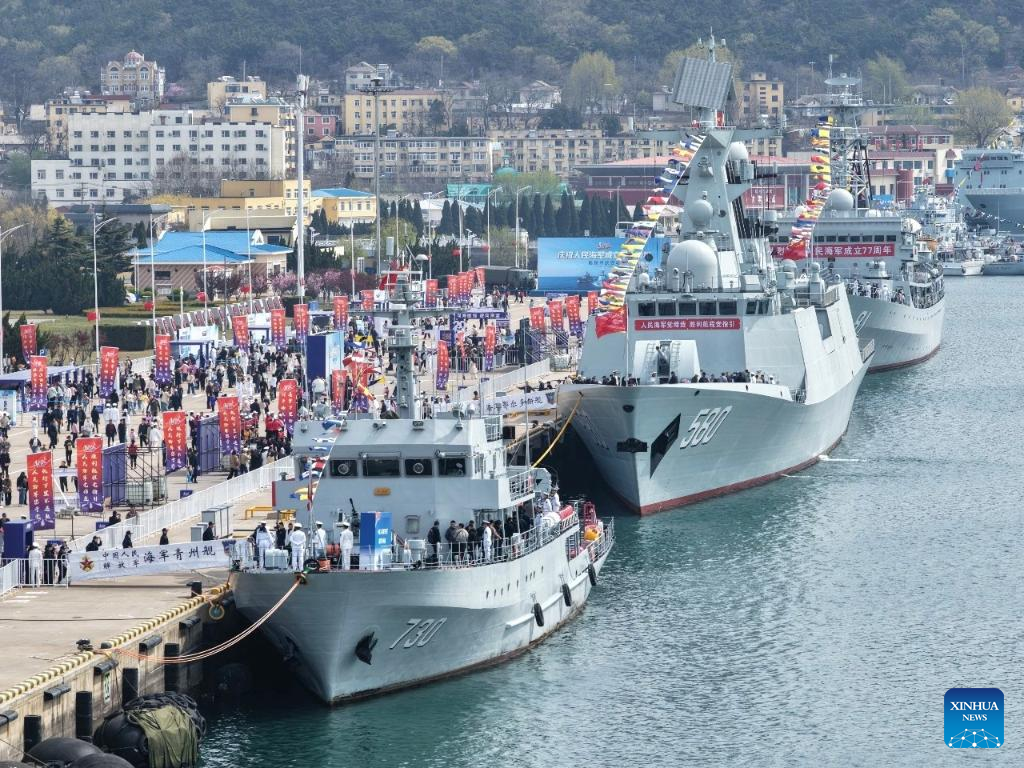
This screenshot from a video clip shows people participating in a navy open-day event in Dalian, northeast China's Liaoning Province, on April 23, 2026. (Photo by Han Fangda/Xinhua)
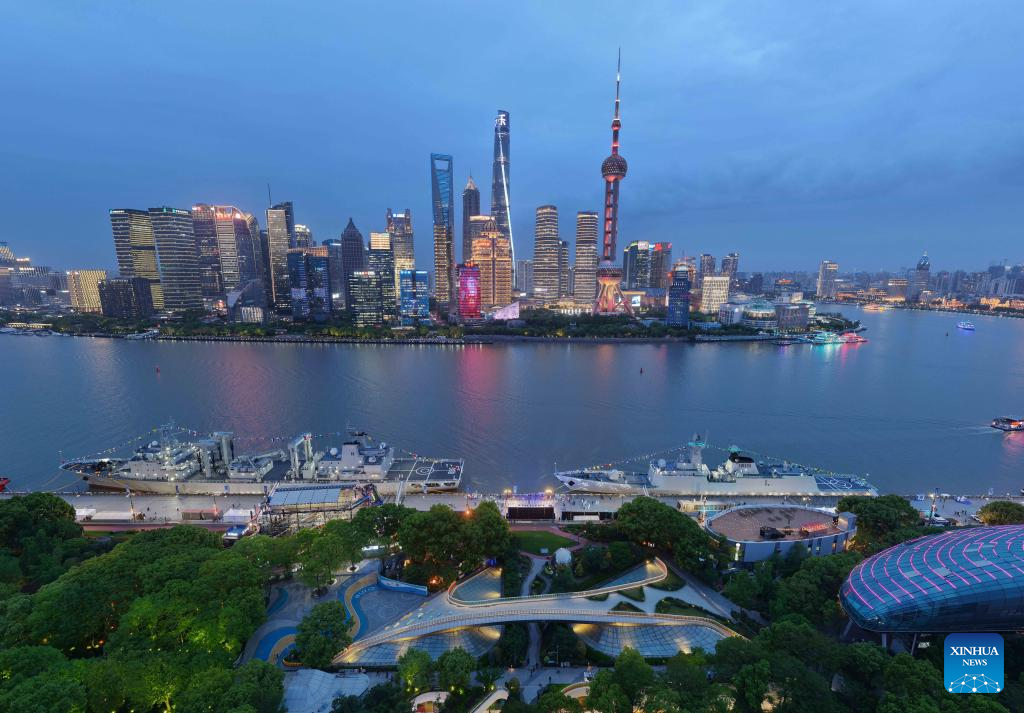
This aerial drone photo taken on April 21, 2026 shows people participating in a navy open-day event in east China's Shanghai. (Photo by Sun Wei/Xinhua)
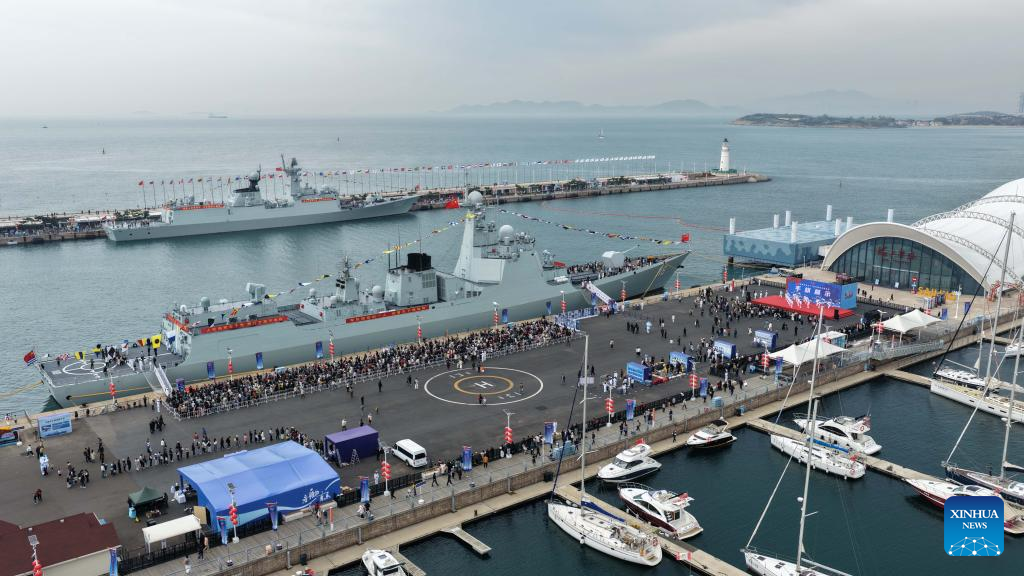
This aerial drone photo taken on April 23, 2026 shows people participating in a navy open-day event in Qingdao, east China's Shandong Province. (Photo by Li Fengxiang/Xinhua)


