
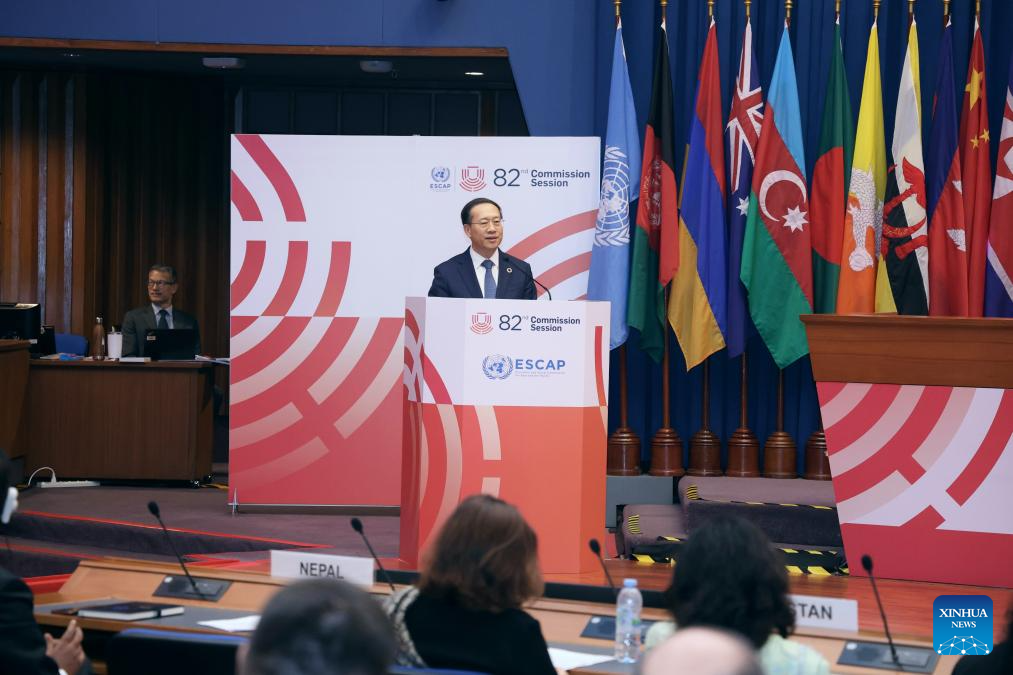
Chinese Vice Foreign Minister Ma Zhaoxu speaks at the 82nd session of the United Nations Economic and Social Commission for Asia and the Pacific (ESCAP) in Bangkok, Thailand, April 20, 2026. Global and regional leaders gathered here on Monday, calling for stronger action to ensure no one is left behind in a rapidly changing world. (Xinhua/Sun Weitong)
BANGKOK, April 20 (Xinhua) -- Global and regional leaders gathered here on Monday, calling for stronger action to ensure no one is left behind in a rapidly changing world.
The call came from the 82nd session of the United Nations Economic and Social Commission for Asia and the Pacific (ESCAP), which is held in Bangkok from April 20 to 24.
The meeting comes at a time of mounting pressures on the region, including economic uncertainty, geopolitical tensions, climate risks and rapid technological change, alongside major demographic shifts such as ageing populations, youth employment challenges and widening intergenerational inequalities.
"As the crisis in the Middle East compounds global shocks and affects countries across Asia and the Pacific in different ways, the effects are often falling hardest on the most vulnerable. Sustainable development remains our best strategy to advance progress for all ages and to strengthen resilience amidst uncertainty," United Nations Deputy Secretary-General Amina J. Mohammed said.
"This crisis underscores something fundamental about the region. Asia and the Pacific are deeply interdependent," Executive Secretary of ESCAP Armida Salsiah Alisjahbana emphasized.
"This interdependence creates shared vulnerability. It also creates a shared responsibility and calls for a shared vision, one in which no one is left behind, and where resilience lies at the heart of development," She added.
Guided by the theme "Leaving no one behind: advancing a society for all ages in Asia and the Pacific," the 82nd session of ESCAP also provides a platform to discuss current and emerging demographic trends and socioeconomic priorities.
"Development must be inclusive. Otherwise, the most vulnerable will fall further behind. That is why this year's theme of advancing a society for all ages is not just a policy aspiration, but a strategic priority," Thai Prime Minister Anutin Charnvirakul said.
Chinese Vice Foreign Minister Ma Zhaoxu said openness and cooperation are crucial to maintaining rapid growth in Asia and the Pacific.
"No matter how the international situation changes, we must adhere to the correct direction of openness and cooperation, safeguard the multilateral trading system with the World Trade Organization at its core, promote trade and investment liberalization and facilitation, ensure the stability and smoothness of industrial and supply chains, and advance regional economic integration," he said.
Next year marks the 80th anniversary of the founding of the ESCAP, and China is willing to host the 83rd session in Shanghai in April 2027, Ma added.
The ESCAP is an important intergovernmental comprehensive economic and social development organization established by the United Nations in the Asia-Pacific region.
More than 400 participants from ESCAP member states, associate members and permanent observers, as well as representatives from academia, international organizations, youth, business and civil society, attend the session this week. ■
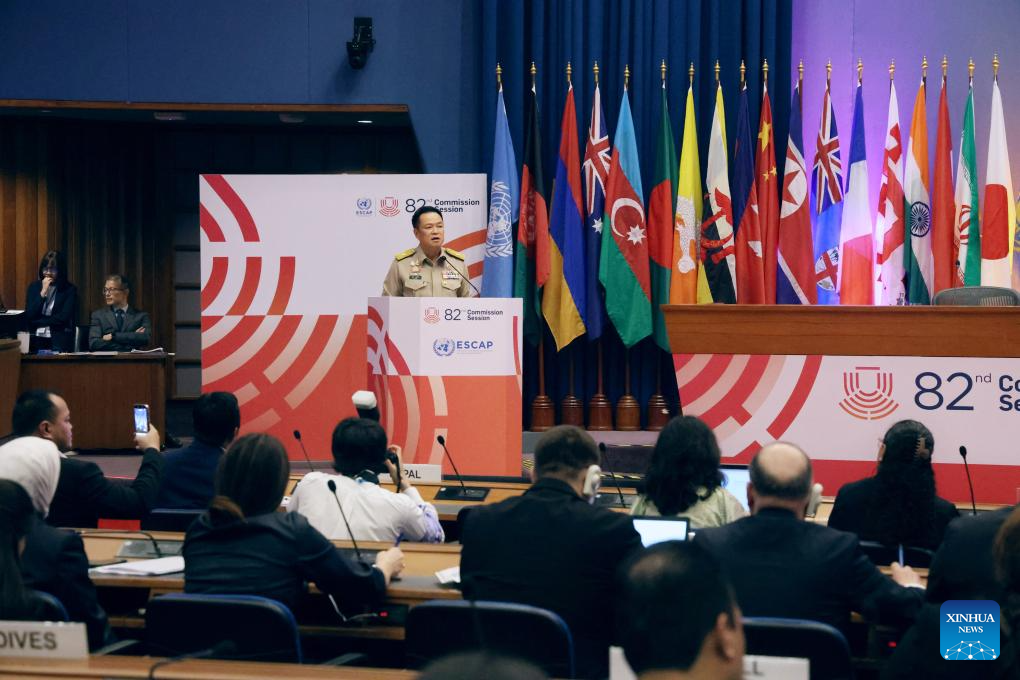
Thai Prime Minister Anutin Charnvirakul speaks at the 82nd session of the United Nations Economic and Social Commission for Asia and the Pacific (ESCAP) in Bangkok, Thailand, April 20, 2026. Global and regional leaders gathered here on Monday, calling for stronger action to ensure no one is left behind in a rapidly changing world. (Xinhua/Sun Weitong)


