
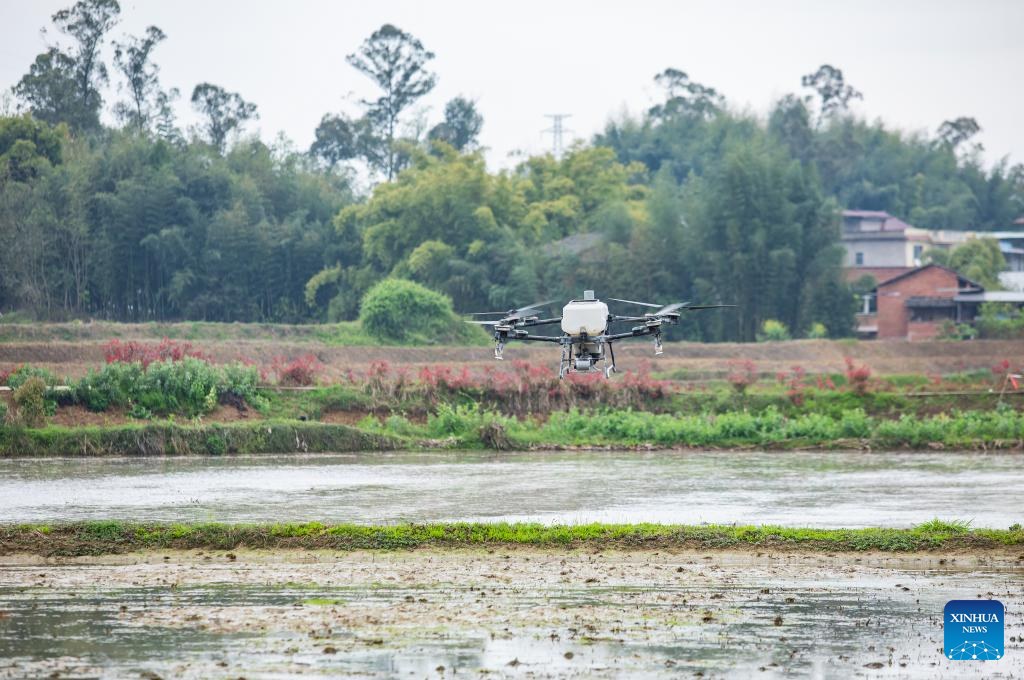
A drone sows rice seeds over fields in Lianglu Village of Liangping District, southwest China's Chongqing, on March 29, 2026. (Photo by Xiong Wei/Xinhua)
CHONGQING, April 21 (Xinhua) -- Burgeoning smart technologies are taking the heavy lifting out of mountain farming in southwest China's Chongqing, famed for its fiery hot pot cuisine and rugged mountain landscapes.
During this spring farming season, the intensive use of drones, intelligent seedling cultivation, and smart greenhouses, alongside other explorations and applications of smart agricultural technologies and farm machinery, is propelling the local mountainous agricultural region toward high-quality development.
Over the patchwork of rugged mountain farmlands, agricultural drones buzz, busy applying fertilizer and spraying pesticides, freeing farmers from trudging up and down slopes for repetitive farm work.
"Each drone can fertilize about 300 mu (20 hectares) in a single day, matching what ten farmers could achieve in around one week of manual labor," said Jiang Lixiang, technical director of Chongqing Tianzhongyang Agricultural Technology Cooperative.
This is a drone operation pilot program underway in an agricultural community in the Liangping District of Chongqing, where local farmers, under the guidance of technicians, are learning to operate drones for fieldwork.
The community is exploring a cooperative model involving both agricultural cooperatives and individual farmers to carry out spring planting. This year, they plan to use drones to sow rice across about 200 hectares of farmland and use automated machinery to transplant rice seedlings on approximately 866.7 hectares.
China's vast territory features diverse and complex terrain. Therefore, it is of great importance for each region to identify and continuously develop solutions for agricultural production in accordance with local conditions. The use of drones as new farm equipment in Chongqing is a typical example of how China develops new quality productive forces to address practical needs.
Chongqing, known as the "mountain city of China," has over 70 percent of its land composed of hills and mountains, with slopes and gullies crisscrossing the landscape. Locals often jokingly refer to the extremely scattered and tiny plots of farmland as "palm-sized fields" and "chicken-nest lands."
Now, the development of smart agricultural technologies and the promotion of intelligent farm machinery are sustaining mountain agriculture here, improving work quality and efficiency, and reducing agricultural production costs.
China's latest five-year plan for the 2026-2030 period emphasizes coordinating the development of technology-driven, green, quality and brand agriculture, transforming the country's agricultural sector into a modernized, large-scale industry.
It also highlights strengthening research and development in key core technologies and fostering leading enterprises in the agricultural sector.
The "No. 1 central document" for 2026, which China unveiled in February, also outlines plans to advance agricultural and rural modernization and to promote all-around rural revitalization. It pledged to expand application scenarios for advanced technologies such as drones, the Internet of Things, and robots.
Just as drones have taken to the skies to relieve farmers, smart automated rice seedling cultivation is also empowering local farmers to sow more quickly and effectively in the springtime.
"Seedling cultivation is a critical step in rice planting. Thanks to automated circulation, as well as intelligent UV and temperature control, the rice seeds can sprout and break through the soil in only about three days," said Wang Dajun, general manager of Chongqing Hengwangda Agricultural Technology Co., Ltd.
What Wang referred to is an intelligent rice seedling breeding base located in the Shuangxing Village of Xianlong Town in Chongqing.
"Don't underestimate this automated seedling plant. Though it covers just about 0.4 hectares, it can supply enough seedlings for about 1,333 hectares of spring plowing," Wang told Xinhua, adding that the intelligent automated seedling breeding is under exploration.
Inside the greenhouse-like plant, rice seedlings sprout on 20 sets of circulating mobile seedling beds that ride "elevators" moving up and down in a continuous cycle, evenly receiving light and water from the greenhouse equipment.
Wang explained that, compared to the vast northern regions of China, where seedlings can be spread out over large areas, Chongqing's farmlands are not only small and fragmented but also pose harsh challenges for farmers due to the mountainous terrain with steep slopes. Moreover, the frequent cloudy weather is even more challenging.
"In our intelligent rice seedling greenhouses, the three-dimensional breeding equipment can provide both water and illumination," he said.
"Via automated technologies and unique vertical design on limited land, we tackle challenges from geographical and natural limitations, helping farmers overcome many difficulties of growing rice in Chongqing's unique mountainous areas with higher production efficiency," Wang added. ■
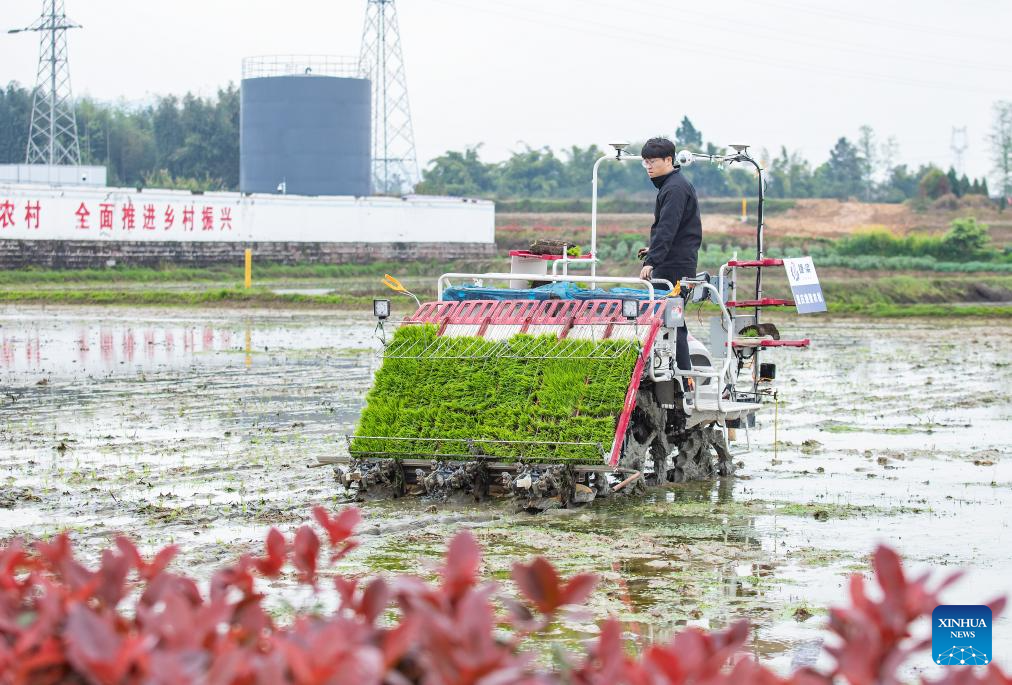
A staff member operates a transplanter to transplant seedlings in Lianglu Village of Liangping District, southwest China's Chongqing, on March 29, 2026. (Photo by Xiong Wei/Xinhua)
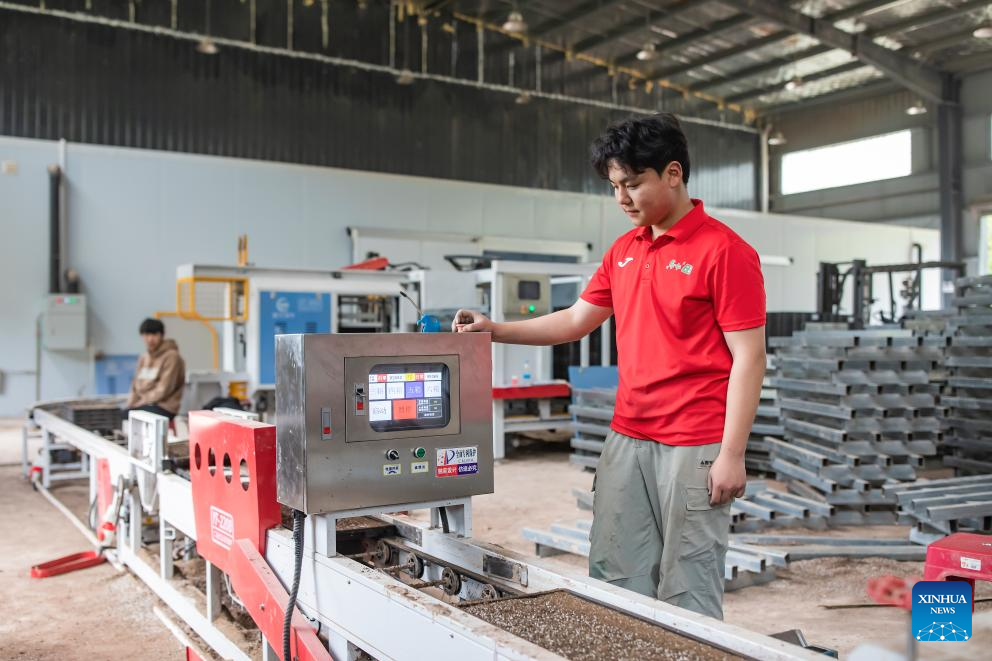
A staff member conducts intelligent seedling cultivation on a machine at a cooperative in Liangping District, southwest China's Chongqing, on March 27, 2026. (Photo by Xiong Wei/Xinhua)
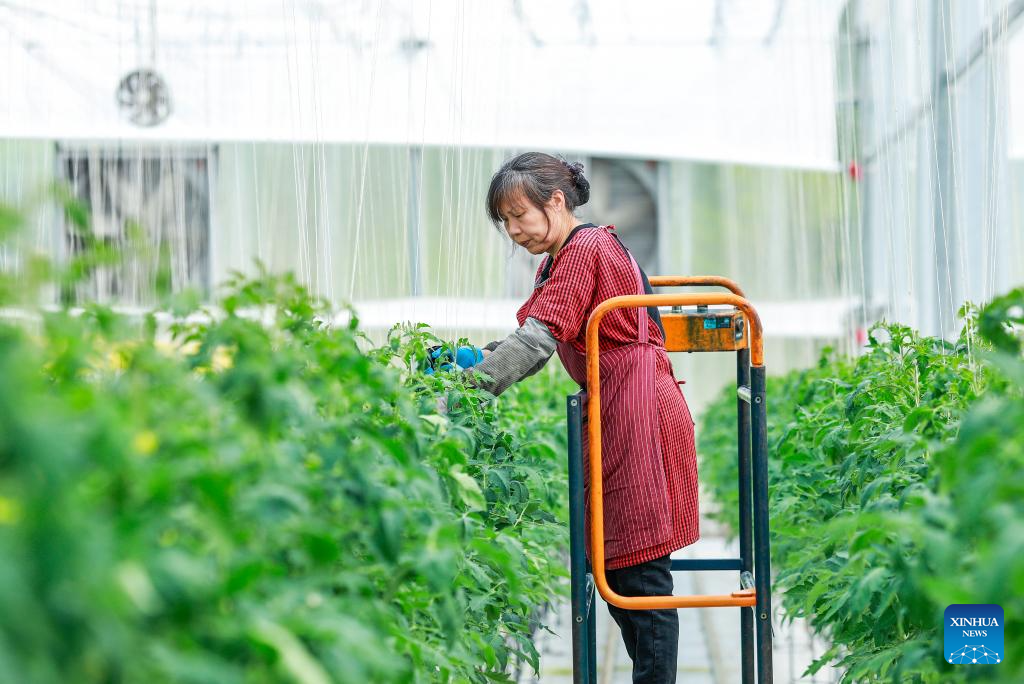
An employee pollinates tomato flowers in Liangping District, southwest China's Chongqing, on April 3, 2026. (Photo by Xiong Wei/Xinhua)


