
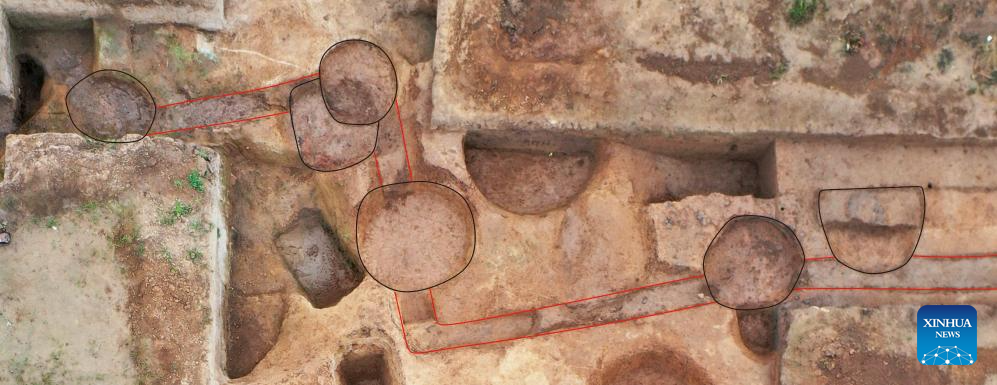
This undated diagram shows a channel linking to individual buildings or kilns at the Wangchenggang site in Dengfeng, central China's Henan Province. (Henan Provincial Institute of Cultural Heritage and Archaeology/Handout via Xinhua)
ZHENGZHOU, April 9 (Xinhua) -- An artificial water channel system dating back some 4,000 years has been unearthed in central China's Henan Province, providing important evidence of the state-level organizational capacity and urban layout of the Xia Dynasty (2070 BC-1600 BC), China's earliest known dynasty, authorities said on Thursday.
The discovery at the Wangchenggang site in Dengfeng, Henan, was revealed at a forum showcasing the province's latest archaeological findings.
Two new artificial ditches from the early Xia Dynasty have been identified at the site, each about three meters wide with a confirmed length of over 120 meters. Running north-south, the ditches were connected to a roughly 10-meter-wide moat, forming a complete water supply, drainage and spatial zoning system, according to Ma Long, a local archaeologist leading the on-site excavation.
"The two ditches are consistent in form, demonstrating a high level of planning, design and engineering standards," said Ma. He added that an estimated thousands of cubic meters of earth were removed to build them, a task that could only be completed with large-scale, well-organized labor.
In addition to the ditches and moat, multiple minor channels, measuring between 0.3 and one meter in width, were uncovered. These channels were linked to individual buildings or kilns, enabling the rapid drainage of rainwater and wastewater, thus keeping the living environment dry.
"Such a large and hierarchically structured artificial water channel system indicates that as early as the Xia Dynasty, the Wangchenggang site had unified organizational capacity and standardized engineering practices," said Yang Wensheng, vice director of the Henan Provincial Institute of Cultural Heritage and Archaeology. He added that this serves as an important archaeological evidence for the maturity of early state formation.
Further excavation and research work are currently underway. ■
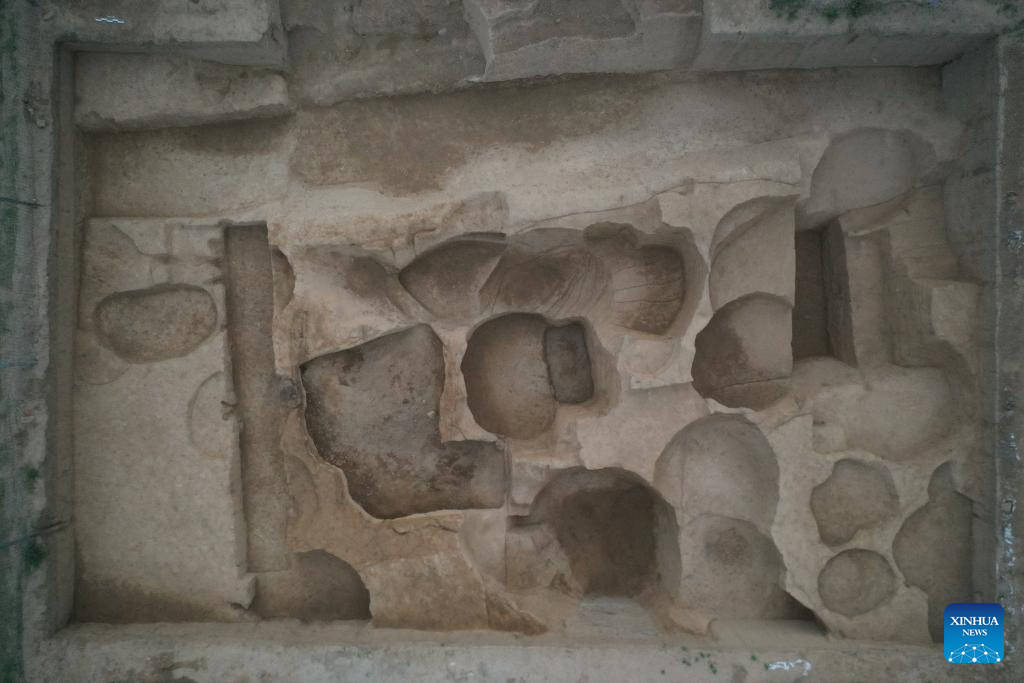
This undated file photo shows a view of the Wangchenggang site in Dengfeng, central China's Henan Province. (Henan Provincial Institute of Cultural Heritage and Archaeology/Handout via Xinhua)


