

China's research icebreaker Xuelong docks at its base in Shanghai, east China, April 9, 2026. Xuelong, or Snow Dragon, returned to Shanghai on Thursday after a 160-day-long voyage which formed part of the country's 42nd Antarctic expedition. (Xinhua/Zhang Jiansong)
SHANGHAI, April 9 (Xinhua) -- China's polar icebreaker Xuelong, or Snow Dragon, returned to Shanghai in east China on Thursday after a 160-day-long voyage, part of the country's 42nd Antarctic expedition, having achieved fruitful scientific research outcomes.
This polar expedition has involved 550 researchers, over 3,600 tonnes of routine supplies and 104 days of inland exploration, setting new records in terms of personnel scale and workload.
It has supported the on-site implementation of 45 national science and technology projects, achieving breakthroughs in major infrastructure construction, scientific research and monitoring, testing and application of home-grown equipment, and international cooperation, according to the Chinese Arctic and Antarctic Administration.
Wei Fuhai, the lead and chief scientist of the expedition team, highlighted Qinling Station, China's fifth Antarctic base that began operations in February 2024, saying it has "come of age" in terms of routine operation capability, with its foundational systems improved and many scientific facilities for weather observation, upper-atmospheric physics observation and marine environment monitoring put into use.
A number of self-made scientific equipment items, including an Antarctic wheeled vehicle and a new inland pressurized cabin, also showed excellent performance during this expedition, withstanding the tests of harsh environments and enhancing support capability for field operations in Antarctica.
Good equipment, notably, has facilitated technological breakthroughs. For instance, the expedition has set a new record with the country's first hot-water drilling experiment on the Antarctic ice sheet, reaching a depth of 3,413 meters and surpassing the previous global mark of 2,540 meters. It will greatly support studies on life under the ice, ancient climate records and Earth's evolutionary history, the expedition team said.
Outstanding results were also obtained in ecological surveys. During the journey, the expedition members completed comprehensive investigations in key sea areas, including the Cosmonaut Sea and the Amundsen Sea. They established an "air-ground" monitoring system for penguin habitats and conducted aerial photography surveys of penguin populations. Additionally, they collected a large amount of precious samples related to krill and ice lakes.
Amid the 160 days of cold Antarctic weather, there were many heartwarming interactions.
The Chinese expedition team carried out an international humanitarian rescue using domestic aircraft to help Russia evacuate sick and stranded personnel. China's Great Wall Station supported four Portuguese researchers in conducting their studies and provided medical assistance to the injured from Russia, the Czech Republic and Uruguay. The icebreaker Xuelong was also invited to assist in transporting 23 expedition members from the Republic of Korea.
In addition, China's three Antarctic research stations, together with two icebreakers, received over 400 visits from researchers of 11 countries. They also organized more than 130 visits to neighboring stations during the journey. Other activities included academic conferences on Antarctic science jointly hosted with Russia and India, as well as a Chinese film festival.
China's 42nd Antarctic expedition team embarked on the journey from Shanghai on Nov. 1, 2025. It has been jointly supported by two icebreakers, namely Xuelong and Xuelong 2. The expedition is anticipated to end in May. ■
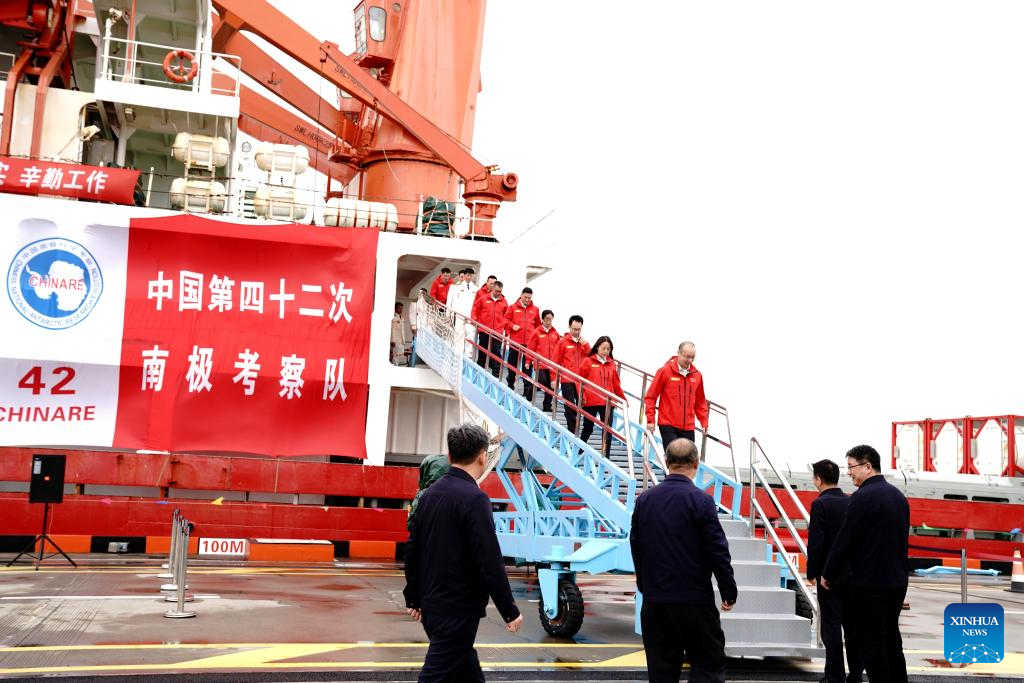
Members of China's 42nd Antarctic expedition team disembark from China's research icebreaker Xuelong in Shanghai, east China, April 9, 2026. Xuelong, or Snow Dragon, returned to Shanghai on Thursday after a 160-day-long voyage which formed part of the country's 42nd Antarctic expedition. (Xinhua/Zhang Jiansong)
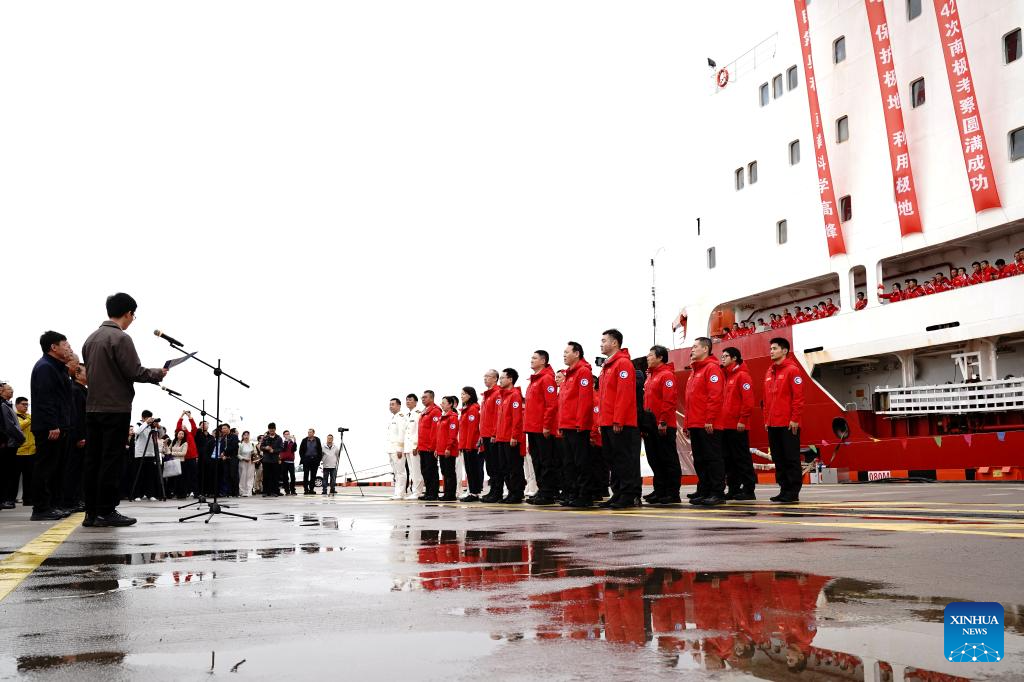
A welcoming ceremony is held for China's research icebreaker Xuelong in Shanghai, east China, April 9, 2026. Xuelong, or Snow Dragon, returned to Shanghai on Thursday after a 160-day-long voyage which formed part of the country's 42nd Antarctic expedition. (Xinhua/Zhang Jiansong)

A member of China's 42nd Antarctic expedition team (L) reunites with her family in Shanghai, east China, April 9, 2026. Xuelong, or Snow Dragon, returned to Shanghai on Thursday after a 160-day-long voyage which formed part of the country's 42nd Antarctic expedition. (Xinhua/Zhang Jiansong)

People welcome the return of China's 42nd Antarctic expedition team in Shanghai, east China, April 9, 2026. Xuelong, or Snow Dragon, returned to Shanghai on Thursday after a 160-day-long voyage which formed part of the country's 42nd Antarctic expedition. (Xinhua/Zhang Jiansong)

China's research icebreaker Xuelong docks at its base in Shanghai, east China, April 9, 2026. Xuelong, or Snow Dragon, returned to Shanghai on Thursday after a 160-day-long voyage which formed part of the country's 42nd Antarctic expedition. (Xinhua/Zhang Jiansong)

A member of China's 42nd Antarctic expedition team (R) reunites with her family in Shanghai, east China, April 9, 2026. Xuelong, or Snow Dragon, returned to Shanghai on Thursday after a 160-day-long voyage which formed part of the country's 42nd Antarctic expedition. (Xinhua/Zhang Jiansong)

People welcome the return of China's 42nd Antarctic expedition team in Shanghai, east China, April 9, 2026. Xuelong, or Snow Dragon, returned to Shanghai on Thursday after a 160-day-long voyage which formed part of the country's 42nd Antarctic expedition. (Xinhua/Zhang Jiansong)
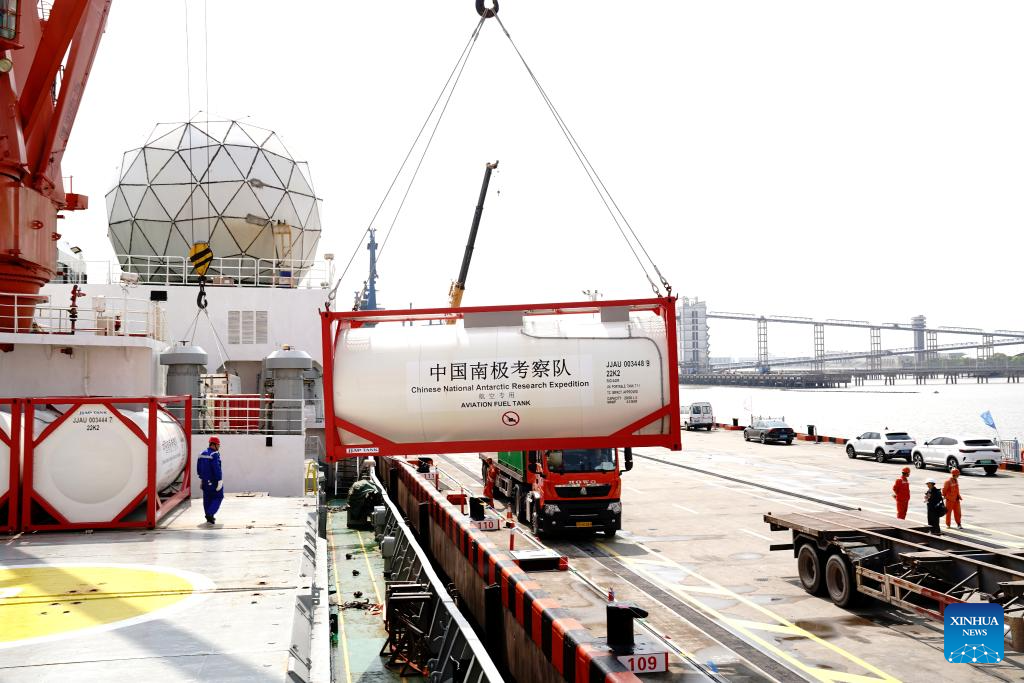
Staff members unload containers from China's research icebreaker Xuelong in Shanghai, east China, April 9, 2026. Xuelong, or Snow Dragon, returned to Shanghai on Thursday after a 160-day-long voyage which formed part of the country's 42nd Antarctic expedition. (Xinhua/Zhang Jiansong)


