
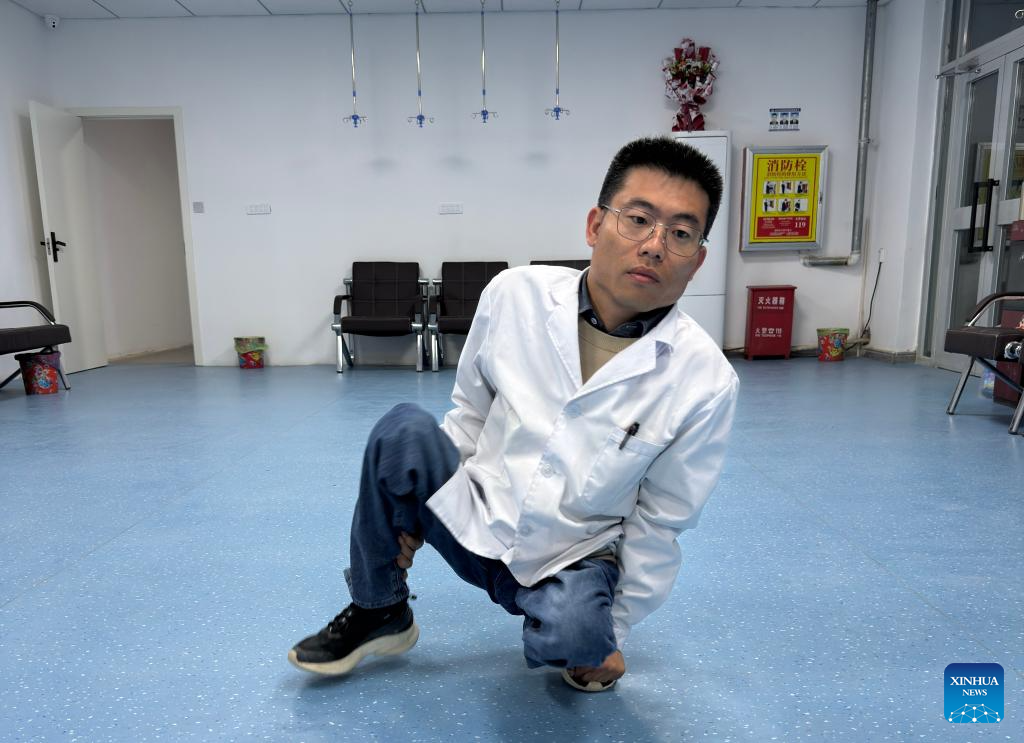
Li Chuangye, a physician paralyzed from the waist down due to polio, works at the clinic he runs in Shache County, northwest China's Xinjiang Uygur Autonomous Region, on April 3, 2026. (Xinhua)
URUMQI, April 8 (Xinhua) -- Li Chuangye cannot walk upright. He moves by squatting, gripping his ankles and swinging his small body forward, one twist and then another.
The 38-year-old man weighs less than 38 kg. When Li was seven months old, he contracted polio, a disease that once posed a major health threat to children. China launched a nationwide anti-polio immunization campaign in the 1960s and made huge progress, but sporadic cases still affected unlucky children like Li in the late 1980s. As a result, he is paralyzed from the waist down, and his height is less than half that of an ordinary person.
Now, in a remote town on the edge of the Taklimakan Desert in northwest China's Xinjiang Uygur Autonomous Region, Li runs a clinic as a certified physician, becoming a trusted healer for his neighbors.
Li's clinic has been operational for three months. It covers an area of 300 square meters and features a consultation area, an infusion room, a pharmacy and a sign at the entrance reading "24-Hour Medical Service."
In this large workplace, he seems extremely petite. When a patient arrives, Li crouches and shifts his body forward until he reaches his wheelchair. With a push, he lifts himself into the seat, allowing him to meet patients at eye level.
This is how Li practices medicine. At first, local residents were skeptical of this slight, bespectacled doctor in a white coat. Could someone with difficulty walking care for patients effectively? However, those doubts were soon dispelled by his professionalism and dedication.
When he learned that three residents aged over 80 had no one to accompany them to medical appointments because their adult children had left the village for work, Li packed his medical bag and visited them at home. He checked their blood pressure, measured their blood sugar, and prescribed medication, all at no cost.
He also offers free care for the disabled and half-price services for the poor.
"They never expected that a stranger, who was in poor health himself, would be so kind to them," said Patigul Zaker, a nurse at Li's clinic, when reflecting on how locals felt about Li.
The town in Shache County in southern Xinjiang has a large Uygur population. Although there is a language barrier with this minority group, Li has nevertheless attracted a growing number of local Uygur residents seeking his care.
A video of him making house calls through the countryside to provide free medical consultations to villagers was posted online by a vlogger. His spirit of perseverance and dedication moved countless netizens. Some commented that "he is a ray of light," lifting the hopes of many others.
Li himself comes from a poor family in rural Henan Province in central China. He was seven months old when a misdiagnosis led to polio. From age one to nine, his family borrowed and repaid money over and over again, trying to find a cure for his disability.
"When I was little, I hated being called a cripple," Li said. "Now I do not mind. I am disabled, and it is true."
His disability made his childhood harder than most. His family was burdened with debts, and he had to learn to crawl and move around on his hands.
The young man began primary school at 16 and progressed quickly, skipping several grades through intensive study. From that point on, he received warmth and kindness from teachers and classmates. His tuition fees were reduced, and his classmates helped by carrying him upstairs.
He set a clear goal: to study medicine. In 2013, Li was admitted to a medical college, and three years later, he was enrolled in the clinical medicine program of Henan University.
Wu Jin'ge, his college counselor, remembered Li as a diligent student who won scholarships and used the money to help others who were even more in need.
"I'm proud of him," his mother said, recalling the childhood days when he sat in the family's courtyard and told her: "Life is not worth living." Li's mother cannot read and still lives in her hometown in Henan.
But today, Li has become a man who cannot stop moving. After obtaining his physician's qualification and running a clinic in Yunnan Province in southwest China, he traveled for 61 hours by train from Henan to Xinjiang in 2025. With the help of a fellow townsman, he managed to open his current clinic there.
Li works very hard. He sleeps only four hours a night, and when he is not seeing patients, he buries himself in medical textbooks. "In rural areas, you see every kind of illness. If I don't keep learning, I might misdiagnose someone," he said. "I cannot let that happen."
To many people's surprise, this disabled man's hobby is climbing mountains. In 2016, he climbed Mount Tai, one of China's most revered peaks. What takes most hikers four hours took him five days and four nights. On the steep stone steps, where others walked on foot, he pulled himself upward with his hands.
Since then, he has climbed many high mountains across the country. He has worn through dozens of gloves, shoes and pants.
Even so, he said climbing mountains is an amazing experience. "When I reach the peak, I feel that I can be just like others."
Li has posted his climbing videos on social media, drawing thousands of views. Some suggested he could become an internet celebrity, making money from his inspiring story. But he has declined the opportunity for a quick cash grab. He only hopes his story will inspire others like him.
With decades of nationwide efforts toward polio prevention and control, China was declared polio-free by the World Health Organization in 2000.
Li has registered to donate his body for medical research after his death. "Since I have this disease, I hope researchers can study my body to find out why it happens, so that no child ever has to grow up unable to stand again," he said. ■
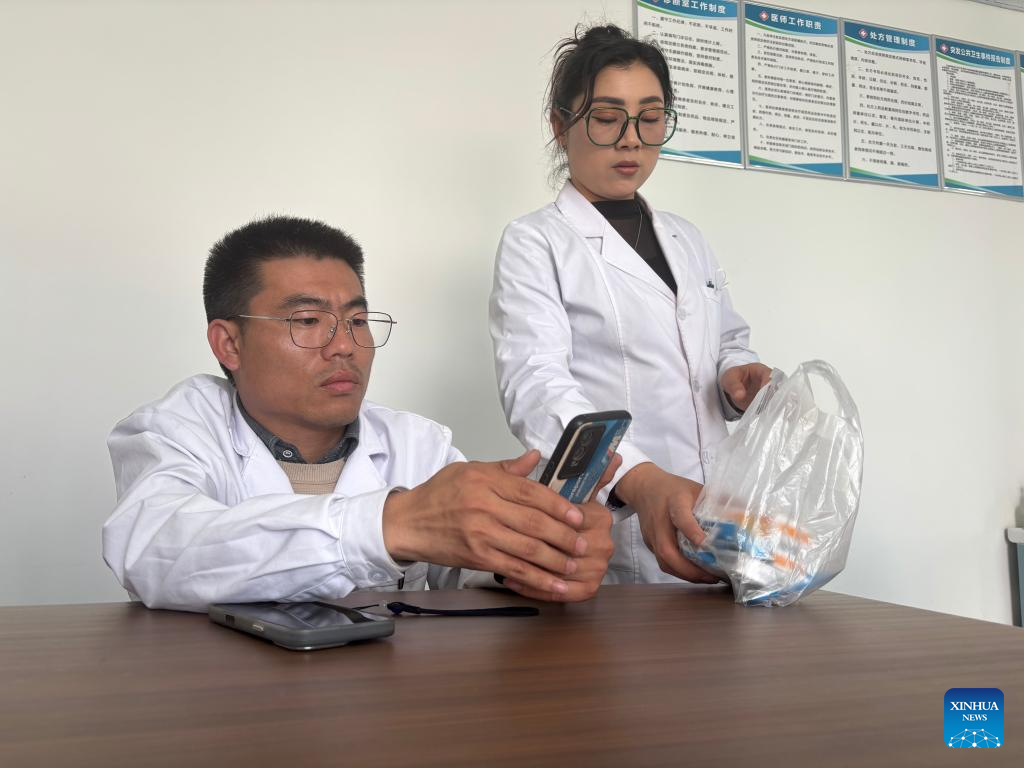
Li Chuangye (L), a physician paralyzed from the waist down due to polio, works at the clinic he runs in Shache County, northwest China's Xinjiang Uygur Autonomous Region, on April 2, 2026.(Xinhua/Du Gang)


