
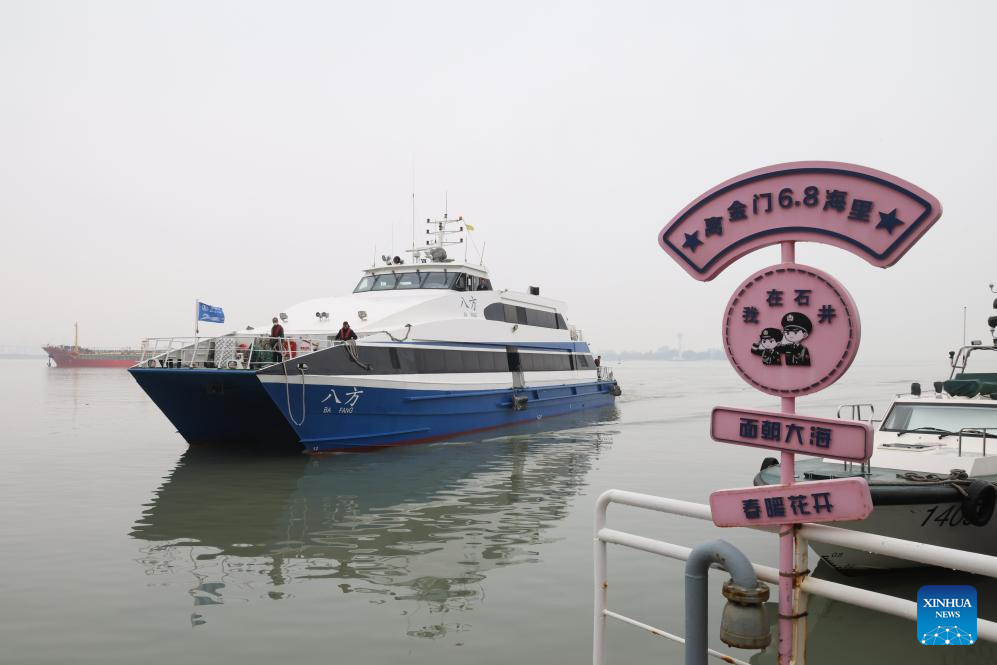
A ferry linking Fujian Province on the mainland with Kinmen approaches a passenger terminal in Quanzhou, southeast China's Fujian Province, April 3, 2026. (Xinhua/Jiang Kehong)
FUZHOU, April 4 (Xinhua) -- Direct ferries linking Fujian Province on the mainland with Kinmen and Matsu and carrying flocks of passengers across the Taiwan Strait have been especially busy this weekend as China's three-day Qingming (Tomb Sweeping) Festival holiday kicks off on Saturday.
At the ports of Fuzhou, Xiamen and Quanzhou in Fujian, travelers from Taiwan have arrived to honor their ancestors and enjoy spring outings during one of the most significant festivals in Chinese culture.
Chiang Wei-wen, originally from Taoyuan in Taiwan and now working in Kinmen, joined the travelers for his first ferry trip from Kinmen to Quanzhou, despite having frequently traveled to Xiamen by ferry in his spare time.
Like many people in Taiwan, Chiang's family moved from Fujian generations ago to settle down on the island. Although he does not know the exact location of his ancestors' origin, he said, "I'm certain that we're Minnan people."
As their name -- literally meaning "southern Fujian" -- suggests, the Minnan people are predominant in Fujian's southern cities of Quanzhou, Zhangzhou and Xiamen, where they have developed a distinct culture featuring a unique dialect, culinary traditions, and the worship of the sea goddess Mazu. They make up a majority of the ancestors of people in Taiwan, with migration believed to date back centuries.
On Friday, the Quanzhou-based China Museum for Fujian-Taiwan Kinship hosted an exhibition focused on tracing the roots of Taiwan residents in Fujian, featuring more than 160 items from its collection, including genealogical records and family letters exchanged across the Strait.
Since its opening in 2006, the museum has helped more than 300 people from Taiwan trace their roots and reconnect with relatives, said Zhuang Xiaofang, director of the documentation and information center of the museum.
At Huangqi port in Fuzhou, extra ferries linking Matsu have been added to meet the demands of ancestor-honoring rituals among travelers from Taiwan.
"We brought our child here to honor our ancestors together, so he will understand that our roots are here, and we should never forget about that," said Lin Tsai-yun, who arrived in Fuzhou by ferry ahead of the Qingming Festival.
According to the Fujian Maritime Safety Administration, 16 passenger vessels will operate on four ferry routes linking Fujian with Kinmen and Matsu over the Qingming Festival holiday from Saturday to Monday. It expects an estimated 19,500 passengers, up 8.3 percent from the same period last year.
In Fujian and across several regions of the mainland, multiple events commemorating the common ancestors and celebrating the same origin of both sides of the Strait are scheduled for the weekend.
In Quanzhou, the ancestral halls of two long-history family clans have invited their relatives from Taiwan for joint ancestor-worship ceremonies. In the northwestern Shaanxi Province, a ceremony honoring the Yellow Emperor, or Huangdi -- the legendary common ancestor of the Chinese nation -- will be held with participants from across the Strait.
In Qufu, the birthplace of Confucius in eastern Shandong Province, a cross-Strait cultural festival commemorating the esteemed ancient Chinese philosopher and educator is underway, with more than 900 participants from Taiwan.
"The wisdom of the sage shines for us on both sides of the Strait, who share the same roots," said Kung Tsui-chang, a 79th-generation descendant of Confucius. "Confucianism is our shared cultural heritage, and together we will pass on the memory of our nation through generations." ■
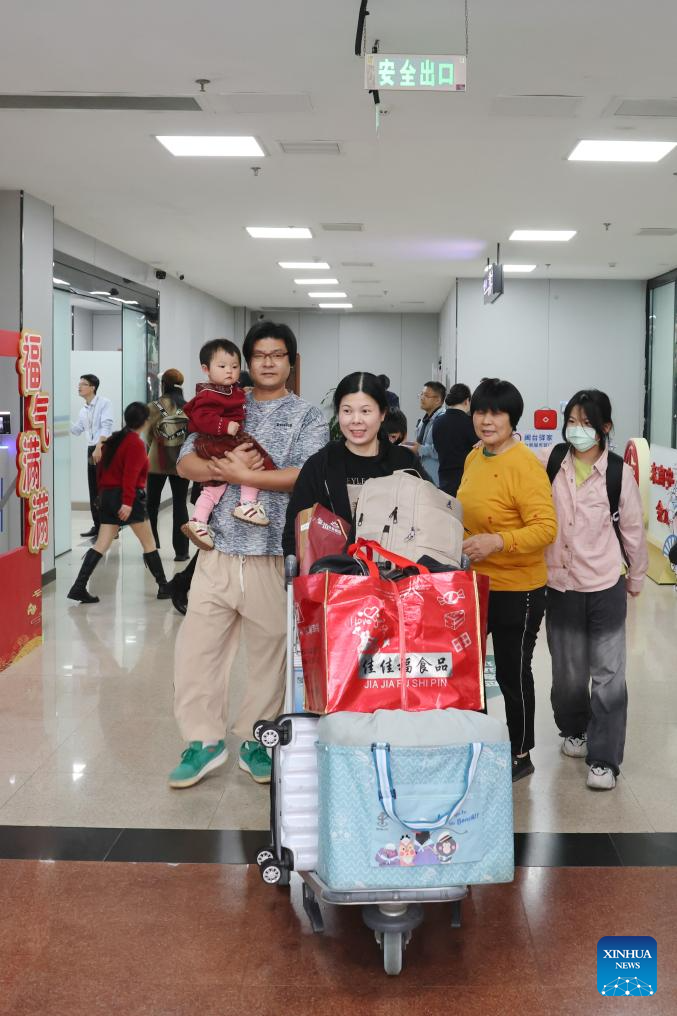
Passengers taking a direct ferry linking Fujian Province on the mainland with Kinmen leave a passenger terminal in Quanzhou, southeast China's Fujian Province, April 3, 2026. (Xinhua/Jiang Kehong)


