
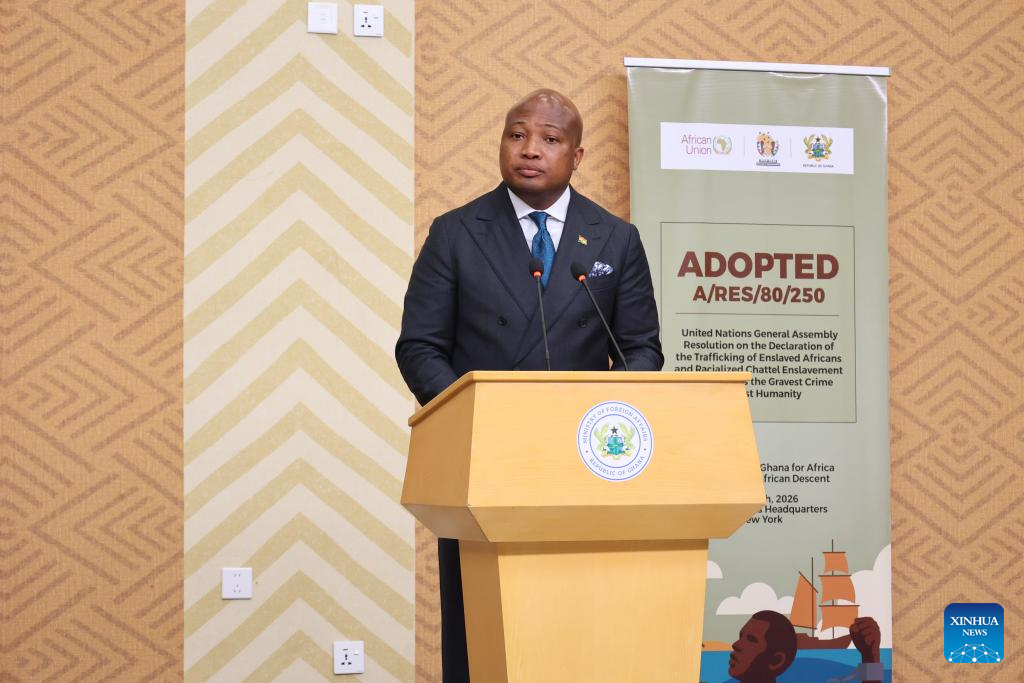
Ghanaian Foreign Minister Samuel Okudzeto Ablakwa delivers a speech at a media briefing on the successful adoption by the UN General Assembly of the historic Ghana-led Resolution A/80/L.48 in Accra, Ghana, March 31, 2026. Ghanaian Foreign Minister Samuel Okudzeto Ablakwa on Tuesday pledged Ghana's resolve to lead a sustained global conversation to promote the implementation of the United Nations (UN) Resolution on reparative justice for the impact of the transatlantic slave trade on Africa and the peoples of African descent. (Photo by Seth/Xinhua)
ACCRA, March 31 (Xinhua) -- Ghanaian Foreign Minister Samuel Okudzeto Ablakwa on Tuesday pledged Ghana's resolve to lead a sustained global conversation to promote the implementation of the United Nations (UN) Resolution on reparative justice for the impact of the transatlantic slave trade on Africa and the peoples of African descent.
Ablakwa made this pledge during a media briefing on the successful adoption by the UN General Assembly of the historic Ghana-led Resolution A/80/L.48, which declared the transatlantic slave trade and racialized chattel enslavement of Africans as the "gravest crime against humanity," supported by 123 member states.
The minister said the adoption of the resolution marked only a significant beginning to the realization of the objectives for reparative justice and upholding the eternal creed that "all men and women were created free."
The minister affirmed that Ghana, under the leadership of President John Dramani Mahama, as the African Union (AU) Champion on Reparations, will continue to work with deep resolve to put in place the necessary mechanisms to support the implementation of the global resolution.
"The government further reaffirms its commitment to work with member states (of the UN and AU) and partners to sustain the momentum and advance the global conversation on historical justice, equity, and full recognition of the historical experiences of Africans and people of African descent," the minister highlighted.
Ablakwa urged member states of the UN, "including all those who missed the opportunity of voting for the resolution," to join the coalition to push for the dismantling of the structures of discrimination and racism around the world.
The Ghana-led and AU-backed resolution passed last Wednesday calls for formal apologies, restitution, compensation, the return of cultural artifacts, and policy changes to address present-day inequalities linked to slavery's legacy. ■


