
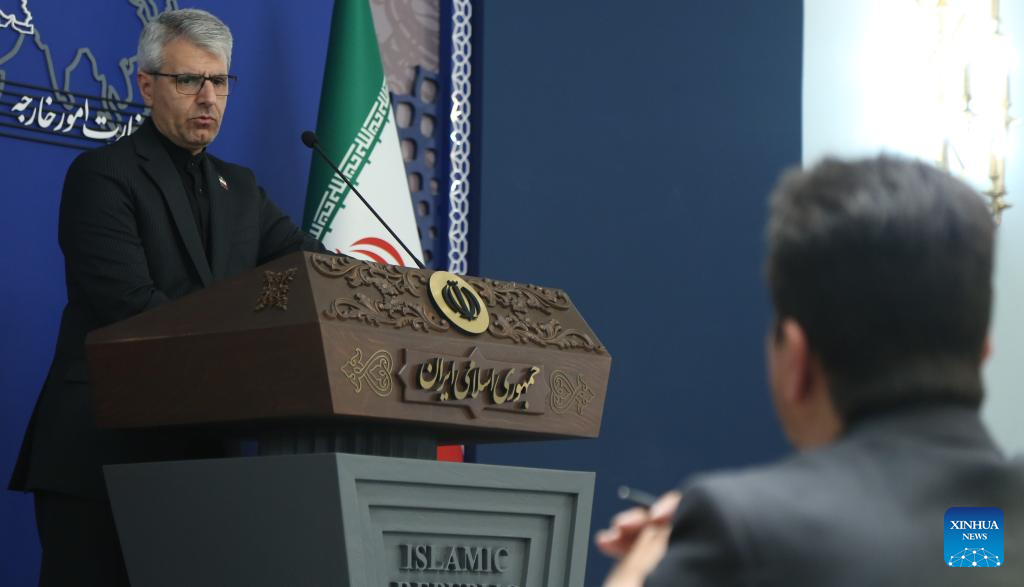
Iranian Foreign Ministry spokesman Esmaeil Baghaei speaks at a weekly press conference in Tehran, Iran, on March 30, 2026. (Xinhua/Shadati)
TEHRAN, March 30 (Xinhua) -- Relevant Iranian institutes, including the parliament, are considering the country's withdrawal from the Non-Proliferation Treaty (NPT), the semi-official Tasnim news agency reported on Monday.
The report added the conclusion that there is no reason for Iran's remaining in the NPT is becoming certain in the country.
The report said under the NPT, the International Atomic Energy Agency (IAEA) must provide conditions to protect and support Iran's use of peaceful nuclear technology and the necessary instruments to that end, noting that there is no justification for remaining in the NPT when the IAEA "implicitly encourages the enemy to use nuclear weapons against Iranian (atomic) facilities, and the U.S.-Israeli enemy attacks the country's facilities without any obstruction or condemnation from the agency."
The report stressed that Iran's withdrawal does not constitute moving towards making nuclear weapons, but would be aimed at preventing the continuation of "espionage" by the United States and Israel under the guise of the IAEA's inspectors.
Commenting on Iran's potential pullout of the NPT at a weekly press conference on Monday, Foreign Ministry spokesman Esmaeil Baghaei said the country is still a member of the treaty and committed to its obligations under it.
He added Iran has never sought to develop nuclear weapons and does not intend to do so, noting that the country's position on the prohibition of making weapons of mass destruction is clear.
Baghaei said, however, Iran is considering the issue particularly owing to the IAEA's "highly unfair" approach and the "destructive" behavior of the United States and some of the agency's member states that have oppressed Tehran's rights over the past years.
On Feb. 28, Israel and the United States launched joint attacks on Tehran and several other Iranian cities, killing Iran's then Supreme Leader Ali Khamenei, along with senior military commanders and civilians. Iran responded by launching waves of missile and drone strikes targeting Israel and U.S. bases and assets in the Middle East.
The United States and Israel have targeted several nuclear facilities in Iran since the war's beginning. ■


