
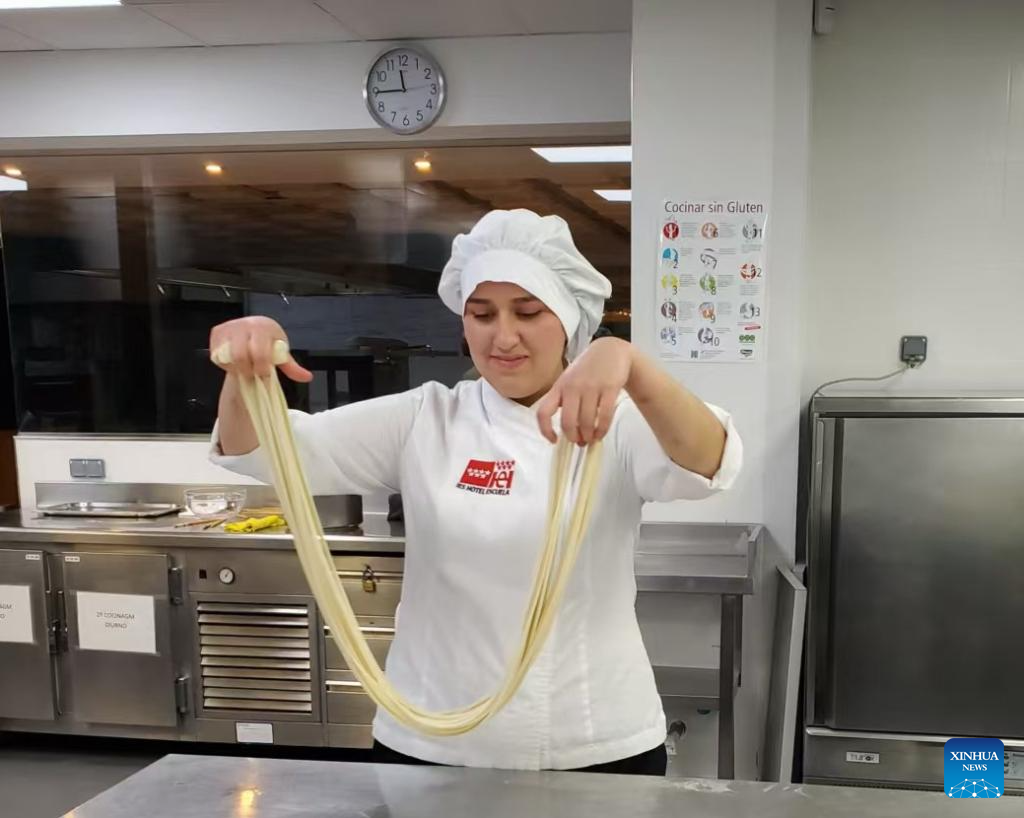
A local vocational student of an international Lamian beef noodle chef training program practises making beef noodles at the I.E.S. Hotel Escuela in Madrid, Spain, in January 2026. (Lanzhou Resource and Environment Vocational and Technical University/Handout via Xinhua)
LANZHOU, March 30 (Xinhua) -- With swift and practiced hands, 42-year-old Peng Jingjing twisted, stretched and folded dough into slender strands before a dozen students at the I.E.S. Hotel Escuela in Madrid, bringing the art of hand-pulled noodles to life.
An associate professor at Lanzhou Resource and Environment Vocational and Technical University in northwest China's Gansu Province, Peng has been teaching the art of Lamian noodle making for nearly two years, and earlier this year she taught in Spain for the first time.
In China, the wide variety of noodles is among the finest expressions of its culinary heritage, with traditional Lamian noodles, or hand-pulled noodles, serving as a signature specialty of Lanzhou. The growth of the Lamian noodle industry has provided local people with a pathway to poverty alleviation and economic prosperity.
The Lamian noodle-making technique is recognized as a national intangible cultural heritage. For many years, however, the skill was passed down mainly through traditional master-apprentice relationships, without formal professional standards.
In recent years, as Chinese culture has gained increasing global appeal, noodles have attracted a growing international following. In response, Lanzhou has strengthened support for vocational training institutions, offering structured courses that cultivate skilled Lamian noodle makers. Today, opportunities to learn the art of hand-pulled noodles in Lanzhou are becoming increasingly professional and systematic.
Since the launch of the Belt and Road Initiative, more Lamian noodle makers have sought new business opportunities outside China. By 2025, the total number of Lamian noodle restaurants -- both domestically and abroad -- had reached 71,000, according to the Gansu Provincial Department of Commerce.
To better support the overseas expansion of the Lamian noodle industry, Lanzhou Resource and Environment Vocational and Technical University established a talent training base in Barcelona last year. The university also launched an international Lamian beef noodle chef training program for local vocational students, benchmarked against the standards of UK NARIC, the National Recognition Information Center for Britain.
As the university's first instructor dispatched to Spain, Peng began coordinating with the faculty of I.E.S. Hotel Escuela months in advance. She also prepared Spanish-language teaching materials to ensure local students could fully engage with the program.
The three-day course in January combined both theoretical lessons and hands-on practice. At the end of the program, every student took a qualification test, with successful participants earning credit points officially recognized by their institution.
During the course, students were amazed by the skill of transforming dough into hair-thin noodles and intrigued by the use of traditional Chinese medicinal ingredients in the broth.
"Although we cannot speak each other's language, we communicated smoothly using translation tools," Peng said, adding that they told her how much they enjoyed the course and hoped she would teach them every day.
The training also attracted representatives from a local Lamian noodle restaurant to engage with the program.
Months after the training, Peng continued to receive photos from her students in Spain, proudly showing the Lamian noodles they had made. Some even emailed her to ask how to incorporate noodle-making techniques into local Spanish dishes.
For Peng, the noodles are more than just food; they represent a gateway to Chinese culture.
"I believe that more overseas diners would fall in love with Lamian noodles in the future and become interested in the skills," she said. ■
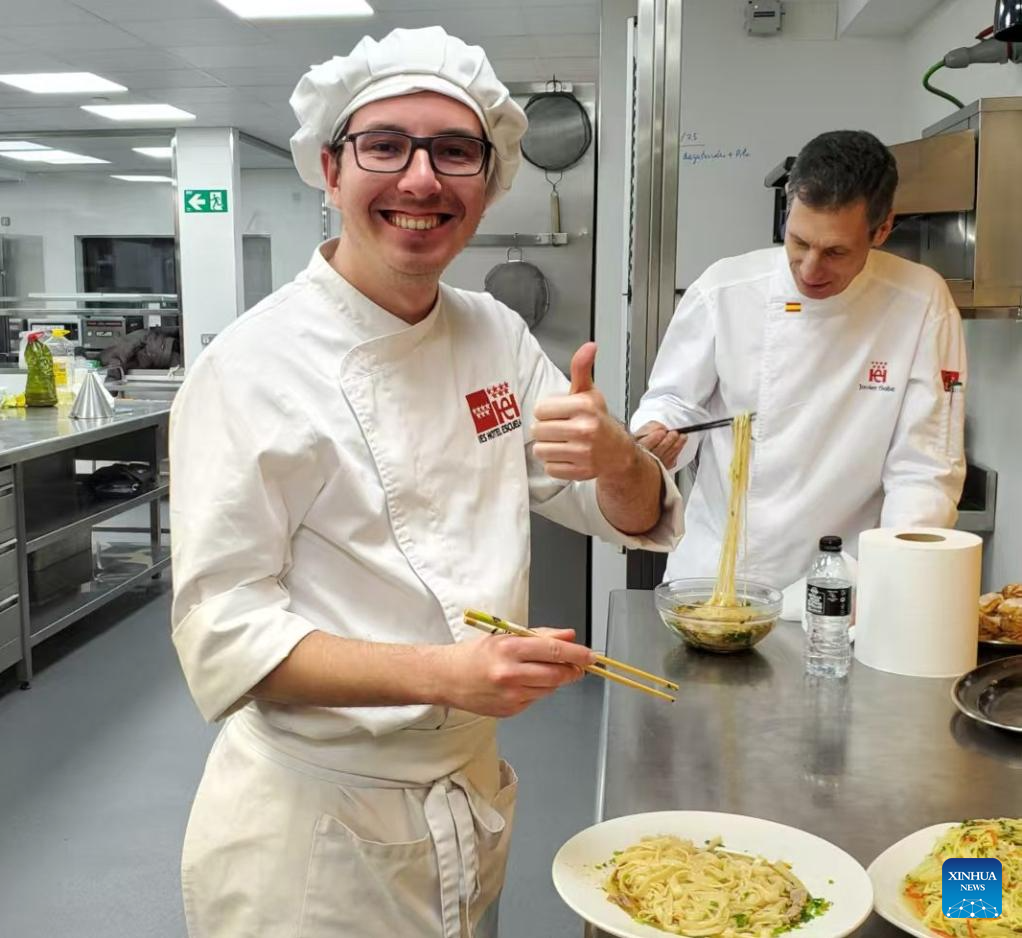
Local vocational students of an international Lamian beef noodle chef training program taste their handmade beef noodles at the I.E.S. Hotel Escuela in Madrid, Spain, in January 2026. (Lanzhou Resource and Environment Vocational and Technical University/Handout via Xinhua)
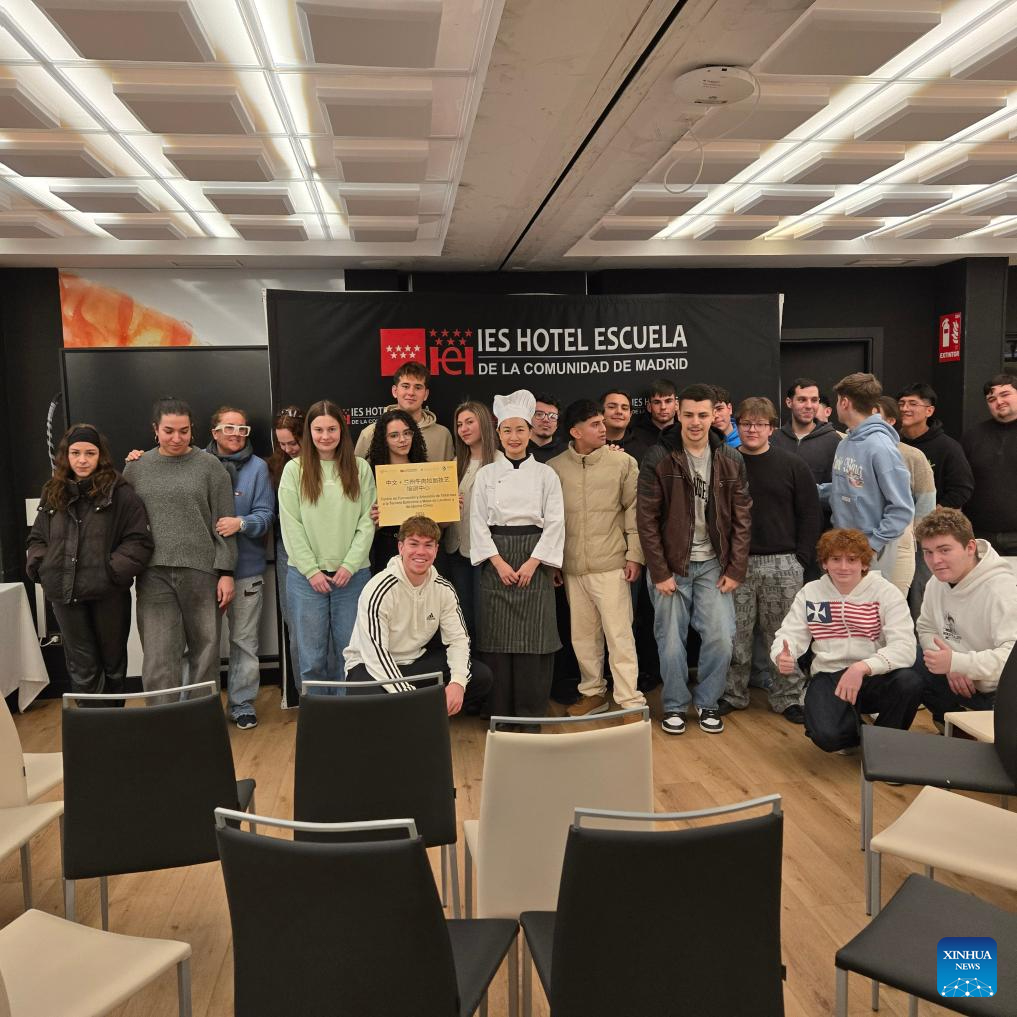
Local vocational students of an international Lamian beef noodle chef training program pose for a group photo with an instructor at the I.E.S. Hotel Escuela in Madrid, Spain, in January 2026. (Lanzhou Resource and Environment Vocational and Technical University/Handout via Xinhua)


