
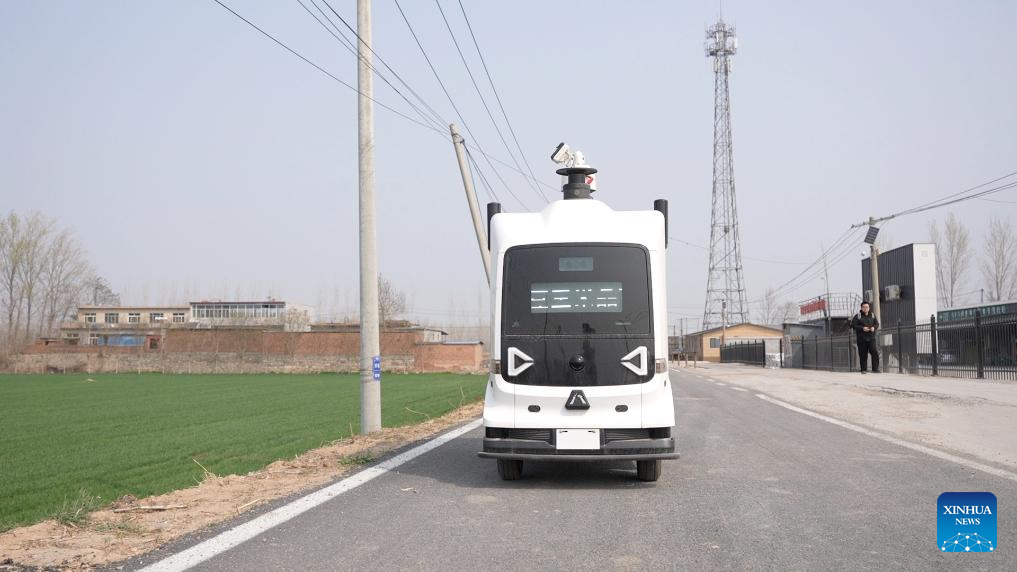
This photo taken on March 24, 2026 shows a robot patrolling the field of Zhang Tong's farm in Jinan, east China's Shandong Province.(Xinhua/Wu Feizuo)
JINAN, March 26 (Xinhua) -- Zhang Tong, 36, oversees a sprawling family farm by the Yellow River in east China's Shandong Province, inheriting his father's dark complexion but none of the rough hands or stooped posture of a traditional Chinese farmer.
As the spring breeze stirs, he strolls to the edge of the 300-hectare field and launches a sleek silver drone to map plots, chart spraying routes and scan from above to check whether the wheat lacks water.
In the field, snake-like pipes that have been prearranged deliver water and fertilizer directly to the roots and cut water use by nearly 30 percent, said Zhang, comparing the pipes to fine blood vessels of the human body.
Zhang's farm is part of a transforming agricultural landscape, powered by advances in machinery, information technology and AI. For a nation feeding 1.4 billion people amid climate volatility and limited resources, the message from the fields is clear that the future of Chinese agriculture is becoming increasingly autonomous and precise.
Having grown up in the river plains, Zhang watched his grandfather and father toil with hoes and carry heavy hoses to water their wheat fields. When he began his own farming career in 2019 in his hometown of Changqing District, Jinan, capital of Shandong, he entered a very different world, one that was highly mechanized and technology-driven.
"I was warned that if you didn't study hard, you'd end up working in the fields. Now, on the contrary, I need to be well-educated to be able to work in the field," he chuckled.
The Zhang family has dozens of machines. Last November, intelligent seeders planted the entire area in a month, maintaining uniform depth and sending automatic alerts for seed shortages. A fertilizer blender tailors prescriptions based on soil tests. Unmanned scout vehicles monitor for pests and crop stress, while driverless harvesters stand ready to collect the wheat in June. The extensive use of machinery has significantly boosted annual wheat yields to 3,000 tonnes.
In China's southern provinces, rice seedlings are being nurtured in climate-controlled facilities. Across the north, winter wheat, including that on Zhang's farm, is in full green-up. China's centuries-old ritual of spring plowing or farming, once defined by oxen, wooden plows and back-breaking labor, is rapidly transforming into a high-tech process guided by drones, robots and machines.
Zhang knows how to operate most of the machinery and is researching customized seeders suited to the local land. "The seeders need to account for the fact that this wheat field will be harvested in early June and then swiftly make way for corn and soybeans," he said. His farm is also an innovation base for soybean-corn intercropping.
Feng Lingyang, a researcher at the Institute of Advanced Agricultural Sciences, Peking University, assists the farmers. "We are using computer vision and machine learning, as well as gene editing, to identify shade-tolerant and high-density-tolerant genes, with the aim of further increasing soybean yields," Feng said. Data show that this approach has generated fresh revenue streams for farmers.
Last year, China's grain output hit a record 715 million tonnes. The outline of the 15th Five-Year Plan (2026-2030) calls for raising comprehensive grain production capacity to about 725 million tonnes by 2030. It stresses stabilizing rice and wheat production while boosting corn and soybean capacity. Achieving this goal will require technology to play a central role in safeguarding the country's food security.
On an even bigger farm north of Zhang's, more than 500 sensors monitor a 660-hectare area for temperature, soil moisture and wind. The land has been made into a demonstration zone showcasing measures that boost yields and reduce losses.
Yu Long, general manager of Jinan Chengfa Agricultural Technology Co. Ltd., which manages the farm, said the aim is to reduce grain loss by 5 percent, raise the yield by 15 percent, while substantially cutting the use of fertilizers and pesticides.
"We are preparing water-saving sprinkler systems and will also bring in even larger harvesters to minimize grain loss," he said. ■


