
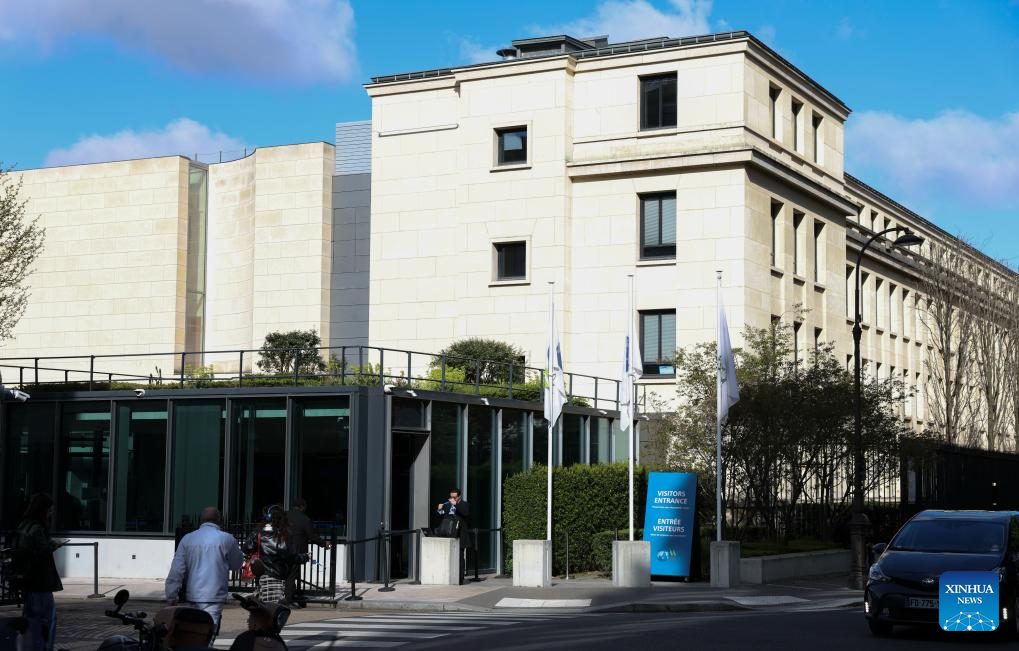
This photo taken on March 26, 2026 shows an exterior view of the headquarters of the Organization for Economic Cooperation and Development (OECD) in Paris, France. Global economic growth is projected to ease to 2.9 percent in 2026 from 3.3 percent in 2025, before edging up to 3.0 percent in 2027, the OECD said in its latest Economic Outlook on Thursday. The report said that the evolving conflict in the Middle East will test the resilience of the global economy. A prolonged period of higher energy prices would add markedly to business costs, raise consumer price inflation, and have adverse consequences for growth. (Xinhua/Wu Huiwo)
PARIS, March 26 (Xinhua) -- Global economic growth is projected to ease to 2.9 percent in 2026 from 3.3 percent in 2025, before edging up to 3.0 percent in 2027, the Organization for Economic Cooperation and Development (OECD) said in its latest Economic Outlook on Thursday.
The report said that the evolving conflict in the Middle East will test the resilience of the global economy. A prolonged period of higher energy prices would add markedly to business costs, raise consumer price inflation, and have adverse consequences for growth.
Prior to the conflict's escalation, global growth remained resilient due to strong AI-related investment and production as well as favourable fiscal conditions, the report said. Following the fighting in the Middle East, surging energy prices and heightened uncertainty have raised costs and dampened demand, offsetting earlier growth momentum, it added.
According to the report, economic growth in the United States will moderate from 2.0 percent in 2026 to 1.7 percent in 2027, as strong AI-related investment is gradually offset by a slowdown in real income growth and consumer spending. In the euro area, economic growth is expected to ease to 0.8 percent in 2026, as higher energy prices weigh on activity, before rising to 1.2 percent in 2027, supported by stronger defense spending.
On inflation, G20 inflation is projected to be 1.2 percentage points higher than previously expected in 2026, at 4.0 percent, before easing to 2.7 percent in 2027 as energy price pressures fade. Core inflation in G20 advanced economies is expected to decline from 2.6 percent in 2026 to 2.3 percent in 2027.
The report said that the global economic outlook remains highly uncertain. The projections were based on the assumption that current disruptions to global energy supply will gradually moderate from mid-2026 onwards. Persistent disruptions to exports from the Middle East could push energy prices even higher, aggravate shortages of key commodities, add to inflation, and reduce growth.
The OECD called for policy vigilance. Central banks should ensure inflation expectations remain well anchored and adjust policy if needed. Governments are urged to provide targeted support to vulnerable households and viable firms, safeguard debt sustainability, and improve fiscal efficiency.
It also stressed the need for stronger financial oversight, reduced trade tensions, and the avoidance of new export restrictions. Over the medium term, improving energy efficiency and reducing reliance on imported fossil fuels should be prioritised. ■

This photo taken on March 26, 2026 shows an exterior view of the headquarters of the Organization for Economic Cooperation and Development (OECD) in Paris, France. Global economic growth is projected to ease to 2.9 percent in 2026 from 3.3 percent in 2025, before edging up to 3.0 percent in 2027, the OECD said in its latest Economic Outlook on Thursday.
The report said that the evolving conflict in the Middle East will test the resilience of the global economy. A prolonged period of higher energy prices would add markedly to business costs, raise consumer price inflation, and have adverse consequences for growth. (Xinhua/Wu Huiwo)


