
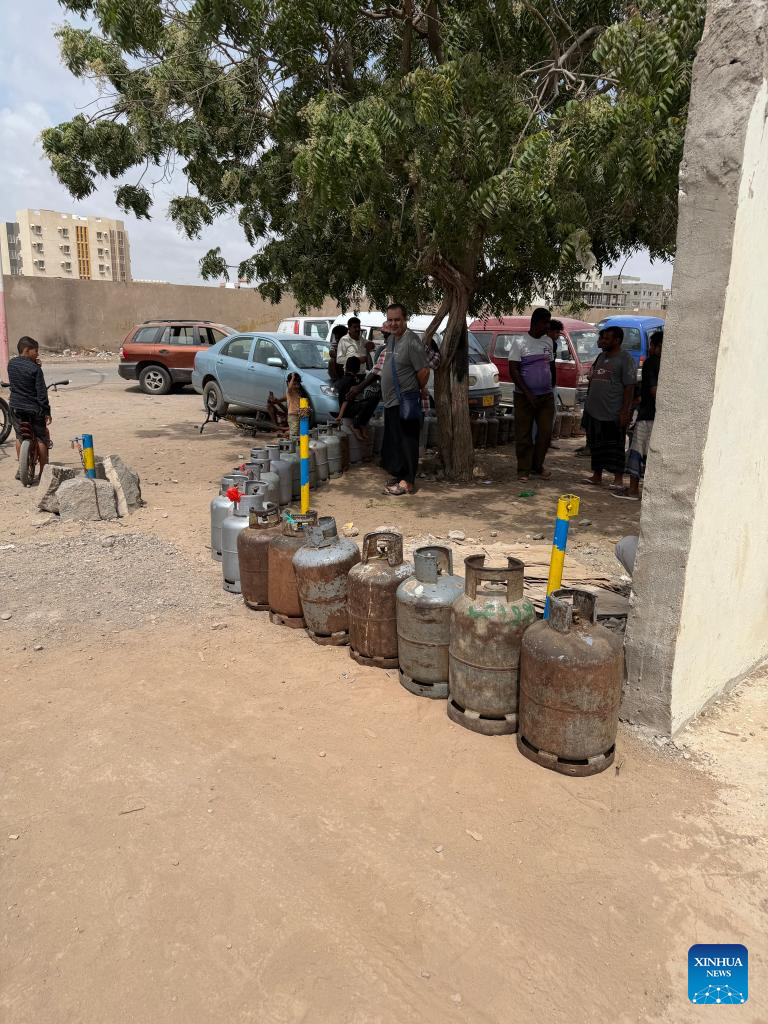
Photo taken by cellphone shows people gathering beside rows of empty gas cylinders while waiting to refill them in the southern port city of Aden, Yemen, March 24, 2026. A fresh rise in prices of essential goods and services is deepening economic hardship in war-ravaged Yemen, as households face mounting costs stemming from supply disruptions, higher import expenses and recent policy adjustments affecting key commodities. (Photo by Murad/Xinhua)
ADEN, Yemen, March 24 (Xinhua) -- A fresh rise in prices of essential goods and services is deepening economic hardship in war-ravaged Yemen, as households face mounting costs stemming from supply disruptions, higher import expenses and recent policy adjustments affecting key commodities.
In the country's government-controlled southern provinces, residents report a surge in the cost of living in recent weeks, extending beyond food to include transportation, dining and basic household needs. The increases come at a time when many families are already grappling with limited incomes and prolonged economic instability.
"Prices are rising on multiple sectors at once," said Bashir Ali, a resident in Aden. "It is no longer just about food -- everything connected to daily life is becoming more expensive here."
A notable development is a recent adjustment to cooking gas prices, a staple for local households. The shift has coincided with the long queues at gas distribution points in Aden.
Under a newly issued government directive, the price of a gas cylinder has been set at 12,000 Yemeni riyals (nearly 8 U.S. dollars), a 33-percent increase from the previous rate of 9,000 riyals.
The adjustment is expected to have a ripple effect on household expenses, particularly for low-income Yemeni families.
Local traders say the cumulative impact of higher fuel-related costs, including cooking gas, is likely to drive up broader market prices. "When energy costs go up, it affects transportation, storage and production," Ahmed Al-Haddy, a gas station owner in Aden noted. "This eventually pushes up prices for consumers."
The surging costs are a reflection of external factors, including rising global energy prices and ongoing disruptions to maritime routes. Increased shipping costs and insurance premiums, driven by heightened regional tensions, have added further pressure to import-dependent markets.
Some Yemeni people say the price hikes have been both sudden and severe. Khalid Jalal, a Yemeni citizen in his 40s, described the recent increases as "shocking and unexpected," noting that the escalation of regional conflict has had an immediate impact on daily living costs.
"People here are always the ones who pay the price," Jalal said. "Whether it is internal conflict or external crises, it is the ordinary citizen who suffers the most."
Travel expenses have also been affected. "Moving between cities or returning from abroad like Saudi Arabia now costs much more than before," said Mustafa Al-Kapy, highlighting the broader strain on mobility and trade.
Despite growing public concerns, official government statements have largely focused on ensuring the stability of supply, with authorities frequently emphasizing the availability of goods and calling for stricter market oversight. However, the underlying causes of the price increases have remained unaddressed, local residents said.
"There is no clear horizon yet for de-escalation, and the longer the regional conflict persists, the deeper its economic impact will be," Nabil Kasim, a local economic researcher noted. "For countries like Yemen, which depend heavily on imports, even minor disruptions in maritime trade can trigger sharp increases in prices and worsen living conditions."
According to recent assessments by the World Food Programme, Yemen continues to face a worsening food security crisis as it enters 2026.
January data show that about 63 percent of Yemeni households are unable to meet their minimum food needs, while 36 percent are suffering severe food deprivation. ■
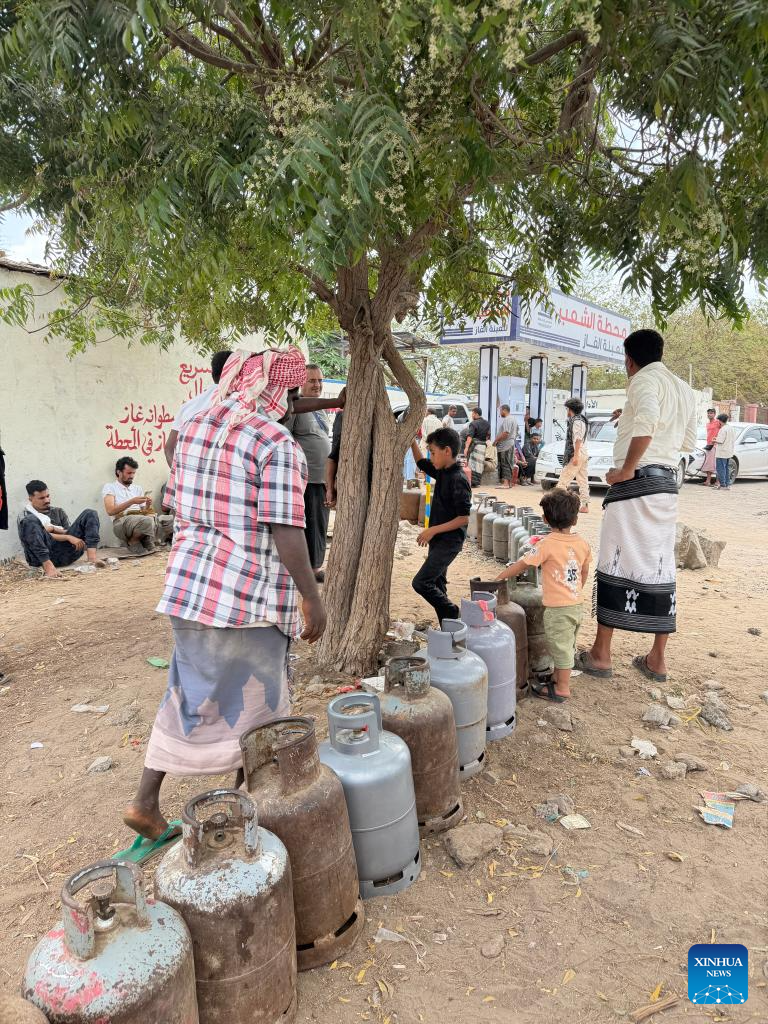
Photo taken by cellphone shows residents standing near lines of cooking gas cylinders under a tree as they await refills in the southern port city of Aden, Yemen, March 24, 2026. A fresh rise in prices of essential goods and services is deepening economic hardship in war-ravaged Yemen, as households face mounting costs stemming from supply disruptions, higher import expenses and recent policy adjustments affecting key commodities. (Photo by Murad/Xinhua)
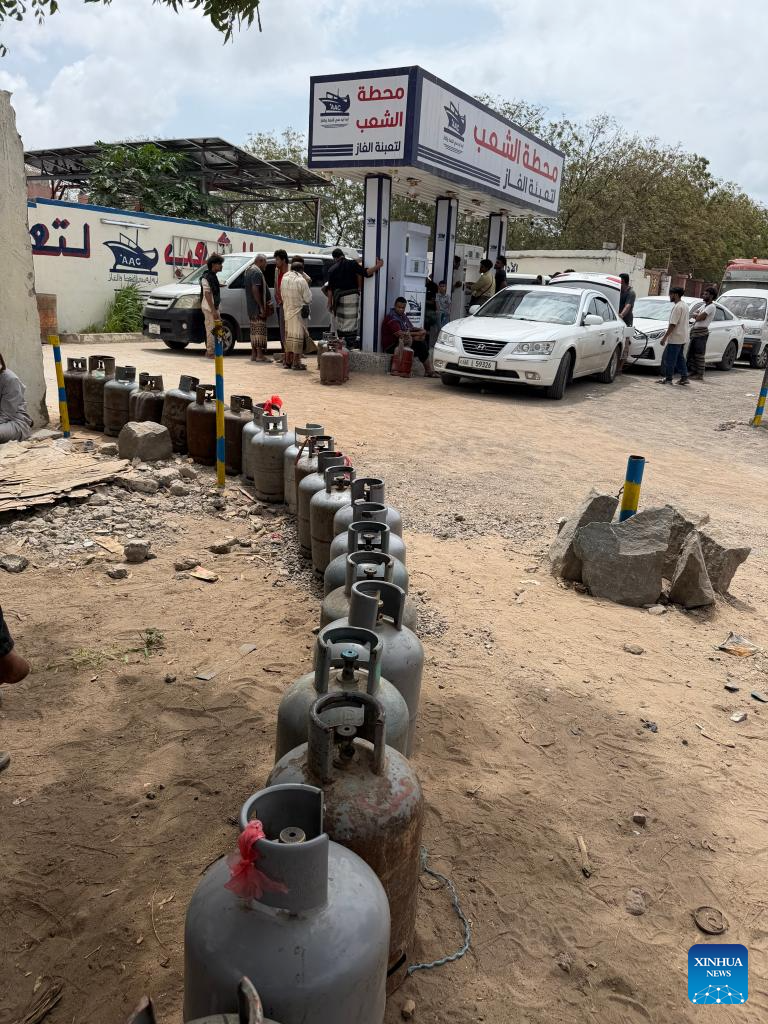
Photo taken by cellphone shows vehicles and residents queuing at a gas filling station as shortages persist in the southern port city of Aden, Yemen, March 24, 2026. A fresh rise in prices of essential goods and services is deepening economic hardship in war-ravaged Yemen, as households face mounting costs stemming from supply disruptions, higher import expenses and recent policy adjustments affecting key commodities. (Photo by Murad/Xinhua)


