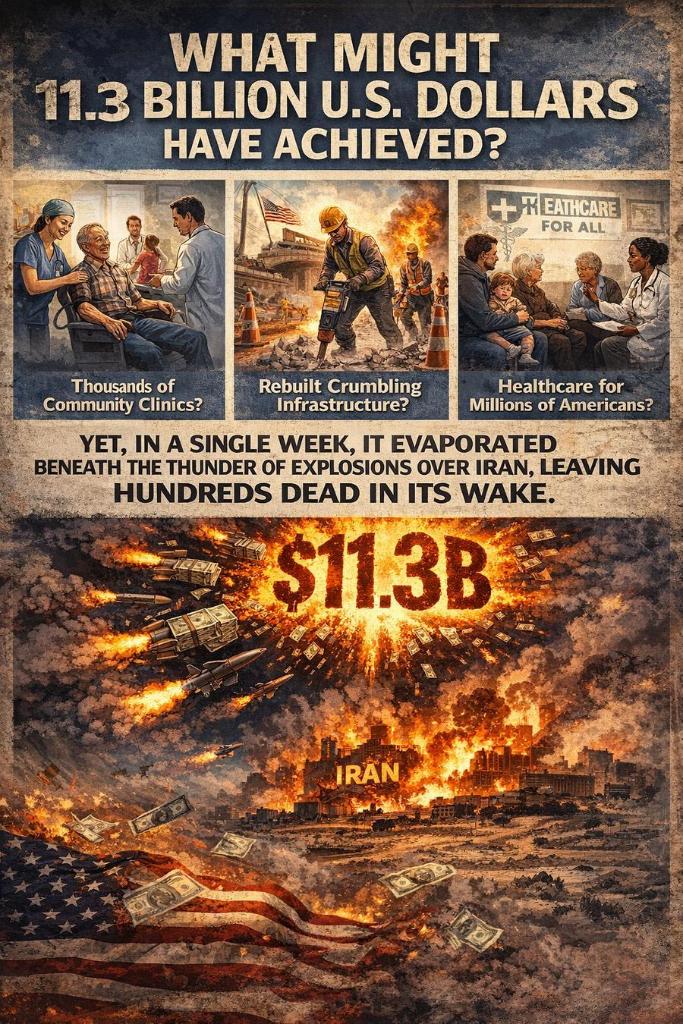
Pentagon officials revealed that the initial six-day surge of the Iran campaign carried a price tag exceeding 11.3 billion dollars, reigniting debate not just over Washington's fiscal priorities, but the war's necessity itself
BEIJING, March 20 (Xinhua) -- What might 11.3 billion U.S. dollars have achieved? It could have funded thousands of community clinics, rebuilt crumbling infrastructure, or provided healthcare to millions of Americans. Yet, in a single week, it evaporated beneath the thunder of explosions over Iran, leaving hundreds dead in its wake.
The sum is the estimated cost of the first six days of the U.S. military campaign against Iran, according to Pentagon officials, who briefed Congress on the early stage of the operation.
The staggering cost has reignited debate not just over Washington's fiscal priorities, but the war's necessity itself. As expenses rise, critics are highlighting the domestic opportunity costs and questioning the rationale for this "war of choice," bringing the classic "guns or butter" dilemma back into sharp focus.
BILLIONS BURNED
In a briefing to Congress, Pentagon officials revealed that the initial six-day surge of the Iran campaign carried a price tag exceeding 11.3 billion dollars. Yet skepticism mounts among legislators who contend this is merely a down payment as the tally omits extensive logistics, force deployment, and long-term sustainment costs.
"I expect that the current total operating number is significantly above that," Democratic Senator Chris Coons has told reporters. "If all you're looking at is the replacement cost for the munitions used, it's already well beyond 10 billion dollars."
For instance, an estimated 400 Tomahawk cruise missiles were fired into Iranian skies in the first 72 hours of the operation, with each costing roughly 2.2 million dollars. That amounts to nearly 1 billion dollars sent up in smoke in just days.
Experts familiar with the Pentagon budget said the war is burning through between 1 billion and 2 billion dollars per day, or roughly 11,500 to 23,000 dollars per second.
Even such staggering sums may only be the beginning, as the Pentagon signals that additional funding will be needed to sustain the campaign. As multiple media outlets reported, the department is requesting an additional 200 billion dollars as military attacks on Iran ground through Day 20.
"That 12 billion dollar price tag is just the start. Nobody knows how long this war is going to go on. And the impacts on the economy are just getting started: higher grocery price, higher gas, higher electricity costs are all coming," noted Arwa Mahdawi in her commentary on theguardian.com.
PRIORITIES MISPLACED
The ballooning price tag has drawn nationwide scrutiny, with critics noting that the conflict's early costs alone are already comparable to the annual funding of major domestic priorities.
"While there is no money for 15 million Americans who lost their health care, there's a billion dollars a day to spend on bombing Iran," Senator Elizabeth Warren of Massachusetts told reporters after a classified briefing.
Such comments highlight a stark contrast between the rapid flow of funds to military operations and tightening budgets for domestic programs. Under the Donald Trump administration's 2026 budget proposal, non-defense discretionary spending would face deep cuts of an estimated 163 billion dollars, or 23 percent, from the 2025 enacted level, with science and health agencies among those hardest hit.
U.S. Congresswoman Diana DeGette echoed these concerns on social media, noting that the mounting war costs could have fully funded the training of 100,000 new nurses to address the country's staffing shortage. "Instead, it was spent in just six days on an illegal war with no endgame."
Beyond healthcare, the sum could have reshaped other domestic priorities. A TIME analysis found that roughly 12 billion dollars -- close to the early war costs -- could fund a full year of food assistance for about 5.5 million Americans, support housing assistance for 800,000 to 1.5 million low-income households, or finance universal pre-K education for roughly 900,000 children. The same amount could also keep the National Park Service operating for more than three years across more than 400 parks and public lands.
"This just shows a disturbing prioritization of militarism over the health and welfare of the American public," Adam Gaffney, a professor at Harvard Medical School, told the Guardian, a British daily.
"With that money, we could be doubling public health expenditures or doubling environmental protections ensuring that Americans have clean air and water. We could bring healthcare to millions of Americans. Instead, we are putting that money into a war of choice," Gaffney said.
WAR OF CHOICE
At the heart of Gaffney's criticism lies a deeper, more troubling inquiry: Were the attacks on Iran an absolute necessity, or simply a war of choice?
Joe Kent, director of the U.S. National Counterterrorism Center, announced on social media Tuesday his decision to resign from his position, noting that he "cannot in good conscience support the ongoing war in Iran."
In his letter to Trump, Kent said that he cannot support sending the next generation off to "fight and die in a war that serves no benefit to the American people nor justifies the cost of American lives."
As an article on online forum Just Security argued, "The fundamental problem with any attempt to justify Operation Epic Fury on the basis of self-defense is that the U.S. attack was unnecessary. Far from being a war of necessity ... An unnecessary use of force is an unlawful use of force."
As early as the war broke out, Richard Haass, president emeritus of the Council on Foreign Relations, said in an article that "this is a war of choice" as the United States had other policy options available.
"Iran posed no imminent threat to vital U.S. interests. Iran was not on the verge of becoming a nuclear weapons state or using what weapons it did have against the United States," he wrote, adding that last year's cost-free bombing of three Iranian nuclear sites and the more recent intervention in Venezuela may made Trump and those around him highly confident that they could achieve ambitious ends with limited means at a low cost.
However, he warned: "While it takes only one side to begin a war, it takes two to end it. And Iran now has a vote in how big this conflict becomes and how long it continues."■