BEIJING, March 18 (Xinhua) -- With China's new five-year blueprint ushering in fresh commercial opportunities driven by tech innovation and industrial upgrading, foreign capital is repositioning for another wave of investment in the country's emerging sectors.
The outline of the 15th Five-Year Plan, released last week, urges steering foreign investment toward advanced manufacturing, modern services, high-tech industries, energy conservation and environmental protection, a move that forms part of the country's broader push to expand "high-standard opening up."
Just last Wednesday, U.S. pharmaceutical giant Eli Lilly unveiled plans to invest 3 billion U.S. dollars over the next decade to scale up its supply chain and manufacturing capacity in China, including the local large-scale production of an innovative oral drug.
Huzur Devletsah, Lilly vice president and China general manager, said the company will expand production capacity at its existing Suzhou facility in east China's Jiangsu Province, while also stepping up investment in Beijing to add oral solid dosage manufacturing capabilities.
Since the start of 2026, a growing number of multinationals have taken note of China's new emphasis on attracting foreign investment with higher technological added value.
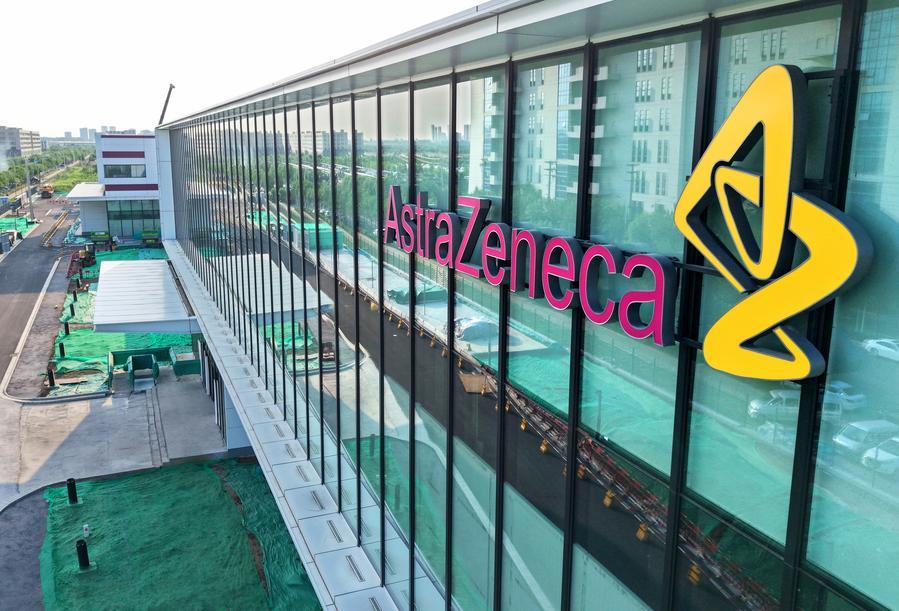
Among them, British drugmaker AstraZeneca has pledged to invest 15 billion U.S. dollars in the country through 2030 to expand its manufacturing and R&D facilities.
Over the past two years, Shanghai and Beijing have become home to AstraZeneca's two global strategic research hubs. Firms like Pfizer and Bayer, meanwhile, have also set up innovation facilities in China.
Now, the call to "vigorously attract foreign companies to establish regional headquarters and innovation centers in China" has been written into the nation's five-year plan.
China's biopharmaceutical sector particularly stands out as it transitions from a "follower" to a "source" of innovation, Zhou Xiaolan, executive vice president, Pharmaceuticals Division, Bayer AG, told Xinhua. Bayer is set to invest 750 million yuan (about 109 million U.S. dollars) in rolling out a new project in Qidong, eastern China, in 2028.
"Investing for patients in China is also investing in innovation, manufacturing and the export of these medicines to the rest of the world," said AstraZeneca CEO Pascal Soriot. Official data shows that China's innovative drug outbound licensing deals exceeded 130 billion U.S. dollars in total value in 2025, hitting a record high.
Betting on China's tech sector extends well beyond biopharma. Republic of Korea semiconductor equipment maker STI signed an agreement in February to build a power semiconductor smart manufacturing base in the country's southern tech hub of Guangzhou. The ceramic substrates produced there will be used in new energy vehicles and smart grids, with operations expected to begin by year-end.
Notably, an international tire giant has already put a tech-intensive factory floor into operation to ride the wave of China's tech shift. In January, the Michelin Group inaugurated its first global "future factory" in Shanghai, with a total project investment of 3 billion yuan. The new plant features advanced, flexible production systems designed to serve China's expanding new energy vehicle market.
RECALIBRATING RATHER THAN RETREATING
Official data from China's Ministry of Commerce reveals that 70,392 foreign-invested enterprises were newly established nationwide in 2025, up 19.1 percent year on year. This momentum has carried into 2026, with 5,306 new foreign-funded firms set up in January alone, marking a 25.5-percent surge from a year earlier.
Growth was particularly pronounced in high-tech sectors, as the actual foreign capital used in R&D and design services skyrocketed 175.1 percent in the first month of 2026 compared with a year earlier.
Amid headwinds fanned by sluggish global investment and complex geopolitics, China's actual foreign capital inflows have contracted in tandem. Yet, beneath this volatile surface lies a robust structural transformation: high-tech investment in the country is picking up, which signals a pivot away from labor-intensive manufacturing toward high-value R&D, with more small foreign firms and startups accelerating entry into China.
China is seeing "a transition from 'growth at all costs' to 'industrial upgrading,'" and its focus is "no longer just on attracting capital, but on integrating foreign technology into China's new quality productive forces," said Shirley Yinghua Shen, Greater China tax policy leader of Ernst & Young (China) Advisory Limited.
"With the 15th Five-Year Plan officially commencing, the investment community is looking for strategic continuity," Shen added.
Jiang Liqin, a managing partner at KPMG China, told Xinhua that amid undercurrents of "deglobalization," China's embrace of high-standard opening up serves not only as a strategic choice to navigate risks but also as a core driver for high-quality economic growth.
China's Commerce Minister Wang Wentao said at a press conference earlier this month that China is not just a market where foreign firms turn a profit, but also a "gym" where they come to build strength through fair competition with domestic players.
This has been echoed by Denis Depoux, global managing director of Roland Berger, who sees China no longer as just a large market, but "increasingly a critical arena for sharpening global competitiveness."
The new five-year roadmap also pledges greater convenience for foreign capital to conduct equity and venture capital investment in China, making it easier for them to tap into the country's capital markets.
Last Friday, the brain-computer interface startup StairMed completed a 500 million yuan strategic round, partly backed by LAV, a corporate venture subsidiary of Eli Lilly, as the Shanghai firm prepares for trials this year of its 256-channel wireless implantable system -- a technology now designated a future industry in China's government work report.
Over the past few months, capital giants including JPMorgan, UBS and BlackRock have been steadily increasing their holdings in Chinese tech stocks through global capital markets.
"Chinese companies are demonstrating dynamic innovation in artificial intelligence, high-end manufacturing, semiconductors, and new energy -- reshaping global investors' perception of Chinese assets," said Janice Hu, chairperson of UBS Securities.
More global investors are recognizing that as China's five-year blueprint unfolds, the question is no longer whether to be in China, but how deeply and quickly to integrate into and benefit from its innovation ecosystem. ■