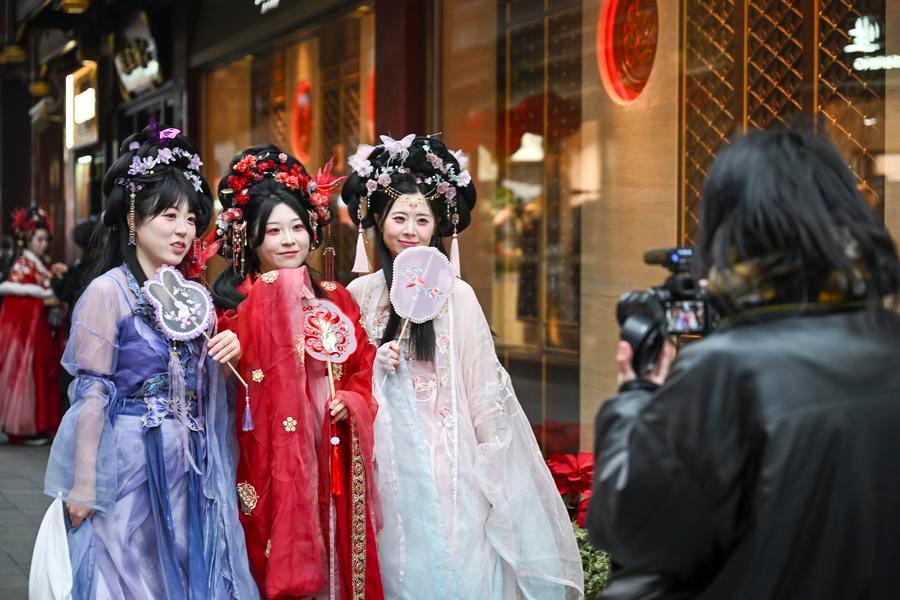
JINAN, March 13 (Xinhua) -- At 6:30 a.m., while most villagers are still in their slumber, a two-story building bursts into life with the rhythmic sound of sewing machines humming through the windows. Wei Ping'an stands among rows of dresses illuminated by the soft morning sunlight, ready for another busy day.
Wei is general manager of the Zhichunhe Clothing Co., Ltd. in the Ancailou Township of Caoxian County, east China's Shandong Province. The Hanfu garments produced here are to be worn not only by people across China but also by enthusiasts in countries like Malaysia. "These dresses are more than just clothing; they are carriers of Chinese culture," Wei said when discussing his products.
Hanfu, the traditional clothing of China embellished with intricate embroidery, can be traced back to the Han Dynasty (202 B.C.-220 A.D.). It has evolved throughout history, resulting in a diverse array of designs seen in different Chinese cities today.
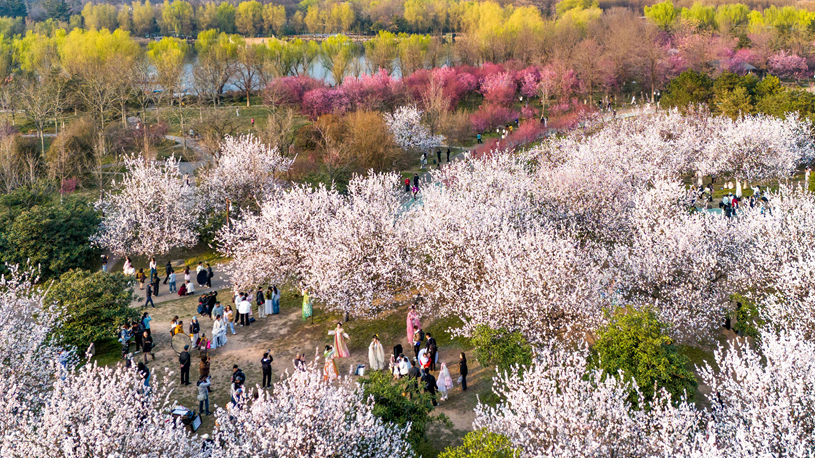
In recent years, it's made a big comeback, thanks to a surge of interest in traditional culture among the younger crowd and its rising popularity on social media. In China, about half of the Hanfu dresses are produced in Caoxian.
HOMETOWN OF HANFU
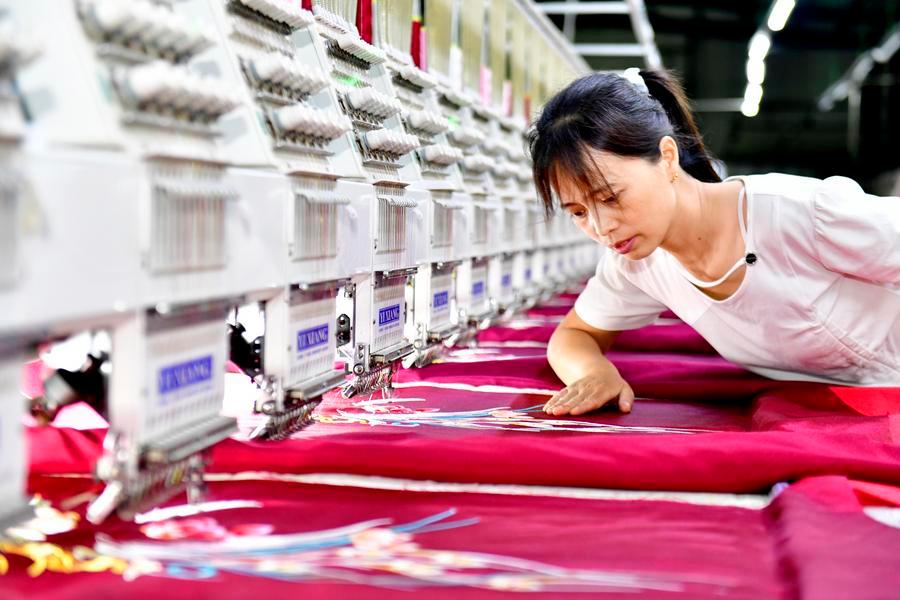
Caoxian's journey with Hanfu began nearly two decades ago when a handful of villagers started crafting Hanfu costumes for photo studios and live performances. With the advent of e-commerce in China, local Hanfu makers seized the opportunity to open online stores, and to their delight, they encountered a robust demand for their creations.
Seven years ago, Wei, who was then working nearly 300 kilometers away operating machine tools, was lured back to his hometown by the burgeoning industry.
During the day, he would reach out to fabric suppliers and prepare orders for shipment. At night, he dedicated himself to learning e-commerce operations, photo editing, and customer service skills. In his very first month, he sold over 30 sets of clothes. "I used to think that leaving home was the only path to success. But now, I've discovered that I can carve out a unique niche right here at my doorstep, one that we've woven stitch by stitch," he told Xinhua.
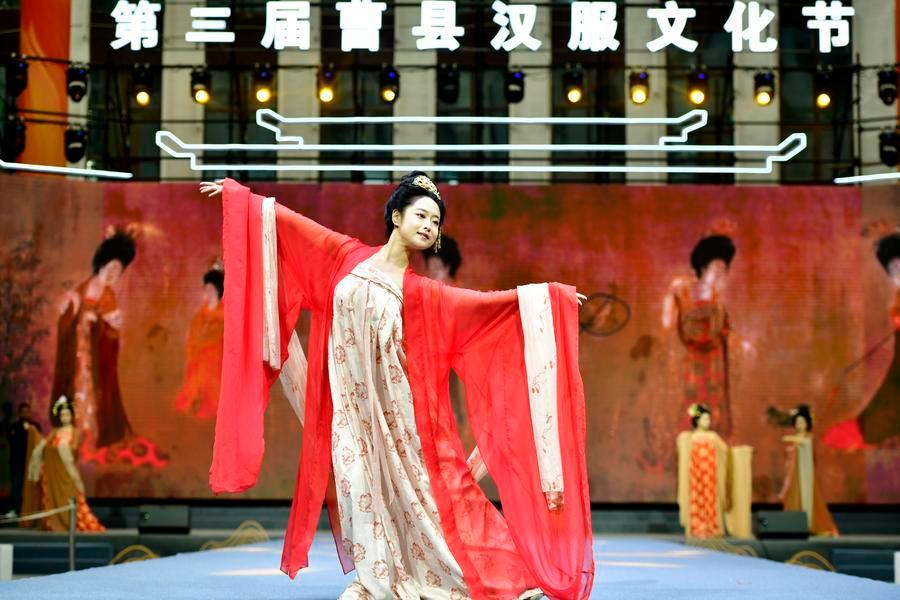
In 2023, the Hanfu industry in Caoxian really took off, and the horse-faced skirt -- a unique Hanfu style with its high, flat front and pleated sides -- became super popular in the year that followed. Customers from across China waited outside the factories to purchase the products. During the Spring Festival holiday alone that year, the sales of horse-faced skirts exceeded 300 million yuan (about 43.6 million U.S. dollars).
Today, Caoxian, with a population exceeding 1.7 million, is home to over 2,800 Hanfu businesses, engaging nearly 100,000 people directly. The county's combined annual online and offline Hanfu sales in 2025 exceeded 13 billion yuan. From designing to cutting and pattern making, embroidery and printing, the county has a complete industrial chain coverage within a radius of 5 kilometers.
However, the booming market also presents challenges, with innovation emerging as the key to sustained success.
Luoruyan, a designer brand where a single dress can sell for thousands of yuan, has jumped on this trend. In 2024, it launched its "fragrant Hanfu" line, incorporating fibers from flowers such as peony, rose and lotus blossom into the fabric. It also released horse-faced skirts with light colors, which buyers could wear in their daily life.
"We would like to find a way to inject modern fashion into traditional Hanfu," said Yao Chixing, founder of the brand. "Some of our products can be worn even when you go to work."
The brand has also collaborated with universities to develop an antique-style brocade weaving technique in an attempt to successfully restore traditional patterns with over 90 percent accuracy. They've also launched an "AI+ Hanfu" intelligent design system that has already produced over a thousand unique patterns using advanced algorithms.
GOING GLOBAL
In recent years, China has eased its visa policy, making it easier for tourists from abroad to visit. In 2025, the number of inbound and outbound travels by foreign nationals surpassed 82 million, up by 26.4 percent year on year. The Hanfu craze has transcended national boundaries, captivating hearts worldwide.
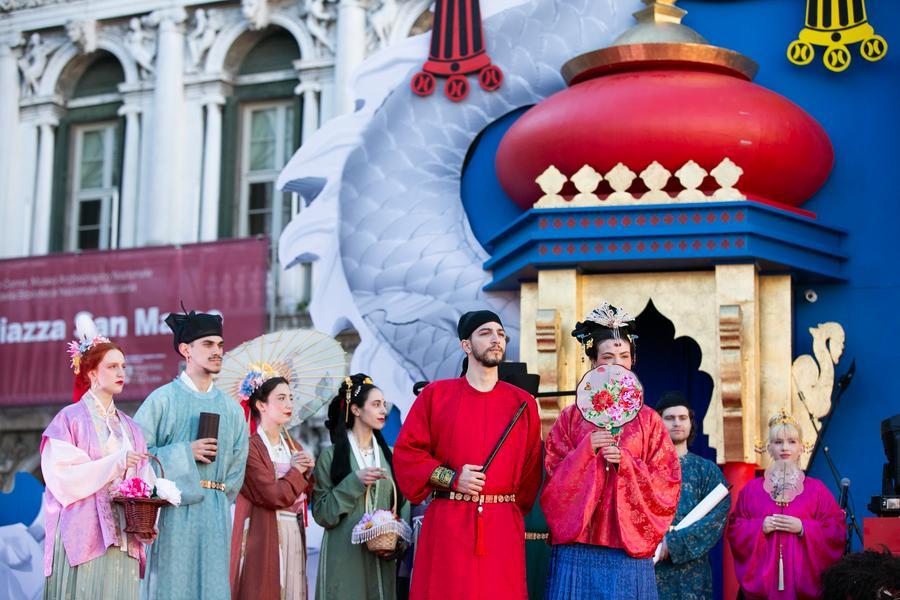
From the streets of Paris and Rome to the parks of Kuala Lumpur, the traditional Chinese attire has found a vibrant new life amidst the global celebrations of the Chinese New Year.
On Feb. 22, as dozens of individuals clad in the traditional garb of the Han Chinese paraded through the streets of Rome, it marked the third consecutive year that the event had drawn a sizable and enthusiastic crowd.
Chen Yifang, one of the organizers, told Xinhua that Hanfu now serves as a carrier of Chinese culture in Italy and the parade's growing popularity signals increasing recognition of Chinese traditions overseas.
"The enthusiasm for joining the parade is on the rise. Two months prior to the event, inquiries about this year's parade schedule had already begun flooding our social media group, which boasts over 250 members," Chen said.
On the lifestyle social media platform rednote, there are tons of posts featuring foreigners rocking Hanfu, highlighting their love for this traditional Chinese attire.
El Mousselly Maroua, a Moroccan woman in her 20s, often posts photos of herself wearing Hanfu on Instagram. "True cultural treasures can stand the test of time, and they can return to people's lives in more fashionable ways," she said, when explaining her love of the traditional Chinese attire.
According to Zhang Longfei, director of the Caoxian e-commerce service center, an average of approximately 50,000 sets of Hanfu are sold overseas each year, generating around 10 million U.S. dollars in revenue.
"In an era when China-chic is on the rise, Hanfu is not only a carrier of traditional Chinese culture, but also a name card of the country on the international fashion stage," said Cao Jiachang, president of the China Chamber of Commerce for Import and Export of Textiles.
During the Milan Fashion Week last September, Chinese fashion brand HEAVEN GAIA unveiled its Spring/Summer 2026 collection, incorporating elements inspired by traditional Hanfu. The brand has also presented its collections at Paris Fashion Week.
"The rise of Hanfu is by no means a simple restoration of the past," said Hu Chunqing, president of the Caoxian Hanfu association. "Instead, it represents an enhancement of the traditional clothing style, harmoniously blending it with contemporary life scenarios and traditional aesthetic sensibilities. This resurgence reflects the profound cultural confidence of the Chinese people." ■