
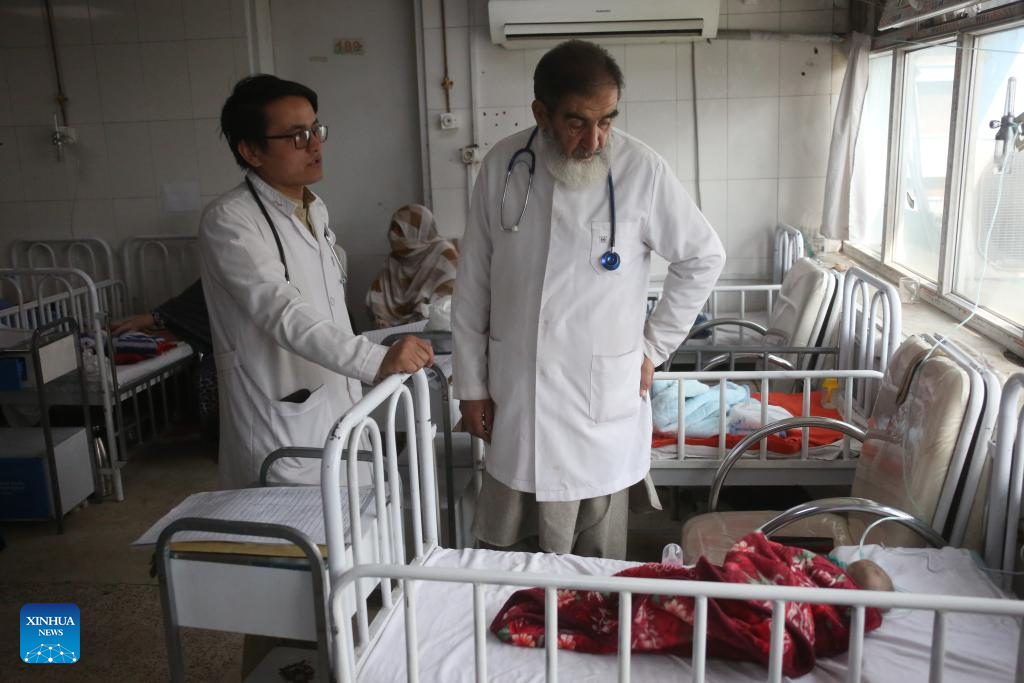
Doctors check on a malnourished child at the Indira Gandhi Institute of Child Health in Kabul, Afghanistan, March 4, 2026.(Photo by Saifurahman Safi/Xinhua)
KABUL, March 11 (Xinhua) -- In a pediatric ward in Afghanistan's Kabul, the room is quiet except for the soft cries of infants. Mothers sit beside narrow metal beds, gently rocking babies whose bodies are far smaller than they should be.
Some children are so thin that their arms seem almost weightless beneath the hospital sheets. Others look unusually swollen, their fragile bodies holding fluid where strength should be.
For more than three decades, Dr. Amir Ahmad Jalali has treated young patients in Kabul's main pediatric hospital. Over the years, he has witnessed countless children arrive in similar conditions, their bodies weakened not by a sudden illness, but by a slow and silent lack of nutrition.
He explained that severe child malnutrition often appears in three different forms.
"Some children arrive extremely thin and weak, their bodies reduced to skin and bone. Others appear swollen because their bodies retain fluid, a condition that can hide the seriousness of their illness. A third group shows a mixture of both signs, thin limbs combined with swelling in other parts of the body."
These forms of malnutrition can all be seen in the ward today, where doctors move from bed to bed, monitoring the fragile condition of their youngest patients.
Yet the hospital cannot accept every child who arrives.
"Only those in critical condition are admitted, while others receive medicine and advice before being sent home," Jalali said.
For the families here, these beds tell the story of children growing up in the shadow of hunger.
Sima, a 40-year-old woman from Baghlan province, sat quietly beside her grandchild, who lay weakly on a hospital bed.
Sima works as a cleaner and earns just enough to help support her family. She said the problem began long before the baby was born.
"I did not have money to provide proper food for the mother, and because of this lack of food and weakness, the child became very weak," she said.
The mother's poor nutrition eventually affected the baby. When the child first became sick, the family could not afford to seek treatment. For nearly two months, the infant remained at home without medical care.
By the time they finally reached the hospital, the baby's condition had worsened significantly. To pay for the first expenses, Sima borrowed 6,000 afghanis (about 95.33 U.S. dollars) from her employer.
Not far from her bed, another father kept watch over his child.
Delawar sat beside his four-month-old daughter, whose tiny body rested quietly on a thin mattress. He earns a living pushing a street cart in Kabul, selling small goods to passersby.
"When my daughter was born, her mother had surgery and could not produce breast milk for the baby. I am a street vendor, and my financial situation was not good enough to buy medicine worth up to 4,000 afghanis for the mother to help produce milk," Delawar said.
Without enough money for medicine or proper milk, he bought small amounts of powdered milk whenever he could. Gradually, the baby's health began to decline.
"Her skin turned yellow, and her body became weak. Even simple cleaning sometimes caused wounds on her fragile skin," he said.
Several prescriptions sat folded in his pockets, each representing another expense he must somehow manage.
Treating children like these requires specialized nutrition. Hospitals often use therapeutic milk formulas designed specifically for severely malnourished children. But these products are usually imported and expensive.
Doctors said that local foods could help prevent some cases if families had better access to balanced nutrition.
"Beans, chickpeas and similar foods are common in many households and contain valuable plant-based protein. With proper planning, these local foods could help reduce dependence on expensive imported formulas," Jalali explained.
Still, in the hospital ward, the focus remains on the children already struggling to survive.
Each small recovery brings a moment of relief for parents who have spent days and nights worrying beside hospital beds. ■
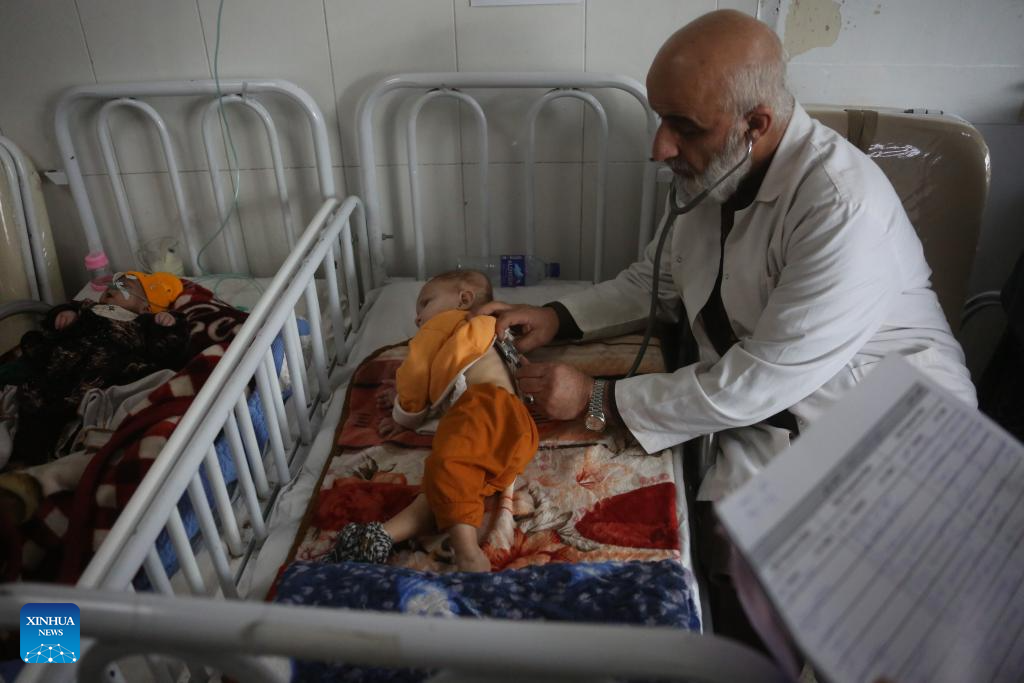
A doctor checks on a malnourished child at the Indira Gandhi Institute of Child Health in Kabul, Afghanistan, March 4, 2026. (Photo by Saifurahman Safi/Xinhua)


