BEIJING, March 11 (Xinhua) -- When China's first Five-Year Plan began in 1953, the nation's industrial base was negligible. The country could barely feed itself and had yet to build a single mile of modern freeway.
Before the 15th Five-Year Plan concludes in 2030, that same country is likely to have already left footprints on the moon via space travel.
Bridging these two eras are 15 blueprints, each a rung on a ladder leading China from scarcity to basically achieving modernization by 2035.
As the 15th plan (2026-2030) takes shape during the ongoing annual session of China's top legislature, it is expected to consolidate the trajectory of the country's high-quality development, which is defined in multiple dimensions that headline growth rates alone cannot fully capture.
Behind these five-year plans lies a deeper question: how does a nation maintain progress over generations on a scale that no other country has achieved?
METRONOME: ACCUMULATING SMALL VICTORIES
While the annual government work report targets 2026 growth at 4.5 to 5 percent, the broader five-year plan proposes keeping economic expansion within an "appropriate range," calibrating subsequent annual rates to shifting realities. This pragmatic approach anchors a far grander ambition: doubling the 2020 per capita GDP by 2035 to reach the level of a moderately developed country.
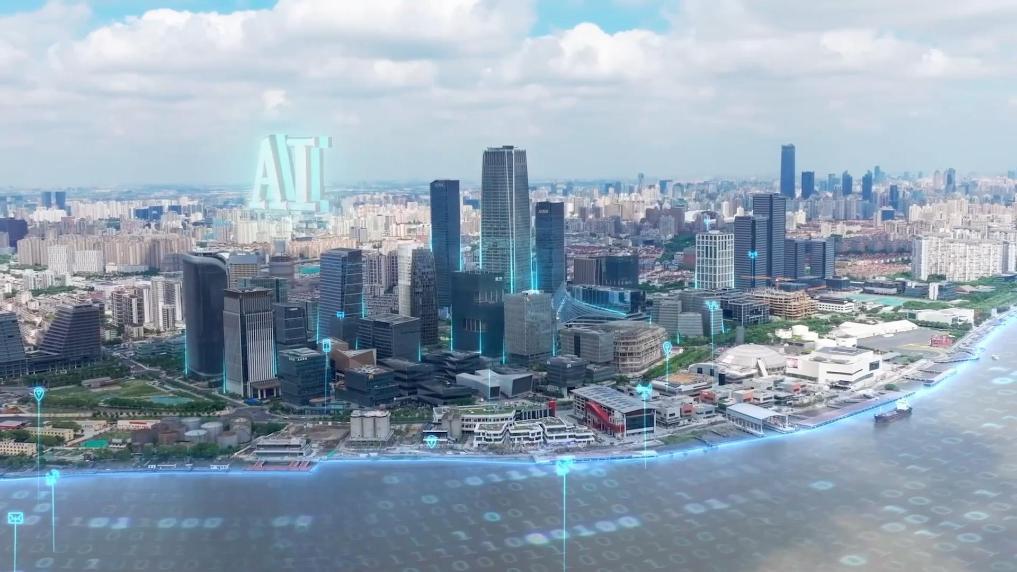
Beyond top-line growth, the draft outline of the 15th Five-Year Plan identifies emerging strategic industries China will nurture, including new-generation information technology, new energy, robotics, and aviation and aerospace. It also maps frontiers to reach, from quantum technology and embodied artificial intelligence (AI) to nuclear fusion power and 6G. Quality-of-life metrics account for more than a third of key targets, with a commitment to raise average life expectancy to 80 years.
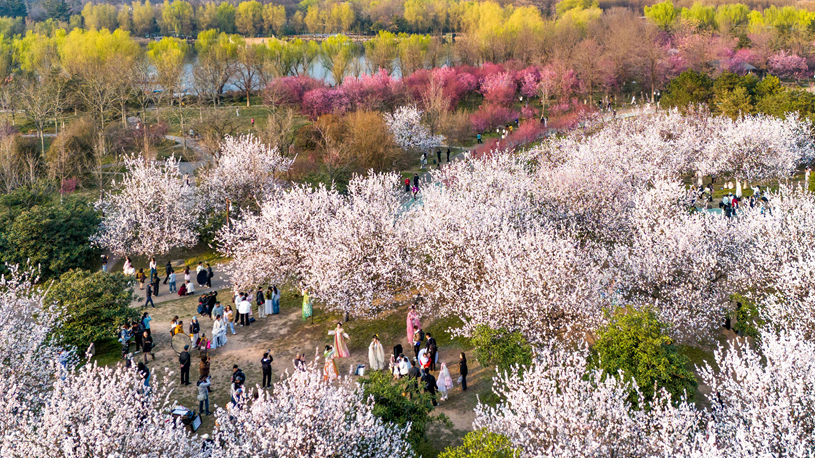
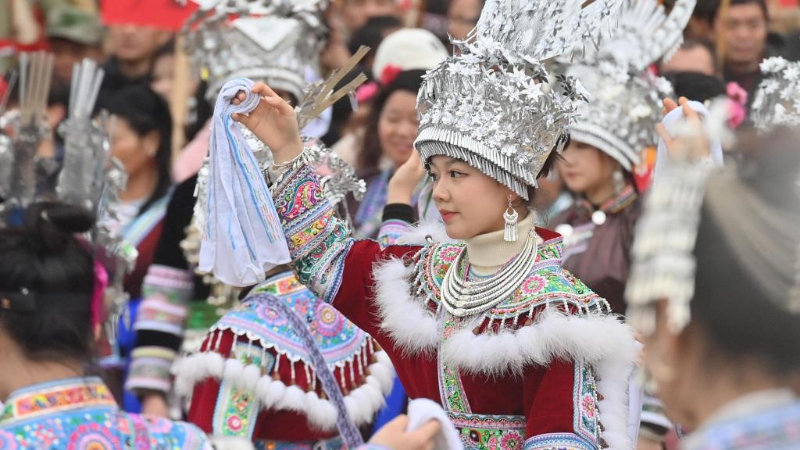
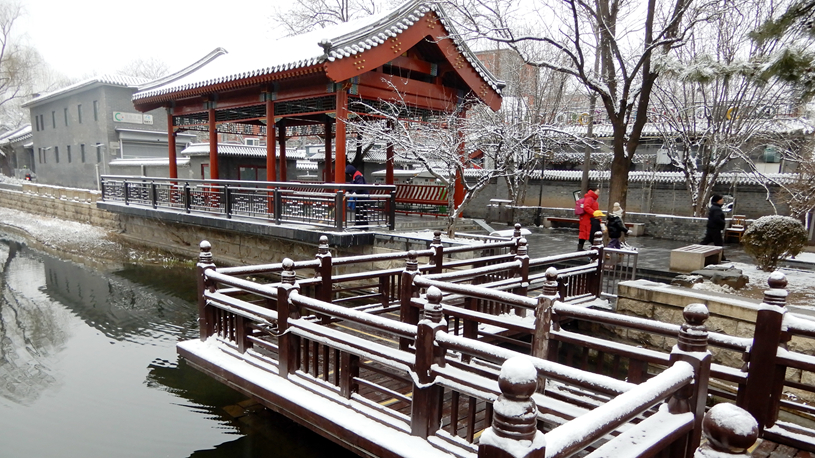
In the policy document of more than 100 pages, three visuals sketch this vision: a landscape of lucid waters and lush mountains, a tapestry of cultural heritage, and a panorama of clean energy.
Together, they offer a vivid window into the ethos of Chinese modernization. It is unprecedented in scale, yet committed to shared prosperity over polarization, to combining material wealth with cultural depth over lopsided growth, and to humanity-nature harmony and peaceful development over pollution and external expansion that scarred earlier chapters of global development.
The 14th Five-Year Plan (2021-2025) made tangible strides. Economic output scaled new heights, with GDP crossing successive thresholds of 110 trillion yuan (about 15.96 trillion U.S. dollars), 120 trillion yuan, 130 trillion yuan and 140 trillion yuan, averaging 5.4 percent annual growth and significantly outpacing the global average. Technological breakthroughs have accelerated, and the nation has successfully navigated global challenges to mitigate systemic risks.
"China is not the first country to formulate five-year plans, but it is the only one to have sustained the practice and achieved the twin miracles of rapid economic development and long-term social stability," said Yang Yongheng, director of the China Institute for Development Planning at Tsinghua University.
A question that is often overlooked is why not all countries have been able to keep up with such a marathon of development. Part of the answer lies in institutional continuity -- the ability to hold a strategic direction across political cycles that would often fracture governance elsewhere.
Part of the answer lies in what Yang described as a cascading architecture: annual plans, sector-specific plans, and regional plans derived from the overarching framework, each carrying its assigned share of targets, guiding every locality and department toward a common destination.
The underlying logic is a Chinese governance concept: accumulating small victories into great successes.
Jiang Ying, chair of Deloitte China and a national political advisor, said that the five-year plans serve as the "metronome" of China's modernization process, translating long-term strategic goals into phased, practical steps that continuously drive socioeconomic development.
"The 15th Five-Year Plan transforms the grand vision into work agendas for governments at all levels, development opportunities for companies, and tangible support and security that each of us can feel," Jiang told Xinhua.
NAVIGATOR: INVISIBLE HAND WITH VISIBLE CALENDAR
In China today, the market plays a decisive role in resource allocation. But this "invisible hand" is sometimes less competent in areas like coordinating decade-spanning investments in computing infrastructure, clean energy, or the semiconductor sector that could shape tomorrow's economy.
That is where the five-year plans step in, as they are designed to pool resources for major tasks, grasp strategic frontiers with foresight, and guarantee the unbroken continuity of the development agenda. These blueprints work as a navigator for China to pursue future development and for investors to precisely explore business opportunities.
"The Chinese government has a strong track record of achieving its stated objectives. Treat plan commitments as leading indicators, not aspirational goals," said Simon Smith, director and general manager of Taikoo Engine Services (Xiamen) Co., Ltd., an engineering branch of the multinational company Swire.
This clarity and predictability, with the five-year plan working as a calendar not a cage, carries an increasingly high market value for global investors as 2026 unfolds with mounting trade and geopolitical uncertainties.
"The five-year plan transforms investment decisions from probabilistic bets to calculated strategic positioning," Smith told Xinhua.
The plan points to future opportunities, according to Konnie Zhu, vice-president of corporate affairs at Budweiser China.
"While market signals tell us 'what' consumers want today, the five-year plan provides structural certainty about 'where' the economy is heading tomorrow," Zhu said. "This long-term certainty allows us to invest confidently in offline experiential platforms that align with national priorities in service consumption, culture-tourism integration, and urban vitality."
For Coach, the five-year plan cycle functions more as a shared time horizon that helps multinational companies align long-term planning across global and local teams, said Liliana Lucioni, president of Coach China.
"For us, it provides a consistent cadence for synchronizing priorities between our global headquarters and China organization, translating strategy into a sequenced roadmap with clear governance and resourcing over a multi-year horizon," Lucioni told Xinhua.
Meanwhile, the 15th Five-Year Plan's focus on nurturing emerging and future industries is sparking intense market interest.
Janice Hu, chairperson of UBS Securities Co. Ltd., said that Chinese companies are demonstrating dynamic innovation in AI, high-end manufacturing, semiconductors, and new energy -- reshaping global investors' perception of Chinese assets.
"Chinese assets are no longer just a portfolio option. They are a strategic must-have," Hu told Xinhua. "This presents a historic opportunity for foreign financial institutions with global resource allocation capabilities to take part in China's transition toward high-quality development." ■