
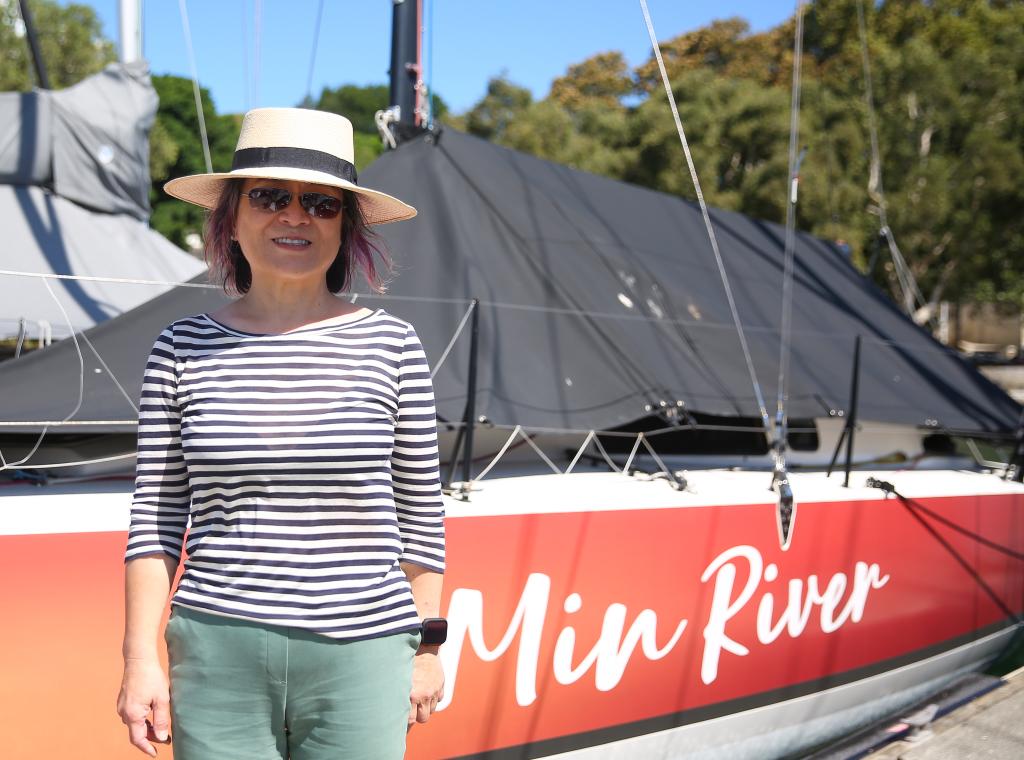
This photo taken on Feb. 24, 2026 shows Lin Jianghui posing with her double-handed yacht "Min River" in Sydney, Australia. (Xinhua/Ma Ping)
by sportswriters Xue Yanwen, Zhang Shuhui, and Ma Ping
SYDNEY, March 8 (Xinhua) -- As a child, Lin Jianghui's world floated on the Min River. Her family lived aboard a boat on this mother river of east China's Fujian Province, which flows eastward into the vast ocean she had never seen. Yet in her imagination, nothing was more romantic than white sails rising against the deep blue.
Decades later, she would paint that very picture herself.
Steering the double-handed yacht Min River - named after the stream of her hometown, Lin and her partner Alexis Loison of France claimed overall victory in the Sydney Hobart Yacht Race, one of the world's most treacherous ocean classics. Lin became the first female skipper to win the race in its 80-year history.
"In that moment, all the past frustrations were made right," Lin said. "I hope all women will never abandon their confidence and aspirations."
At 60 years old, the champion sailor acknowledges the odds she defied. "I'm not young. I'm not tall. English isn't my first language. I didn't start this sport as a child," she said. "So if I can do it, I believe others absolutely can too."
SPREADING HER SAILS
When Lin first arrived in Australia, she learned that sailing was woven into the country's coastal life. But she never imagined it would become part of her own until 2012, when she was invited to a yacht club party and decided to sign up for training - at the age of 47.
It is an age when many women might feel adrift, facing a career bottleneck, declining physical health and shifting roles within the family. "But I prefer the me in my forties," Lin said. "I no longer worked just for the sake of work. My children were older, I was wiser, and it was time to chart a new life."
However, sailing is a sport that demands everything: physical strength, intelligence, and accumulated experience. It's not just about handling the vessel, but also navigation, reading wind and sea, and even making mechanical repairs. And for Lin, many hard lessons lay ahead.
"When the waves are crashing, and you're tumbling like laundry in a machine, I'd think: why on earth am I here?" she laughed. "My mother never understood it either. 'All that wind and sun,' she'd say, 'Why would a woman want to put herself through that?'"
The 2023 race left its mark on her, literally. On the final day, as they tacked into the Storm Bay in winds of up to 50 knots, the boat pitched hard and a wave hurled her into the mast. Head spinning, blood running down her face, she had a split-second thought: Is this worth it?
"After every close call, I'd think: I'm done, never again. But I always forget," she said, recalling how she just clenched her teeth and carried on. "Perseverance and the willingness to endure hardship - these are in our blood as Chinese people."
Not all memories are written in pain. On the last night of the 2024 race, after three days of relentless wind, they drew near the Tasman Island, where the sea turned to mirror. Stars seemed to shimmer on the surface until she realized they were jellyfish, glowing faintly as they drifted, turning the water into a living constellation.
"In that moment, all the hardships dissolved," she recalled. "Moments like that, you can't plan them, you can only receive them."
"Every time I take the helm and set sail, it's a busyness that detaches me from everything ordinary," she said. "All else fades away. Only freedom remains."
FULL AHEAD TO VICTORY
Lin named her JPK 10.30 boat "Min River." "I grew up on that river," she said. "No name fits better."
That boat would carry her further than the river ever could.
When she and Loison left Sydney Harbour on December 26, 2025, for her fifth Sydney Hobart, Lin carried no illusions of victory, although she had done well in previous years.
The Sydney Hobart is one of the world's three classic offshore races, alongside the Newport Bermuda Race and the Fastnet Race. Its 628-nautical-mile course runs through the Bass Strait, a notorious stretch known as the Roaring Forties. Of the 128 vessels that started in 2025, more than a quarter would retire before reaching Hobart.
Min River was not among them.
Lin and Loison had never sailed together before, but she knew his name well: in 2013, Loison and his father became the first double-handed crew to win the Fastnet, a feat that made him a hero to Lin, then a novice finding her way in the sport. Now, more than a decade later, they became teammates.
The first two days were sailed upwind, conditions favoring smaller boats like Min River. Then, on the third night, they went full ahead. They forgot to eat, they forgot to sleep.
By the time they crossed the Bass Strait, they had overtaken most of the fleet. Somewhere ahead, they could sense the leading boat, BNC.
As they hoisted full sail and pushed onward, Lin understood something she had only read about in poems - the feeling of wind filling your sails as you chase down a dream. It was no longer just a line on a page; it was her life.
After crossing the finish line, Lin held up her hands - red, swollen, battered by days of hauling lines and battling the sea.
"These," she said, "are the hands of a sailor."
But the race was not yet over. BNC had crossed first on the water, but following a protest by the race committee against it for a rule infringement, it was penalized 65 minutes, delivering the overall victory to Min River. Lin and Loison became the first double-handed crew to win the Tattersall Cup.
When the decision came, Lin, who had remained calm through the uncertainty, finally let herself feel it. As the trophy was placed in her hands, her calm cracked, and joy poured through.
She hopes her victory sends a message to women, and to the Chinese community worldwide. "Believe in yourself," she said. "Don't let others define what you can or cannot do."
Once, while she was scrubbing her yacht at the dock, a passerby asked, "Where's your skipper?"
"Not here," she joked. "Come back another day."
After her victory, no one asked that question again. A mother drove three hours with her child, just to see the champion boat that made history.
Just days ago, a model of Min River was installed on the champions' wall at the Cruising Yacht Club of Australia. Among the 79 larger boats, the small red-and-white one stood out, unmistakably telling her story:
The woman who steered her all the way to the sea - she came from the Min River. ■


