
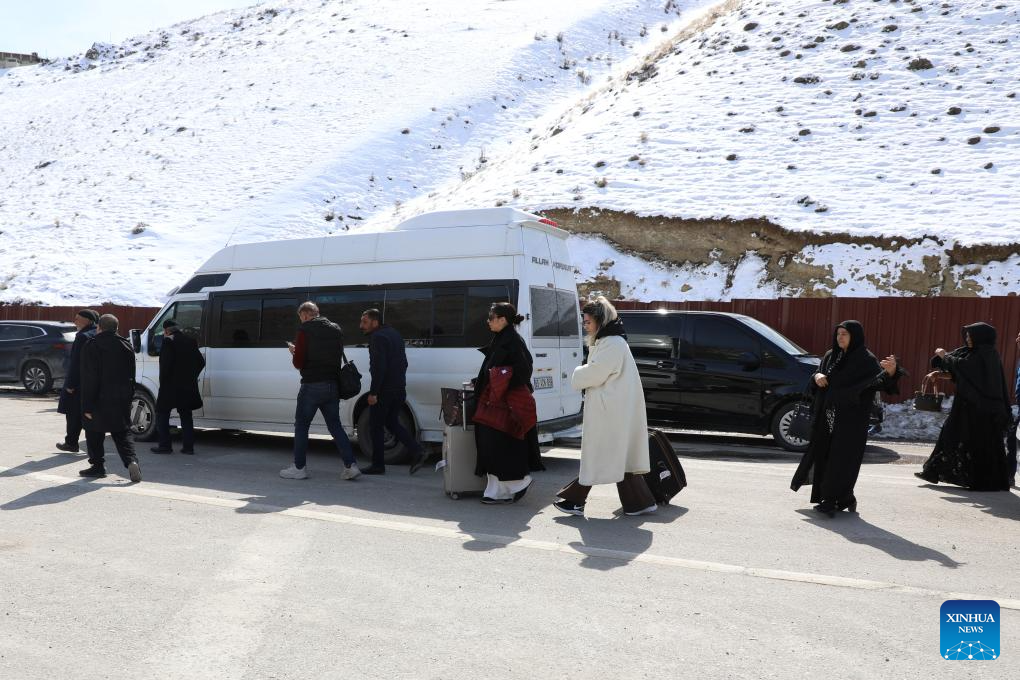
Foreigners including Iranians are seen to have entered Türkiye from Iran at the Kapikoy border gate in Van province, Türkiye, on March, 4, 2026. (Photo by Mustafa Kaya/Xinhua)
by Burak Akinci
ANKARA, March 7 (Xinhua) -- In early spring, the streets of Van, a border city in eastern Türkiye, usually buzz with Persian accents. Iranian families stroll past shop windows, couples linger in lakeside cafes, and tour boats drift across the sparkling waters of Lake Van, the country's largest lake and the Middle East's second-largest.
In recent years, hundreds of thousands of Iranians have made their way to Van annually for short holidays, shopping sprees, and seasonal getaways, with early spring marking the peak season.
To cater to Iranian visitors, Persian-language signs now line the city's main streets. Retailers adjust prices and product selections to match Iranian tastes, while hotels, restaurants, and transport services have expanded rapidly to keep up with growing demand.
"Tourism and border trade are of vital importance for Van," Necdet Takva, president of the Van Chamber of Commerce and Industry, told Xinhua, noting that the latest figures show the number of Iranian visitors to the city has surpassed 800,000 in a single year.
But in the past few days, a tense quiet has settled over the border city.
On Feb. 28, the United States and Israel launched sudden strikes on Iran, prompting widespread Iranian retaliation across the region.
As the regional conflict intensifies, Van, a city whose economic recovery has long depended on cross-border tourism, is increasingly bearing the brunt of its fallout.
These days, Iranian visitors are barely seen on the streets of Van. "We were expecting one million Iranian tourists for 2026," Takva noted. "But under the current circumstances, this will not materialize."
Van shares a 285-km border with Iran, forming part of the roughly 530-km frontier between the two countries.
"There may not be limitations on tariff-based trade in goods, but daily border trade has been seriously affected," Takva said. "Commerce and tourism revenues are expected to drop by hundreds of millions of U.S. dollars," according to the business leader.
The timing of the conflict has left Van's tourism sector even more on edge. Nowruz, the Persian New Year holiday starting in March, is usually a peak season when hotels are booked to the rafters, as Iranian visitors flock to the city to ring in the New Year abroad.
This year, however, reservations are thinning.
"In normal years, we would be preparing for near full occupancy during Nowruz," Oktay Aksoy, general manager of the five-star Elite World Van Hotel, said. "This year, we see a sudden stop in arrivals. Guests are postponing their plans."
Iranian visitors typically stay several nights and spend across a wide range of sectors, from hotels and restaurants to clothing and electronics stores. Even a short-term disruption, Aksoy noted, sends ripples through the wider urban economy.
"If uncertainty continues, it will affect not only this season but also future investment decisions," the hotelier pointed out.
Over the past decade, local investors have expanded their businesses in Van, assuming stable bilateral relations and relatively smooth border crossings between Türkiye and Iran.
That assumption is now being put to the test, particularly after Türkiye's Ministry of National Defense claimed on Wednesday that a ballistic missile fired from Iran toward Turkish airspace was intercepted by NATO air and missile defense systems over the eastern Mediterranean.
Although Iran denied launching any missile at Türkiye, the incident has nonetheless stirred unease in Ankara.
Local business leaders say they are closely monitoring diplomatic developments and hope de-escalation efforts will restore predictability before the summer season.
"If the war drags on," Takva warned, "every tourist and trade opportunity that Van has worked so hard to build will be at risk."
For now, shopkeepers wait, hotel managers revise their forecasts, and the boats on Lake Van continue their slow circuits, carrying fewer passengers than usual as uncertainty looms over Türkiye's eastern frontier. ■
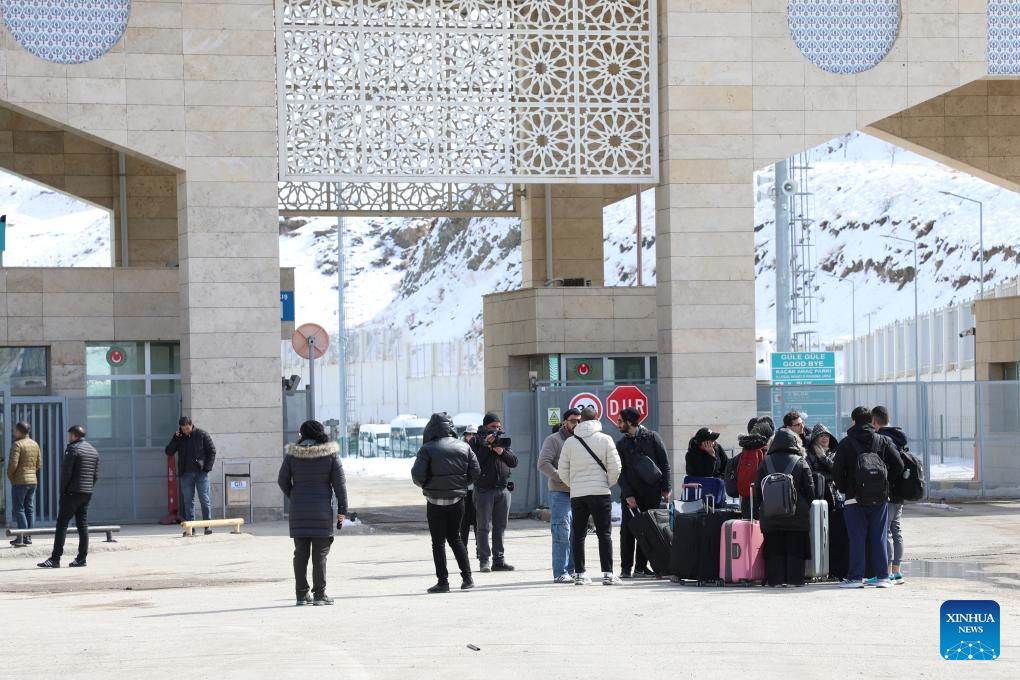
Foreigners including Iranians are seen to have entered Türkiye from Iran at the Kapikoy border gate in Van province, Türkiye, on March, 4, 2026. (Photo by Mustafa Kaya/Xinhua)


