* Artificial intelligence (AI) is moving beyond its role as an added feature layered onto networks and terminals and is increasingly embedded within the infrastructure that shapes how digital systems operate.
* Analysts said the congress reflects a shift from concept to deployment. Francisco Jeronimo, vice president for Data and Analytics at IDC EMEA, told Xinhua that AI is moving beyond marketing slogans into everyday workflows.
* Over the past two decades, mobile technology expanded connectivity from isolated devices to interconnected systems. The current transition extends that trajectory by embedding intelligence throughout those connections.
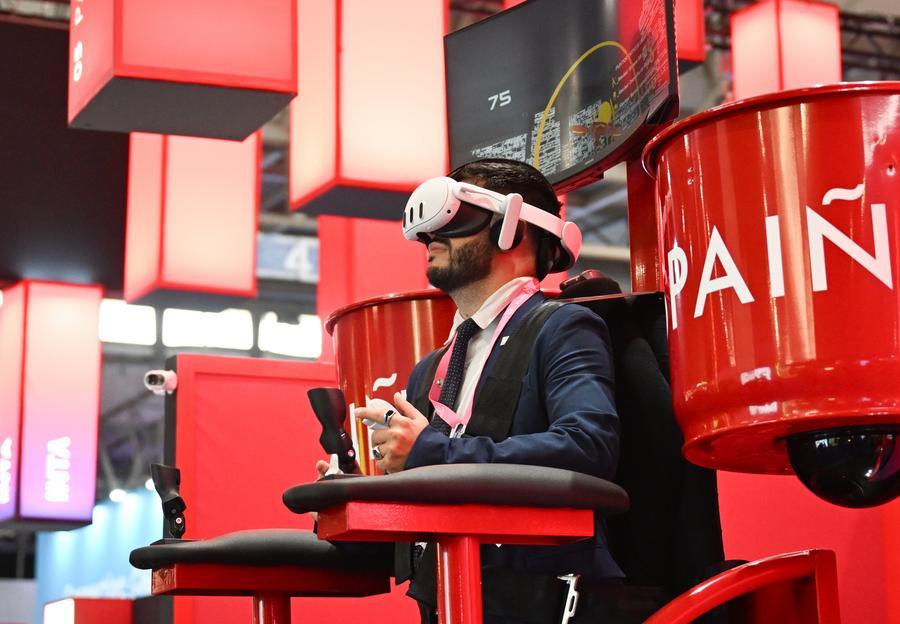
BARCELONA, March 3 (Xinhua) -- For years, the Mobile World Congress (MWC) was defined by what could be seen: sleeker handsets, foldable screens and sharper cameras.
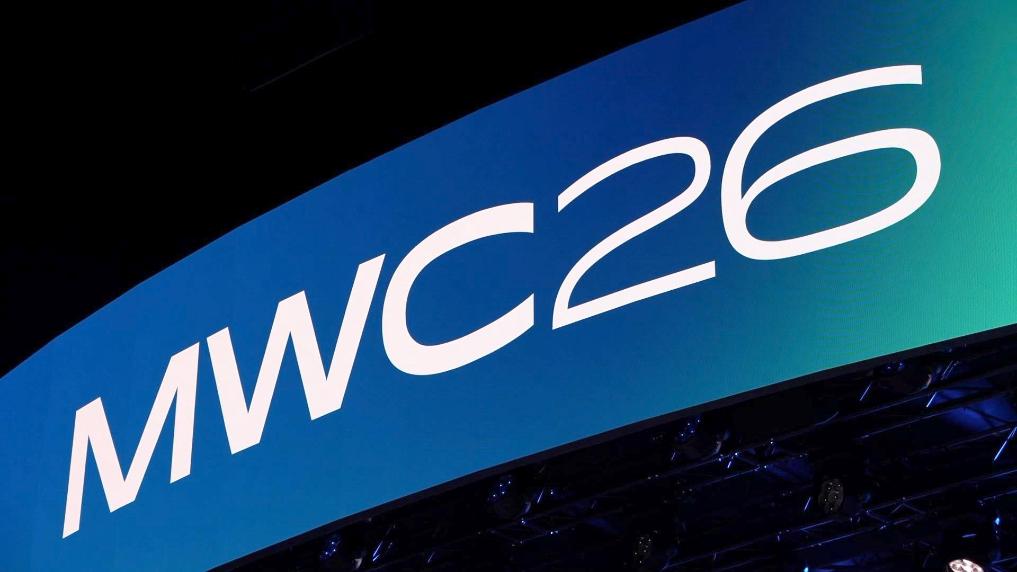
At MWC 2026, the most consequential innovations are harder to photograph.
Under the banner of "The IQ Era," this year's gathering -- marking 20 years since MWC made Barcelona its permanent home -- signals a shift in the technological foundation itself. Artificial intelligence (AI) is moving beyond its role as an added feature layered onto networks and terminals and is increasingly embedded within the infrastructure that shapes how digital systems operate.
5G EVOLUTION CONTINUES, AI FORGES AHEAD
Despite the strong emphasis on AI, industry leaders stressed that the 5G journey is still unfolding.
In his opening keynote, GSMA Director General Vivek Badrinath urged operators to "complete the 5G journey," noting that 5G Standalone could add up to 187 billion U.S. dollars in additional mobile revenues and that markets with broader 5G adoption are already seeing stronger growth.
He also described telecom operators as "a foundational layer of the AI stack," highlighting the role of networks in enabling real-time intelligence at the edge for billions of users.
China Mobile announced a 5G-Advanced initiative aimed at strengthening network performance to support AI devices, connected vehicles and immersive services, reflecting how operators are adapting to evolving usage patterns.
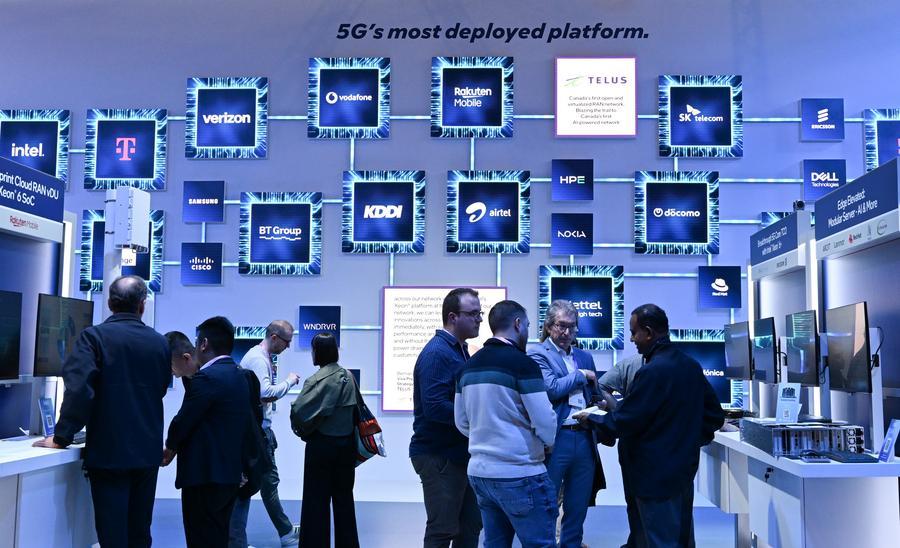
Network architecture is expanding as well. Andrea Folgueiras, Global Chief Technology and Information Officer of Telefonica, said the company is exploring direct-to-device satellite technologies to better understand how satellite connectivity can complement advanced mobile networks and help meet connectivity needs in remote areas of Europe.
Analysts said the congress reflects a shift from concept to deployment. Francisco Jeronimo, vice president for Data and Analytics at IDC EMEA, told Xinhua that AI is moving beyond marketing slogans into everyday workflows.
"In the last couple of years, it was all about the hype. Now it's about what is already happening," he said, adding that enterprises adopting AI-assisted processes are unlikely to revert to previous models.
He dismissed comparisons to the dot-com bubble, arguing that current AI investments are supported by existing infrastructure and practical productivity gains.
As networks expand both capacity and coverage, AI is increasingly shaping not only how those networks are used but what they enable.
FROM HARDWARE SPECTACLE TO STRUCTURAL CHANGE
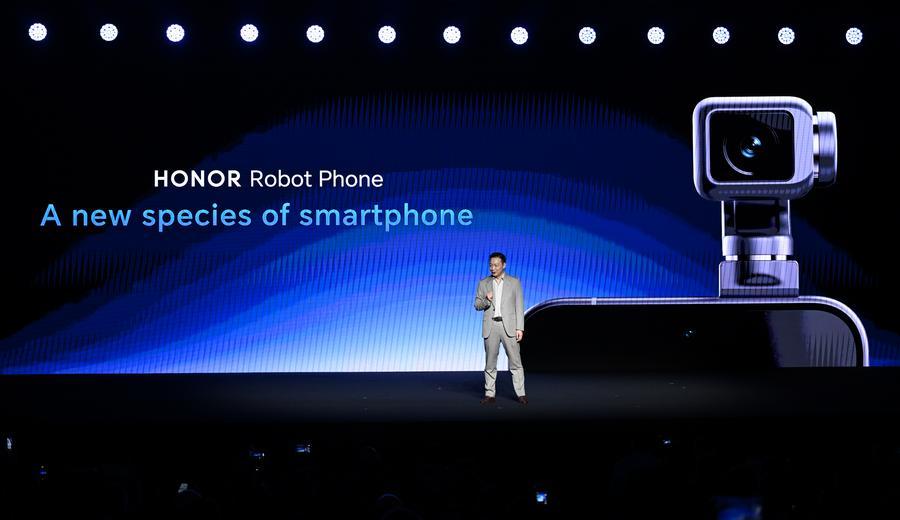
The exhibition halls still feature eye-catching devices. Honor unveiled a "Robot Phone" integrating embodied AI interaction and advanced imaging capabilities.
At the launch event, Honor Chief Executive Officer Li Jian said the company's newly proposed AHI (Augmented Human Intelligence) concept emphasizes a "people-centered" approach, integrating intelligence quotient with emotional intelligence to enhance human adaptability in a rapidly changing world.
Lenovo presented AI-enabled enterprise devices designed to embed intelligent assistance directly into workplace workflows, illustrating how manufacturers are positioning hardware as part of broader AI systems.
Across the exhibition floor, devices are increasingly functioning as entry points to distributed intelligence.
Behind the screens, companies are investing in computing infrastructure.
Huawei showcased AI computing solutions based on its Atlas platform, highlighting the importance of scalable training and inference capabilities for industrial AI deployment. The emphasis was on compute architecture designed to support large models and real-time analytics.
Enterprise hardware makers also highlighted AI-ready terminals for logistics, manufacturing and energy sectors, where reliability and system integration are essential.
MWC 2026 reflects a broader recalibration of industry priorities. Attention is shifting toward distributed computing, automated workflows and network architectures designed to support intelligent coordination.
Over the past two decades, mobile technology expanded connectivity from isolated devices to interconnected systems. The current transition extends that trajectory by embedding intelligence throughout those connections.
If the previous phase was defined by "everything connected," the emerging phase is increasingly defined by "everything intelligent."
(Video reporters: Zhang Huan, Meng Dingbo, Chen Yuzheng and Ismael Peracaula; video editors: Wang Houyuan, Luo Hui and Zhang Ning)■