
China has surged ahead in manufacturing automation and is now spearheading growth in the global robotics industry, said Takayuki Ito, president of the International Federation of Robotics, highlighting the country's unprecedented pace in expanding its industrial robot fleet and modernizing factories.
BEIJING, March 2 (Xinhua) -- When dozens of humanoid robots leapt, flipped and sprinted across the stage of China's 2026 Spring Festival Gala, the reaction was instant. Clips of the synchronized martial-arts performance went viral, dazzling audiences with feats that looked closer to science fiction than factory automation.
Yet the significance of that moment extends beyond spectacle. The same advances in balance, speed, coordination and spatial awareness that allowed the robots to perform complex martial-arts routines also reflect rapid progress in embodied intelligence, which is laying the groundwork for their entry into a much wider range of industries.
Why has China's robotics industry developed so rapidly? What opportunities might this momentum create for the world?
FROM STAGE TO SHOP FLOOR
Public demonstrations have played a visible role in China's technology ecosystem. High-profile showcases help attract attention, talent and investment. But in robotics, what matters more than spectacle is whether machines can survive heat, dust, uneven terrain and relentless usage -- the harsh, unpredictable conditions of the real world.
That is where China's domestic demand comes in.
In sectors such as power inspection, logistics and emergency response, robots are not bought for novelty. They are judged by brutally simple metrics: how many inspections they can complete each day, how accurate their recognition systems are, and how often they fail. As Li Chao, co-founder and chief technology officer (CTO) of Deep Robotics, put it bluntly, industrial clients "care more about whether robots actually solve problems."
This pressure has pushed Chinese robots toward practical robustness. Quadruped robots conduct power inspection continuously across challenging terrain, logistics robots assist with sorting and handling parcels, and home-service robots are learning tasks such as tidying, organizing and cleaning. All operate in real-world environments, generating valuable data while performing useful work.
Taken together, these developments signal more than incremental improvement; they point to a structural shift in scale and ambition.
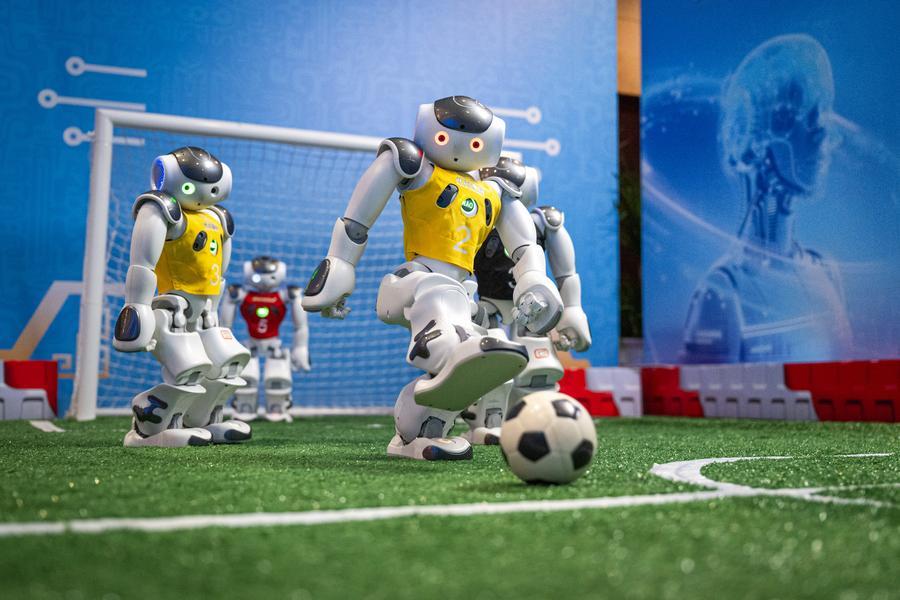
China's Ministry of Industry and Information Technology reports that revenue from the robotics industry reached nearly 240 billion yuan (35 billion U.S. dollars) in 2024, while revenue in the first half of 2025 grew 27.8 percent year on year, with industrial robot production reaching 370,000 units.
China has surged ahead in manufacturing automation and is now spearheading growth in the global robotics industry, said Takayuki Ito, president of the International Federation of Robotics (IFR), highlighting the country's unprecedented pace in expanding its industrial robot fleet and modernizing factories.
According to the IFR's 2025 report, global industrial robot installations amounted to 542,000 units in 2024, more than double the figure a decade ago. China continued to lead the global market, with its industrial robot stock surpassing 2 million units in 2024 -- more than half of the world's total. Annual installations rose 7 percent from 2023 to a record 295,000 units, underscoring the country's strong momentum in automation and manufacturing modernization.
COLLABORATIVE INNOVATION
One key driver of this rapid progress is China's model of collaborative innovation. Training humanoid robots isn't left to isolated experiments; it is treated as a coordinated, large-scale engineering effort that integrates virtual simulation, physical testing and industry participation. Government-backed innovation centers -- co-built with research institutes and private firms -- help consolidate resources and address shared bottlenecks in data, computing power and training efficiency, accelerating the transition from lab prototypes to deployable products.
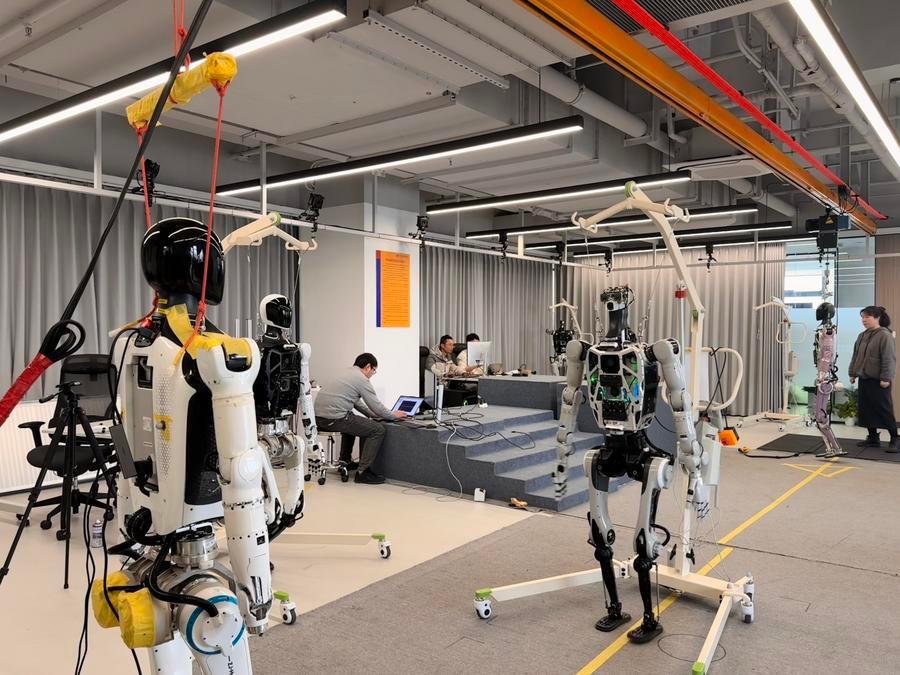
In recent years, national and regional humanoid robotics innovation centers and embodied intelligence training facilities have expanded rapidly. Shanghai's heterogeneous robot training facility, for example, accommodates more than 100 robots for multi-scenario exercises, generating data across industrial and service environments. Open-source datasets and motion-control frameworks further reduce industry entry barriers, enabling faster commercialization.
At the Hangzhou Embodied Intelligence Pilot Base, this ecosystem approach is being formalized. Li Xingteng, deputy general manager of the base, said organizers are establishing academic, industrial and technical committees to align researchers, founders and chief technologists.
In his view, competition in embodied intelligence will ultimately hinge not on a single breakthrough but on the resilience of the entire ecosystem. China already holds globally competitive advantages in robot bodies, dexterous hands and manufacturing capacity, he said, but these strengths remain fragmented. The base aims to integrate upstream and downstream players while lowering corporate costs through shared data infrastructure.
It has aggregated 22 major open-source embodied intelligence datasets and is testing multiple real-world data collection routes to identify the most cost-effective approach. While simulation is useful, Li stressed that real-world data remains essential for task-specific training. By providing diverse collection environments, the base lowers the burden on individual firms and supports joint model development.
WHEN HARDWARE CROSSES TIPPING POINT
For years, robotics progress was constrained by hardware. Motors were underpowered, joints unreliable, supply chains incomplete. Many Chinese firms had no choice but to build critical components themselves.
That constraint has largely eased.
"In 2025, legged robots crossed a hardware threshold," explained Li, co-founder and CTO of Deep Robotics. "The robots are basically capable now. The question is no longer whether they can move, but how well they can scale, how much they cost, and how stable they are."
As domestic supply chains matured, companies shifted strategy. Self-reliance gave way to selective in-house development combined with diverse partnerships. Motors, reducers and actuators -- once scarce -- are now produced at scale by specialized suppliers, driving down costs.
The next battleground is intelligence. Navigation in complex urban environments, manipulation with dexterous hands and meaningful human-robot interaction remain challenges. Even today's robots, Li admitted, are "still a little bit dumb" when it comes to understanding complicated context.
But this is also where China believes it has a structural advantage: scale and real-world scenarios. As autonomous-driving technologies mature, embodied navigation -- robots moving autonomously through streets and buildings -- becomes feasible. Telling a robot to go to a nearby restaurant is no longer science fiction, but a near-term product goal, Li said.
The world has seen robotics hype cycles before. What sets the current moment apart is not just better machines, but faster feedback loops. Robots are deployed early, exposed to harsh conditions, iterated quickly and redeployed again.
China's advantage in robotics is not simply lower costs or state support. It is the speed at which ideas are tested, broken and rebuilt -- on stage, in substations and across the industrial front lines.
And that, more than any single backflip, is what makes China's robot rise worth watching.

GLOBAL OPPORTUNITIES
China's rapid advancement in robotics is generating significant opportunities for global industrial transformation and cross-border collaboration.
As the World Economic Forum noted in a report, "One in every two industrial robots installed around the world is being put to work in China. The country has been the leading market for these machines since 2013." This scale highlights China's central role in driving global automation demand and strengthening the worldwide robotics ecosystem.
The Washington-based Center for Strategic and International Studies further observes that "advanced automation has helped Chinese manufacturers cut costs, climb global value chains, and outcompete foreign competitors. Now, China's robotics leaders are pioneering new robotics innovations and eyeing new markets."

Deep Robotics' business now spans more than 50 countries and regions, serving over 1,200 industry scenarios worldwide. Recognizing that needs vary significantly across markets, it adopts a region-specific approach. In the United States, the focus is largely on addressing labor shortages and high labor costs. In the Asia-Pacific region, solutions are tailored to manufacturing efficiency and factory operations, while in the Middle East, they address challenges related to energy sites and harsh environments such as deserts. By adapting to local needs, the company aims to help solve real-world problems globally.
Other Chinese robotics firms such as Unitree and Agibot are also utilizing these open-source reasoning layers to perform complex tasks in both home and factory settings, helping to set international standards for an AI ecosystem that is transparent and inclusive.■