
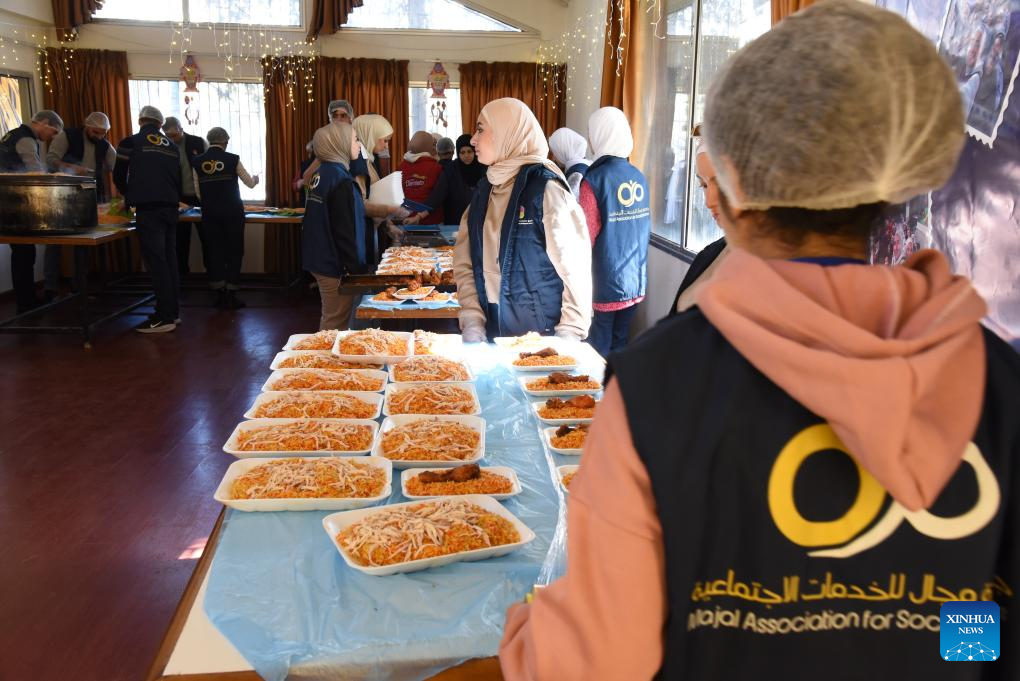
Volunteers prepare meals inside a community charity kitchen in the Mazzeh neighborhood of Damascus, Syria, on Feb. 26, 2026. (Photo by Monsef Memari/Xinhua)
DAMASCUS, Feb. 27 (Xinhua) -- In the Mazzeh neighborhood of Damascus, the kitchen still stands. The pots are still scrubbed clean. The volunteers, young and determined, still arrive each morning. But the quiet hum of activity that fills the room masks a sobering reality: this year, the pots are smaller, the portions fewer, and the silence of shuttered community kitchens across the city echoes louder than the call to prayer.
For years, the "A Piece of Bread" initiative has been a lifeline during the holy month of Ramadan to families struggling through years of conflict and economic hardship. But as it is marking its 14th Ramadan, the lifeline is fraying. Once capable of distributing 400 kg of rice daily across Damascus and its countryside, the volunteer-run community kitchen now scrapes together just 80 kg.
"The economic situation is at its worst," said Saed Abdul Ghani, chairman of the Majal Association for Social Services, a licensed civil society organization running the initiative. "Donors who once supported 200 or 300 meals can now support only 20 to 30 ... We used to support 800 families regularly; now we can reach just 250 because of limited resources."
A World Bank report in July 2025 revealed that 14 years of conflict have shrunk Syria's GDP by more than half since 2010, with per capita income dropping to 830 U.S. dollars in 2024, and one in four Syrians living in extreme poverty.
Yet the volunteers keep coming. Medical students, surgeons, and young professionals work side by side in the modest kitchen, chopping, stirring, and packing what little they have.
Among them is Suad Hamida, a medical student who has volunteered for four years. "You find everyone here, from surgeons to university students, all trying to serve this country," she said, adding that volunteering has become an essential part of her life.
From Mazzeh, the meals are delivered past the battered outskirts of the capital to towns like Nashabiyah, about 25 km east of Damascus. Here, the scars of war are still visible: buildings patched with exposed concrete blocks, streets lined with homes only partially rebuilt. Many residents are women and children, left to navigate a landscape of loss and rising prices.
As the volunteers arrive, children gather quietly. Some wait for a meal. Others hope for biscuits and other snacks handed out alongside the food. On a recent day, about 125 meals were distributed, each containing rice with chicken, yogurt, cheese, and labneh, enough for two. But most families are larger, and demand far outstrips supply.
Some beneficiaries, too wary to speak on camera, expressed quiet gratitude. But they also voiced a deeper concern, that a single meal, however welcome, cannot sustain a family. Assistance, they said, is needed year-round, not just during Ramadan.
Abdul Ghani agrees. "Today, there are families living on just a loaf of bread and a carton of yogurt," he said, "During Ramadan, their food situation may improve slightly, but we need these initiatives 365 days a year."
The Majal Association for Social Services now reaches about 30 areas across rural Damascus with around 250 registered families, rotating distributions so that about 125 families can receive aid every other day. Abdul Ghani said the initiative carries symbolic weight, as it seeks to reach neighborhoods that were destroyed or heavily damaged during the war, places where the state's reach is thin and recovery slow.
But the closures of other charity kitchens across Damascus tell a grim story. One by one, they have fallen silent, unable to absorb rising costs and shrinking donations. The ones that remain operate on a thread.
Still, for the volunteers, the act of showing up is its own form of resistance. Hamida spoke of the drive to reach people in remote areas where no one else goes. "We know we've reached those who truly need help. It means everything to us, especially during Ramadan."
As the sun sets over Damascus, and the call to break the fast rises across the city, the kitchens that remain open offer more than food. What they offer is a glimpse of a society holding onto its traditions of generosity, even as the ground shakes beneath it. But the question hanging over this Ramadan, and those to come, is whether spirit alone can sustain a people worn down by 14 years of war and hardship. ■
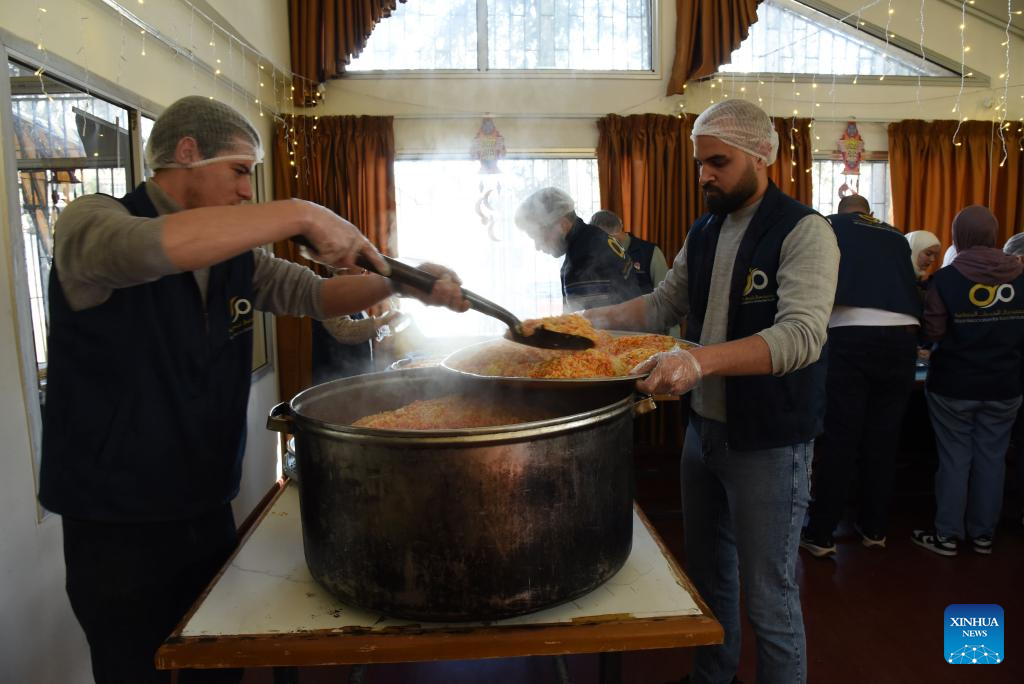
Volunteers prepare meals inside a community charity kitchen in the Mazzeh neighborhood of Damascus, Syria, on Feb. 26, 2026. (Photo by Monsef Memari/Xinhua)


