
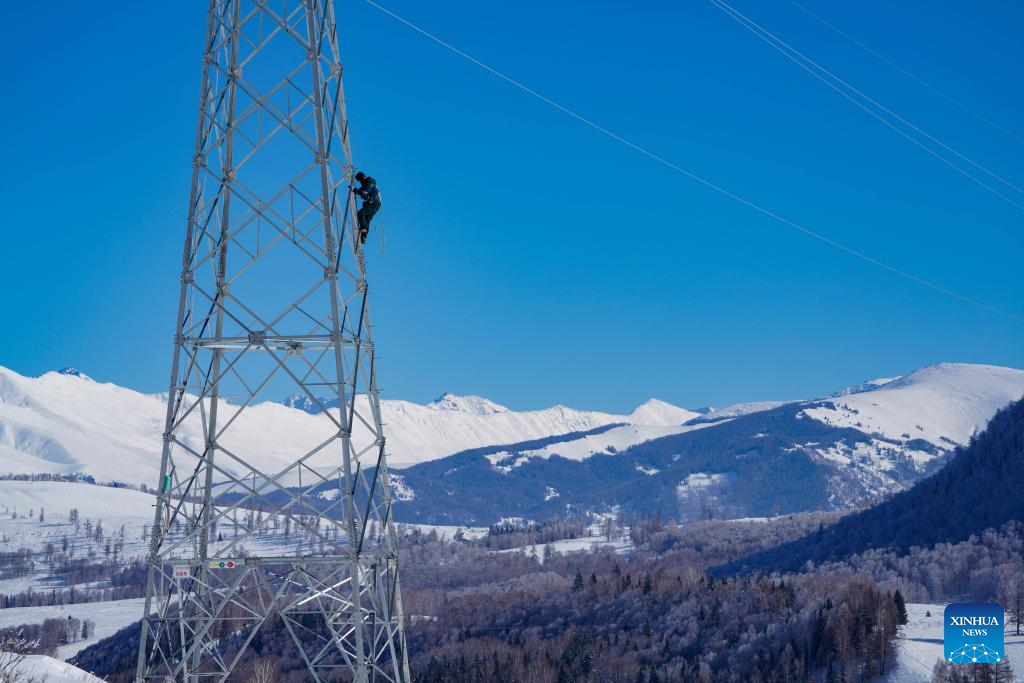
A maintenance worker operates on a transmission tower at Hemu Village of Altay, northwest China's Xinjiang Uygur Autonomous Region, Feb. 5, 2026.(Xinhua/Xu Hongyan)
URUMQI, Feb. 27 (Xinhua) -- While skiers carve their way through fresh snow in northwest China's Xinjiang Uygur Autonomous Region, Qi Fan has been glued to a screen, as one bad reading on it could affect the operation of the ski resort.
Qi heads a power supply station in Hemu Village of Altay in Xinjiang. He is responsible for keeping electricity flowing to the Jikepulin ski resort and some 500 nearby clients, including restaurants and homestays.
When tourists flooded the famed resort during the recent Chinese New Year holiday, Qi and his five colleagues were on full alert, trying to ensure a smooth power supply to keep the winter economy alive.
Upon receiving an emergency phone call, Qi and his team hurried to the affected site and shoveled a narrow path through knee-deep snow toward a transformer. Following a quick inspection and fix, the power problem was solved. Within just two hours, the team received more than 30 urgent calls.
"A decade ago, five transformers were enough to power the whole village," Qi said. "Now we have 162."
Located in the border area of northern Xinjiang, Hemu is a popular tourist destination in summer and autumn due to its cool weather, beautiful prairie and mountainous landscapes, and wooden cabins. After every National Day holiday in October, when temperatures plunged to as low as minus 40 degrees Celsius, most business owners used to put up the shutters, leave the mountains and did not return until spring.
In 2021, the Jikepulin International Ski Resort opened with 103 ski runs, transforming the village into a winter hotspot. In the days around the Chinese New Year earlier this month, daily tourist arrivals reached around 5,000 in the resort.
Briona Bonner, who is from the United States, made her first visit to China this year. She and her friends spent three days in Hemu, learned to ski at Jikepulin, and sampled food ranging from Xinjiang snacks and Sichuan hot pot to Cantonese dishes.
Bonner said the weather in Hemu is much colder than in her coastal hometown in California, but that the skiing experience had proved very cool. "We all wanna come again," she said.
The winter tourism boom has resulted in a surge in power demand. Data showed that Hemu's electricity consumption had exceeded 130 million kWh in 2025, more than four times the 2020 figure. With new hotels and infrastructure still under construction, the load on the grid will keep climbing.
Figures from the regional department of culture and tourism show that, as of August 2025, Xinjiang had 101 skiing venues, including six top-level ski tourism resorts.
According to guidelines released by the State Council, China aims to boost its ice-and-snow economy as a new source of growth, targeting an economic scale of 1.2 trillion yuan (about 174 billion U.S. dollars) by 2027 and 1.5 trillion yuan by 2030.
After a quick lunch, Qi and his team were back on duty, guarding Hemu's power supply.
"Loads are light during the day. But at night, when skiers come back, the bonfire starts, and the village lights up -- that's the peak. We've got to be prepared," Qi said. ■


