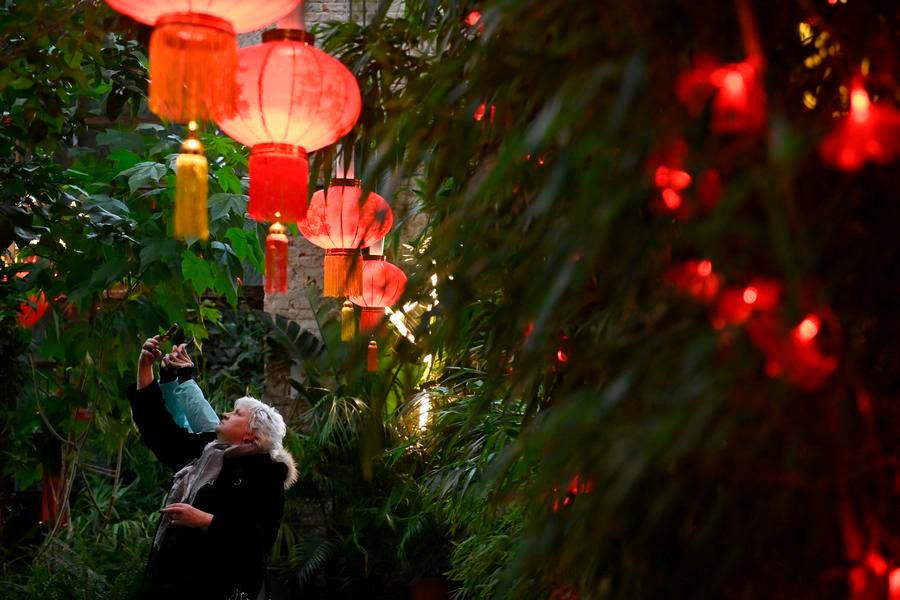
"For Russians, the Spring Festival is often perceived as something exotic, yet people recognize the shared human values that underpin it. It is precisely through these shared values that the festival gains universal significance," said Konstantin Baraboshkin, head of the Department of Chinese Philology at Lomonosov Moscow State University.
MOSCOW, Feb. 27 (Xinhua) -- "Here are ten red envelopes, each holding a secret Spring Festival tradition. Take your pick and let's see which one you get!"
During a Chinese language class at Moscow City University (MCU), 10 red envelopes appeared on the screen. As a student clicked to reveal phrases such as lion dance, dumpling making and family reunion dinner, classmates joined in discussing the cultural meanings behind them.
The Spring Festival has made its way into classrooms at multiple Russian universities, where young students are exploring the cultural charm of the ancient festival through diverse lenses.
LEARNING LANGUAGE, LIVING CULTURE
"With crackers' cracking noise the old year passed away, the vernal breeze brings us warm wine and warm spring day." In another classroom at MCU, Polina Ryzhenkova, a teaching assistant from the Chinese Department, recited these lines of a classical poem about the Spring Festival by Song Dynasty poet Wang Anshi. Her first-year students repeated the lines with expression, following their teacher's lead.
Oksana Malykh, head of the Chinese Department at the Institute of Foreign Languages, MCU, said all instructors strive to bring the aura of the Spring Festival into their lessons. Junior students learn basic Spring Festival-related vocabulary, while senior students compare Chinese and Russian traditions and discuss cross-cultural differences.
"For those learning Chinese, or any foreign language, what matters most is culture," Malykh said. "While modern tools allow us to transmit the linguistic code itself, no translator or artificial intelligence can yet fully capture its cultural dimensions."
The universal longing for renewal and the arrival of spring embedded in the festival is what teachers aim to convey to their students. For Elena, a fourth-year student, the Chinese New Year is a fascinating holiday associated with home, happiness, the start of a new natural cycle and the coming of spring.
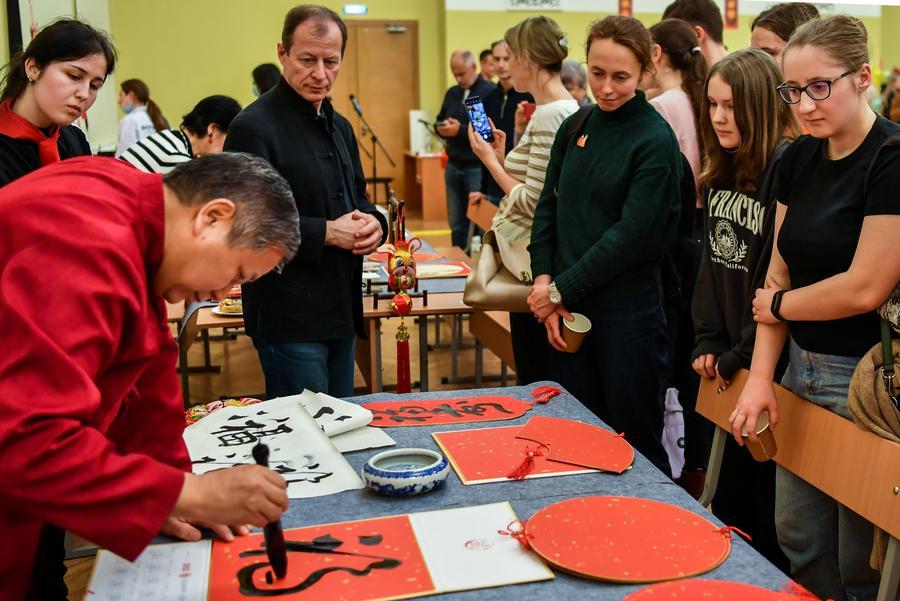
Beyond textbooks, students take part in workshops to make paper lanterns and write the Chinese character "Fu," meaning blessing or good fortune. During the workshop, students explained traditional practices, such as hanging the character upside down to symbolize the arrival of good fortune, drawing on similarities in pronunciation in Chinese.
UNIQUE ROOTS, UNIVERSAL RESONANCE
The festival has also been the focus of academic lectures at Lomonosov Moscow State University (MSU).
"Spring Festival customs such as welcoming spring, honoring ancestors and driving away bad luck are essentially not just traditions, but an ancient worldview embedded in daily life, including belief in the magic of words and actions," Konstantin Baraboshkin, head of the Department of Chinese Philology at the Institute of Asian and African Studies, MSU, explained to second-year students during his lecture.
In Baraboshkin's view, mythology is closely connected to cyclical time, lunar and solar rhythms, and holds the key to understanding the roots of the Spring Festival. "It seems natural to me to place the story of the Spring Festival within the context of Chinese mythology and trace its development from ancient times to the present," he said.
"I realized that through this festival, China expresses its love for traditions and its commitment to preserving them. This is what has always fascinated me about China: its respectful attitude toward antiquity and its continuous effort to pass on its myths, traditions and customs. It unites people and brings joy," Yasya, a second-year student, told Xinhua after Baraboshkin's lecture.
For Baraboshkin, the essence of the Spring Festival is unity. "The Spring Festival is built around unity at every level: from the family gathered around one table to the village, the province and the country as a whole. It is in these values that the festival derives its true unifying power," he said.
"For Russians, the Spring Festival is often perceived as something exotic, yet people recognize the shared human values that underpin it. It is precisely through these shared values that the festival gains universal significance," he added.
NEW FORMS, SAME REUNION
Class discussions have also addressed how the festival is evolving in contemporary China.
At MSU, students noted the growing use of social media platforms to exchange greetings and send digital red envelopes. They also discussed the trend of parents traveling to cities where their children work to celebrate together, reflecting changing lifestyles while maintaining the tradition of reunion.
Yu Jie, a senior lecturer at MSU, said that although forms of celebration have changed, the importance attached to family has remained constant.
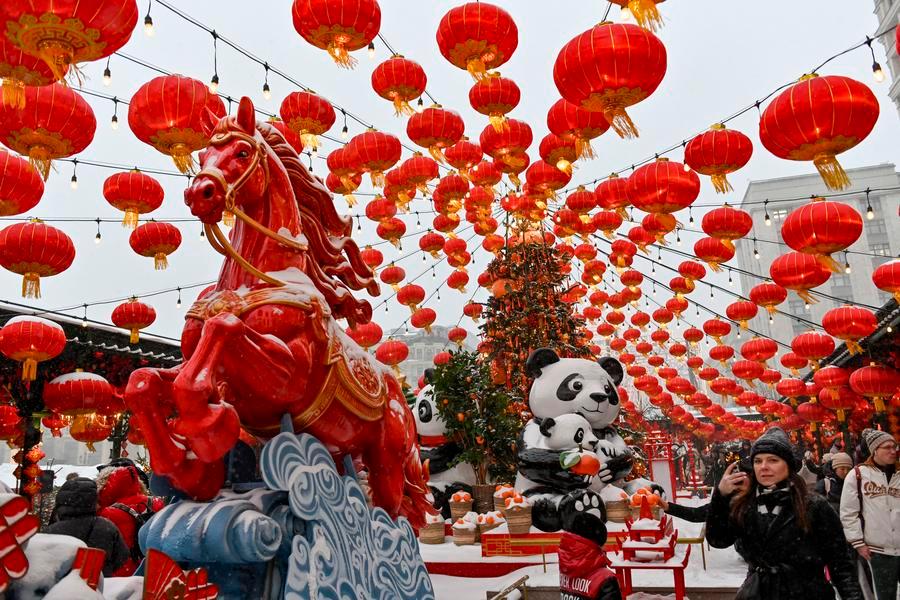
Outside the classroom, the festivities spread into the city streets. At Manezhnaya Square in the heart of Moscow, large-scale celebrations were held to mark the Chinese New Year. Themed venues hosted workshops, concerts and tastings of Chinese cuisine, offering visitors a glimpse into China's rich traditions and customs.
People stopped to watch, took photos to share the joy on social media, and warm greetings of "Happy New Year" filled the air, creating a scene of sincere warmth.
"The Spring Festival is one of the most important festivals in China. It was fascinating to learn not only about its history and traditions, but also about the new forms it takes today," said Alexander, a fourth-year student majoring in Chinese history.■