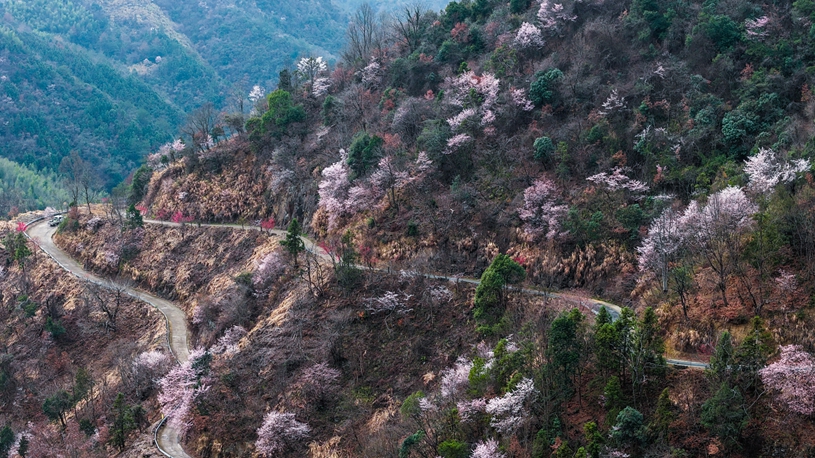
NANCHANG, Feb. 26 (Xinhua) -- China's annual Spring Festival travel rush involving billions of passenger trips continues, while another seasonal migration is yet to begin at the country's largest freshwater lake, with more than 700,000 migratory birds gathered there set to start their northward trips from March.
At the frontline of this avian journey stands Wang Xiaolong, a 61-year-old veteran who has dedicated four decades to bird conservation at Poyang Lake in east China's Jiangxi Province.
At 6:30 a.m. in the morning, Wang boarded a ferry to the Poyang Lake Nature Reserve to start his patrol. Dressed in camouflage gear and wearing boots, he moved swiftly along the water's edge despite his age, while his sharp eyes scanned the area. Only his graying temples confirmed the 40 winters he has spent guarding this location.
Wang's connection to the lake runs deep. "When I was five, I went picking wild vegetables by the lake with my mother and saw a snow crane for the first time," he recalled. "It looked so elegant. It delighted my heart instantly. Even as a child, I thought: these graceful creatures must be protected."
After retiring from military service at 21, Wang returned to his hometown and joined the Jiangxi Poyang Lake National Nature Reserve Administration. He worked there until retirement and then continued as a volunteer.
By his estimate, he has walked over 400,000 kilometers while on patrol -- enough to circle the Earth 10 times. "Sometimes, even in my dreams, I see birds," he said.
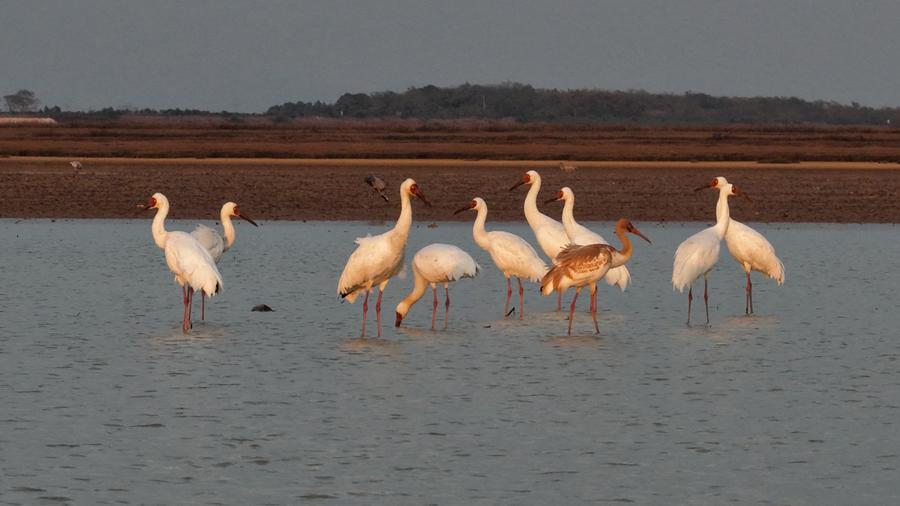
Poyang Lake is a vital wintering and stopover site along the East Asian-Australasian Flyway, one of the globe's nine major flyways. With a surface area of up to 4,000 square km, it hosts more than 700,000 wintering birds every year, including the world's largest wintering population of Siberian cranes, also known as snow cranes. Its vast wetlands, a mosaic of lakes, mudflats and grassy islets, provide rich feeding grounds featuring aquatic plants, mollusks and fish.
Within this expansive ecosystem lies a much smaller wetland, built to imitate the natural habitat: a rescue station for injured birds.
Days ago, Wang received an urgent call about an injured oriental white stork found by villagers. He rushed to the scene along with rescue staff.
The stork was found thin and weak, with a broken left wing. "We examined it carefully and wrapped the wound," Wang revealed. "Now it's resting peacefully at the rescue center."
In the course of over 14,000 days of vigilance, Wang has rescued and released more than 300 birds. "Caring for them takes the same patience as raising children," he said with his eyes softening.
Plans are underway to expand the facility into a 1,600-square-meter standardized rescue center, complete with an operating room, professional rehabilitation enclosures, and outdoor activity areas. Gentle slopes and aquatic plants will help recovering birds readapt to the wild, easing their return to nature.
But Wang knows that guarding birds requires more than just a patrol team. Such efforts also rely on the power of the public. During his long service at the lake, he has taken conservation laws into lakeside villages, schools and even onto boats, thereby teaching residents about protecting wildlife. In 2023 alone, he gave over 30 lectures in more than 20 schools, engaging 2,500 students and 80 volunteers in bird protection activities.
Today, these efforts are paying off. More local residents are joining conservation efforts such as rescuing injured birds, promoting ecological awareness and patrolling wetlands.
Technology is also playing a growing role. Poyang Lake now features an integrated "sky-ground" monitoring network. Combining high-definition cameras, drones and ground patrols, the system tracks bird activity and distribution in real time, providing scientific data to guide protection strategies.
Recent scientific surveys show bird species in the Poyang Lake reserve increasing from 381 to 394, including 20 national first-class protected species and 74 second-class protected species. Rare birds are becoming regular visitors, which is evidence of improving biodiversity.
For Wang, the mission continues. "This is a march without a finish line. As long as I can move, I will stay here and guard them," he said. ■