
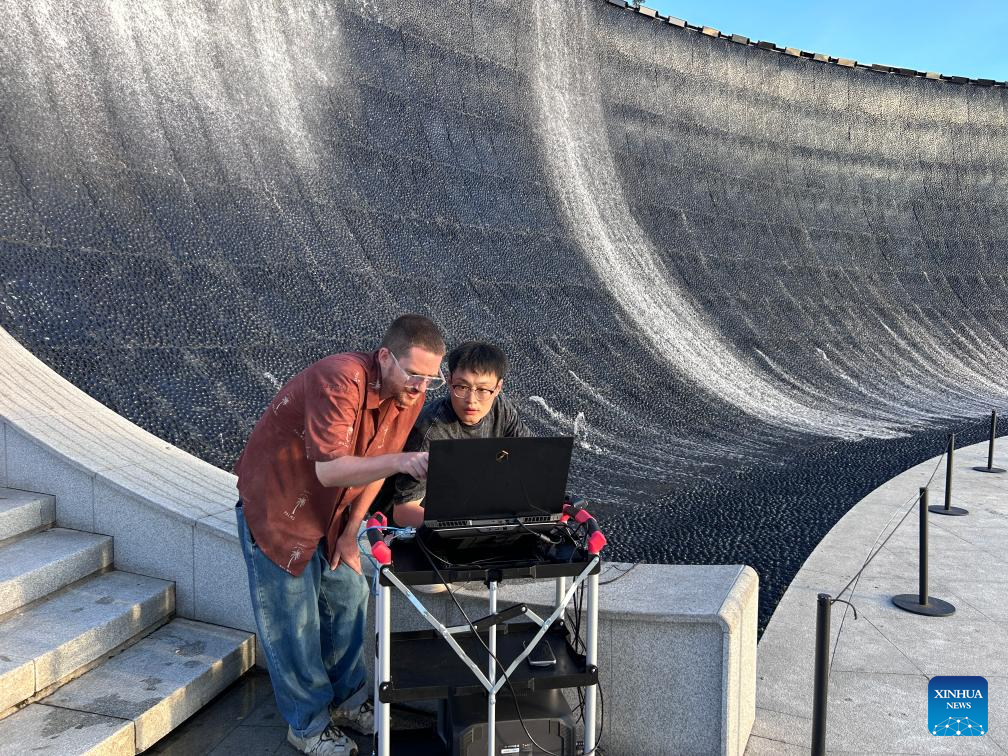
Nikk Mitchell (L), founder and CEO of Hanghzou-based VR production company FXG, conducts shooting with his colleague at the Yanguan ancient town in Jiaxing, east China's Zhejiang Province, June 13, 2025. (Xinhua)
HANGZHOU, Feb. 26 (Xinhua) -- A Peking Opera performer, clad in embroidered armor, raises her spear as gongs reverberate through a studio in Hangzhou in eastern China. There is no traditional stage or theater audience, only a green screen and a ring of specialized cameras capturing each posture.
Later, through a virtual reality (VR) headset, the same scene unfolds again. But this time, the viewer appears to be standing inside the performance rather than watching from afar.
The VR project was created by FXG, a VR production company based in Hangzhou, the capital of Zhejiang Province.
"We're capturing reality and allowing it to be entered again," Nikk Mitchell, FXG's founder and CEO, said in a recent interview with Xinhua. "The goal is to take what's meaningful and valuable about the world and make it accessible in immersive form."
For Mitchell, who was born in Kenya and raised in Canada, much value lies in traditional Chinese culture. His curiosity about martial arts films, tea rituals, and ancient history drove him to arrive in China for the first time at the age of 18.
"I found infinite stories in China's traditional culture, which is a rich treasure trove to me," said Mitchell, who has lived in China for nearly two decades.
While paper-cutting and Dunhuang murals offer rich creation possibilities, it was Peking Opera that left him the deepest impression.
"I never had an interest in Peking Opera before I came to China. But I was fascinated by it when I experienced the sounds, movements and outfits personally," he said.
However, he recognized that for those unfamiliar with it, the intricate art form may feel inaccessible. He sought to change the situation with the VR technology.
In 2012, a VR short film, though technically rudimentary by today's standards, revealed to him a new way of storytelling: not observation, but presence.
"Photos and videos may fail to capture its essence. I knew the technology would change the way we experience art," said Mitchell.
In 2017, he co-founded FXG in Hangzhou, drawn by the city's deep cultural heritage and technological dynamism. His company focuses on the research and development of immersive technologies and content production. "It is really meaningful to capture stage plays with VR so that anyone in the world can experience them," he said.
Mitchell believes that his work resonates with a broader trend in China and aligns with a national policy direction.
"Younger audiences are rediscovering traditional arts with great cultural confidence, and institutions are exploring digital formats," he said.
The Communist Party of China Central Committee's recommendations for formulating the 15th Five-Year Plan (2026-2030) stressed the need to further integrate culture and technology, to empower cultural development with digital and intelligent technologies, and to shift to an IT-based development model, while fostering new forms of cultural business.
"I feel almost destined to be in this place," Mitchell said, while citing the recommendations.
He even adopted a Chinese name, Li Wenlong, in which "Wen" signifies culture and knowledge, while he chose "long," meaning dragon, because he was born in the Year of the Dragon.
"My dream is that one day, a kid in rural China or a student in Paris can put on a headset and stand in front of a master performer without any time or space limits," Mitchell said. "It's such an exciting vision of the future, where anything beautiful and meaningful that humanity has created can be preserved." ■
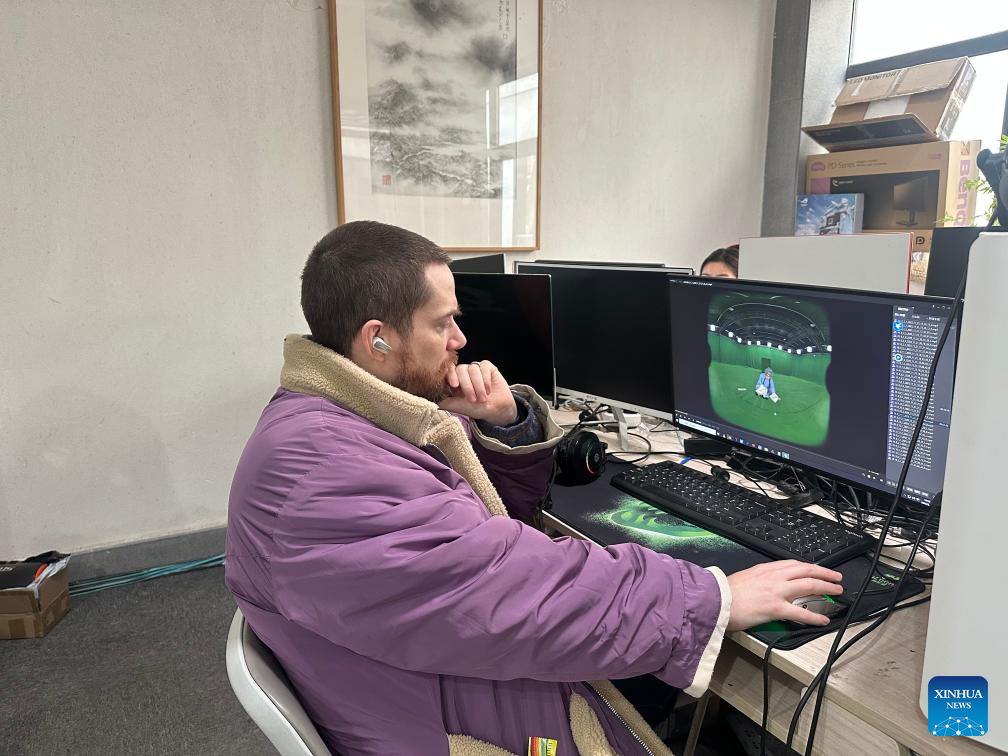
Nikk Mitchell, founder and CEO of VR production company FXG, checks an image on his computer at his company based in Hangzhou, east China's Zhejiang Province, Feb. 27, 2026. (Xinhua)


