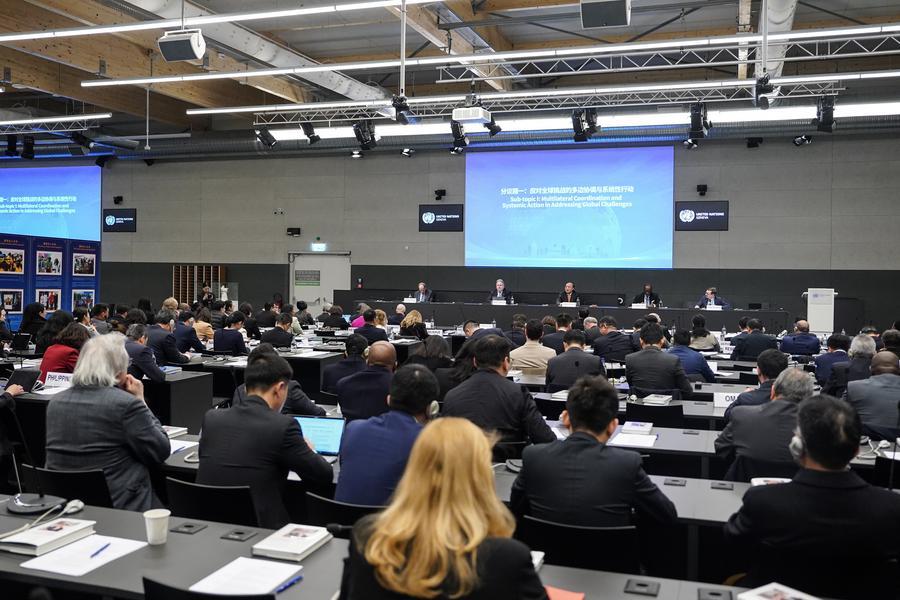
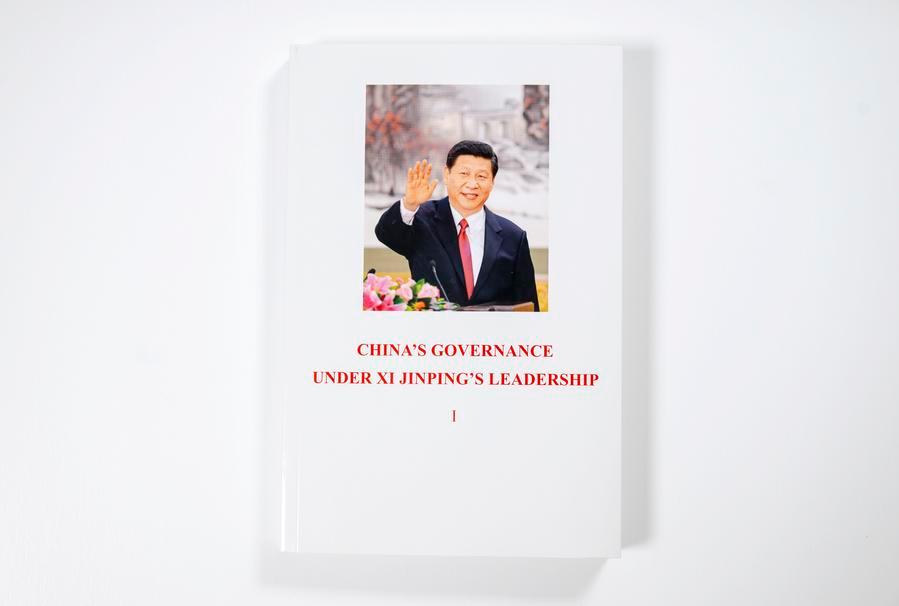
* On Tuesday, a seminar on global governance and the debut of the English edition of the first volume of "China's Governance Under Xi Jinping's Leadership" were held at the Palais des Nations.
* "The world wonders: What's the secret recipe for the Chinese modernization? How has President Xi Jinping steadily led a country of over 1.4 billion people toward prosperity and national rejuvenation?" said Fu Hua, president of Xinhua News Agency. "In this book, I believe readers will find a satisfying answer."
GENEVA, Feb. 25 (Xinhua) -- As an early spring thaw settles over Lake Geneva, the Palais des Nations, home to the United Nations Office at Geneva, is buzzing with renewed diplomatic energy. In a city long recognized as a hub of international law and a bastion of multilateral diplomacy, global voices have once again gathered to navigate the complex challenges of a modern era.
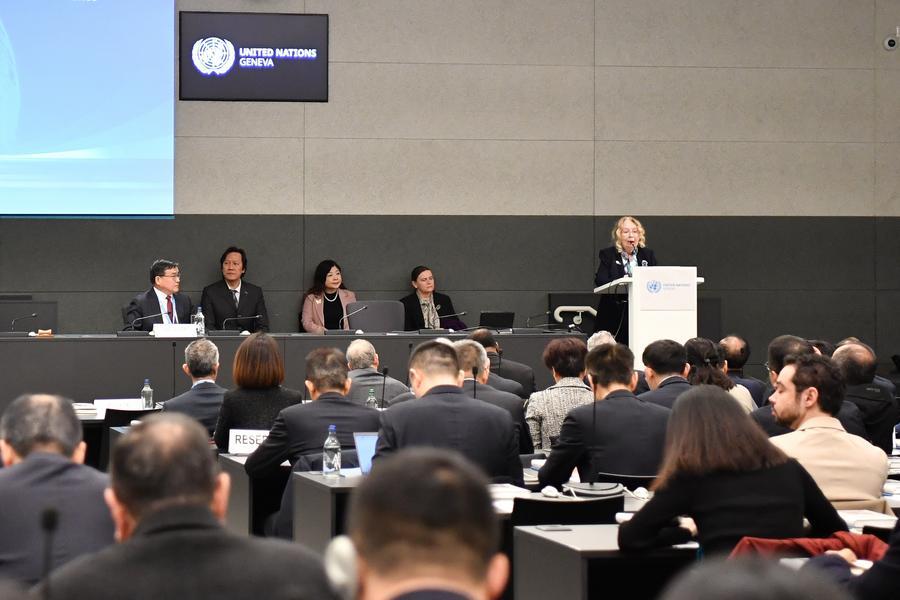
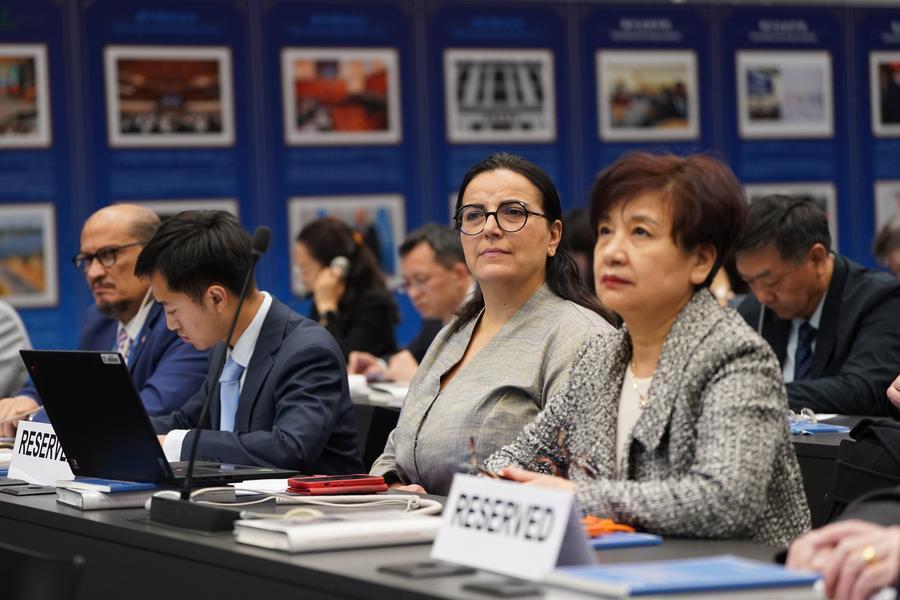
On Tuesday, a seminar on global governance and the debut of the English edition of the first volume of "China's Governance Under Xi Jinping's Leadership" were held at the Palais des Nations. The event convened approximately 200 representatives from United Nations agencies, international organizations, think tanks, and the business community to exchange perspectives on global governance.
GLOBAL GOVERNANCE DEFICIT
Just two months into 2026, the world is enveloped in turbulence. As the Ukraine crisis continues to ravage the region, a U.S. military strike on Venezuela has upended the political order in the Americas, while a rapid military buildup in the Gulf has placed the Middle East on alert.
"We are a world brimming with conflict, impunity, inequality and unpredictability," said UN Secretary-General Antonio Guterres recently.
Tatiana Valovaya, director-general of the United Nations Office at Geneva, also warned of the fragility of the international order. Addressing the seminar, she noted that rising geopolitical tensions, eroding trust, and accelerating climate disruption have made global governance appear elusive.
Yet "it is precisely when global governance is under fire that we need it most," Valovaya said.
"In moments like this, we must return to the principles underpinning our system of global governance, the United Nations Charter adopted eight decades ago."
George Katrougalos, a UN independent expert on the promotion of a democratic and equitable international order, also warned that the world is witnessing "withdrawal from multilateral commitments, protectionist policies."
He criticized the use of tariffs in international trade. "The tariffs are used as a weapon, as a pressure on international institutions to abandon consensual commitments or conventional commitments. Just recently, last week, the United States has succeeded in removing climate change from the main priorities of the International Energy Agency," he said.
"This situation, this might versus right, puts new pressure to the United Nations system," he said. "We need to reinforce the United Nations system."
WHAT CHINA'S GOVERNANCE OFFERS THE WORLD
At the seminar, the English edition of the first volume of "China's Governance Under Xi Jinping's Leadership," published by Xinhua News Agency, drew significant interest upon its unveiling.
"The world wonders: What's the secret recipe for the Chinese modernization? How has President Xi Jinping steadily led a country of over 1.4 billion people toward prosperity and national rejuvenation?" said Fu Hua, president of Xinhua News Agency. "In this book, I believe readers will find a satisfying answer."
For Peter Hediger, a Swiss sinologist, historian and international security policy expert, under Xi's leadership, "China has achieved very impressive achievements in poverty alleviation, providing a development model for countries in the Global South."
"Publishing the book internationally is extremely important to give leaders and communities around the world a window into understanding China's journey from poverty to prosperity. They can also derive many lessons and adapt them to their own development perspective," Hussein Askary, vice-chairman of the Belt and Road Institute in Sweden, also told Xinhua.
Beyond poverty, economic development lies at the heart of how nations rise and how the world remains stable. The book explores how China has consolidated its position as the world's second-largest economy, acting as a critical stabilizer and engine for global growth.
British economist John Ross told Xinhua that China's economy continues to expand steadily and remains a key driving force of global growth. "All claims made in sections of the Western media last year of a serious slowdown in China's economy, as usual, turned out to be entirely false," he said.
Yet sustainable modernization demands more than economic growth: It requires living in harmony with the natural world. Peter Bakker, president and CEO of the World Business Council for Sustainable Development, said China is a leader in sustainable development, producing much-needed solutions in many markets. He expressed his hope that Chinese innovation can be made available to all through partnerships with companies around the world.
Bakker said he views China as "a country with hope, a country where new technologies are being developed faster and where a balance between nature, people and technological development is being thought."
TOWARD SHARED FUTURE
The year 2025 marked the 80th anniversary of the founding of the United Nations. At this historic juncture, China put forward the Global Governance Initiative (GGI), calling for the practice of five key principles: staying committed to sovereign equality, staying committed to international rule of law, staying committed to multilateralism, staying committed to the people-centered approach, and staying committed to real results.
From the Global Development Initiative proposed in 2021, to the Global Security Initiative in 2022, and the Global Civilization Initiative in 2023, and now to the GGI, these four major global initiatives reinforce and complement one another. Together, they form a comprehensive framework of public goods offered by China to address global challenges and promote a brighter future for humanity.
Along the way, the Global South, with a growing sense of historical awareness and purpose, is emerging as a vital force in advancing reform of the global governance system and upholding international fairness and justice.
"The essence of enhancing coordination among the Global South is to build a parallel yet non-separate, independent yet non-confrontational governance space through 'incremental innovation' at a time when 'stock reform' of the Western-dominated global governance system faces numerous difficulties," said Yang Jiemian, chairman of the academic advisory council of the Shanghai Institutes for International Studies.
Yang noted that more should be done to amplify the voice of the Global South, an important force in the international community, to "contribute collective wisdom and strength to creating a more prosperous and just new world pattern."
Jia Guide, China's permanent representative and ambassador to the United Nations Office at Geneva and other international organizations in Switzerland, summarized the consensus reached as follows: In the face of an uncertain world, the international community must stay committed to the right path of multilateralism, choosing dialogue over confrontation, inclusiveness over exclusion, and cooperation over decoupling.■