
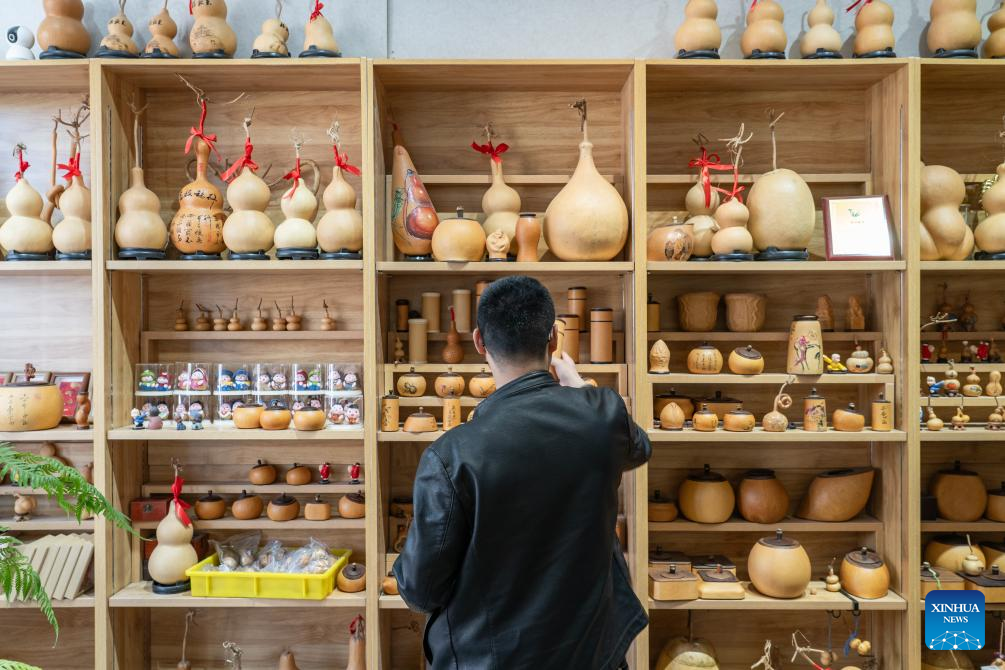
A customer selects calabash products at a calabash artwork shop in the town of Tangyi, east China's Shandong Province, Feb. 20, 2026.(Xinhua/Xiao Bowen)
by Xinhua writers Xiao Bowen, Zhang Liyuan and Wang Di
JINAN, Feb. 23 (Xinhua) -- Hao Xuekun's workshop in the town of Tangyi is filled with hundreds of dry calabashes in every imaginable shape -- all carved and painted with bold colors and bright patterns. Surrounded by these ingenious crafts, Hao cheerfully sends his Chinese New Year greetings to his thousands of audiences through livestreaming.
"Tonight I've prepared this lotus Ruyi for you," the 26-year-old told roughly 8,000 people watching online, lifting a calabash that is carefully carved into the shape of a lotus with two layers of petals. "May it bring you fortune and happiness in the Year of the Horse."
In the past, few would have imagined that Tangyi, a small town of nearly 40,000 in east China's Shandong Province, could turn its hundred-year-old calabash crafting tradition into its mainstay. Today, this once-humble craft has grown into an industry worth 1.8 billion yuan (about 260 million U.S. dollars) annually, and young people like Hao are central to the transformation.
Tangyi is celebrated as the "hometown of Chinese calabashes." For centuries, artisans there have carved calabashes -- known in Chinese as hulu, a homonym for "fortune and prosperity" -- into decorative objects believed to bring good luck. The practice dates back at least to the Song Dynasty (960-1279) and was recognized as a national intangible cultural heritage in 2008.
However, heritage alone did not guarantee prosperity.
As the third generation of his family's calabash business, peddling their works on the street with his parents constitutes a big part of Hao's childhood memories. "In the old days, the whole town only grew a couple of types of calabashes, and carving techniques were also rather basic," said Hao. "Also, if merchants wanted to sell them elsewhere, they had to carry them out themselves."
Like many other small towns across China back then, Tangyi had a traditional craft skill to be proud of, but limited processing techniques and a lack of sales channels made it hard for local craftsmen to turn their skills into money in the modern market.
As an out-and-out digital native, Hao decided to make a change. Being proficient in social media, he opened his own channel dedicated to calabash carving when he was still at college. After graduation, he did not hesitate to return to his hometown to continue his livestreaming career.
Four years later, he has built up an audience of more than 300,000 followers, receiving 100 to 300 orders a night. Hao's success has motivated other young homecomers and local farmers to join in livestreaming, turning this once seasonal street trade into an industry capable of reaching buyers nationwide.
Hao is part of a broader trend. Official data shows that some 12 million people, including young graduates and urban white-collar workers, have returned to their rural hometowns to start their own businesses.
Whether driven by a desire to escape the hustle and bustle of big cities or the sniffing out of better opportunities in hometowns, young returnees have infused local industries with much-needed vitality and creativity.
In Tangyi, their arrival has not only opened new sales channels but also brought innovations to the plant itself.
Traditional calabash carving in Tangyi is known for its intricate patterns, including pyrography and carving. But young designers like Mo Junling, 32, are pushing boundaries.
As an architectural design graduate, Mo returned to Tangyi in 2018, and introduced ink engraving, a modern art technique she had learned at university, to enhance both the sense of depth and color endurance of calabash paintings.
In addition to vivid depictions of calligraphy, animals and landscapes, Mo's works also feature the latest chic or popular cartoon characters like Nezha, securing them considerable popularity among both seasoned collectors and younger buyers.
"Traditional handicrafts can only remain vibrant through constant innovation," she said.
Mo's creativity and Hao's growing business require a steady supply of calabashes. Thus, young people returning to Tangyi have also begun breeding new calabash varieties and exploring more efficient cultivation methods.
Now, Tangyi grows over 30 different types of calabashes, boasting a dozen innovative crafting methods including ink engraving, hollow-carving, embossing and lacquering. It has also developed thousands of different calabash products such as tea cans, bracelets and pendants.
The enthusiasm of young hometown returnees was boosted by strong policy support, too. In 2024, Tangyi invited three national top-tier artisans to offer training courses in calabash crafting. A college student entrepreneurship incubator was also established last year to provide training in farming and carving techniques, enabling young people to participate freely.
With government support and growing recognition of Tangyi calabashes, more and more people are coming back to town. Hao's business is flourishing, and his hometown has become more lively. "Occasionally, there are even traffic jams that I haven't seen for years," said Hao.
Tangyi's evolution reflects a wider trend across China's smaller cities and rural counties, where returning young entrepreneurs are revitalizing local industries.
In east China's Zhejiang Province, a Gen-Z returnee has transformed a thousand-acre flower field into an online flower supermarket through livestreaming. In the southwestern province of Yunnan, a college graduate of the local Yi ethnic group has brought their traditional embroidery clothing to the Milan Fashion Week. And in Guangxi Zhuang Autonomous Region of south China, young entrepreneurs have partnered with universities to improve recipes for sour bamboo shoots, a key ingredient in the famous local dish.
In each case, the formula is similar: local products meet youthful ideas, and small-town businesses find new life.
Hao plans to grow calabashes himself next, extending his role from seller to producer. "The opportunity is here, and you just have to seize it." ■
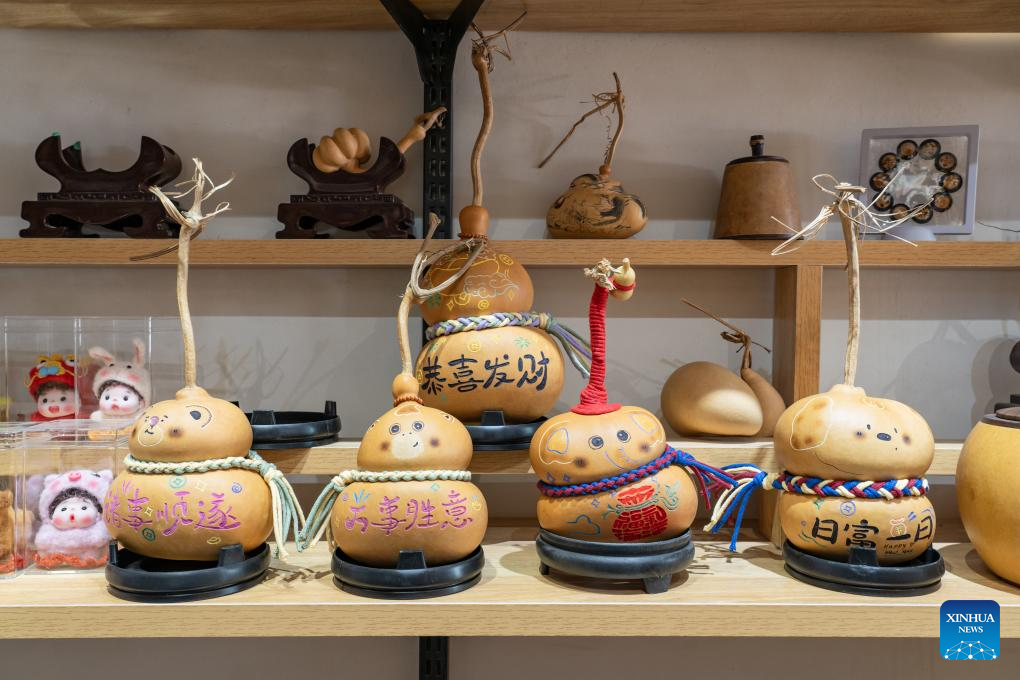
Calabashes carved and painted with calligraphy and cartoon designs are displayed at a calabash artwork shop in the town of Tangyi, east China's Shandong Province, Feb. 20, 2026.(Xinhua/Xiao Bowen)
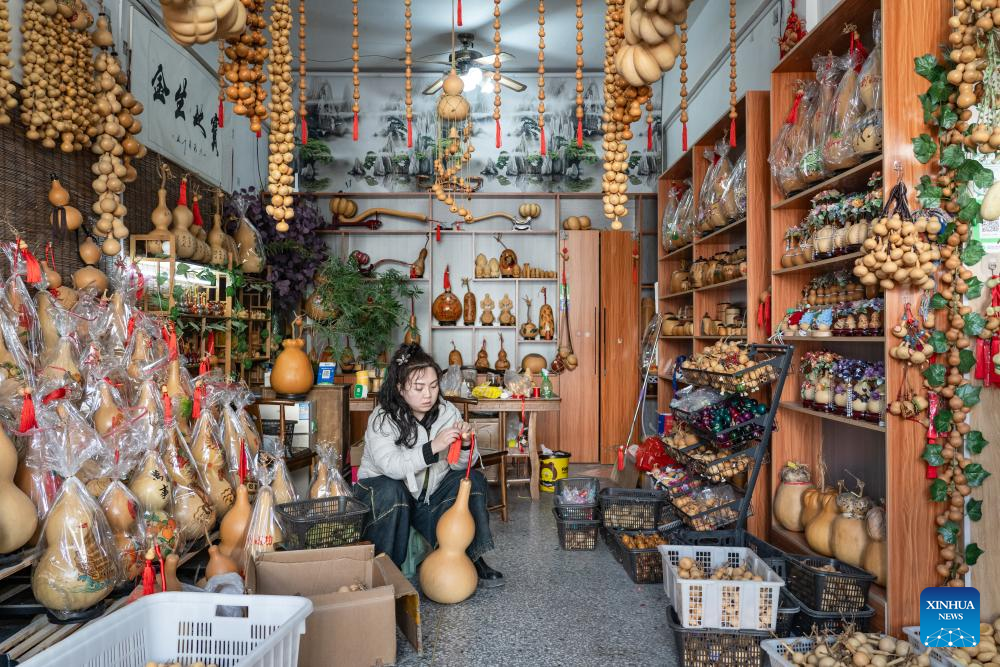
A shopkeeper sits amidst calabashes at a calabash artwork shop in the town of Tangyi, east China's Shandong Province, Feb. 20, 2026. (Xinhua/Xiao Bowen)


