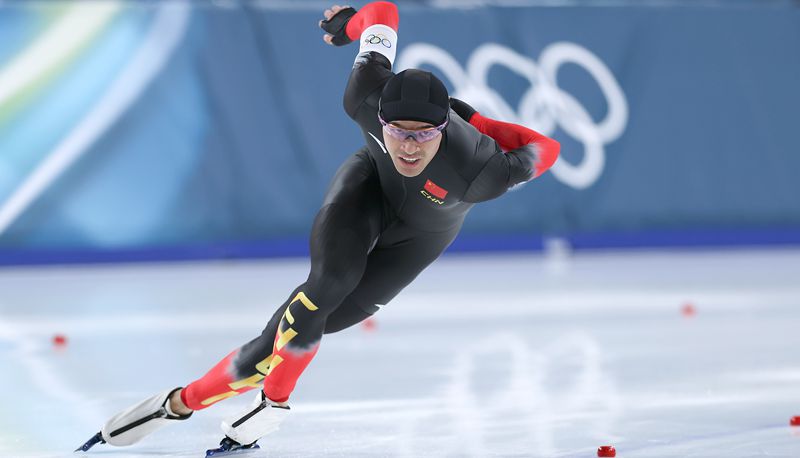
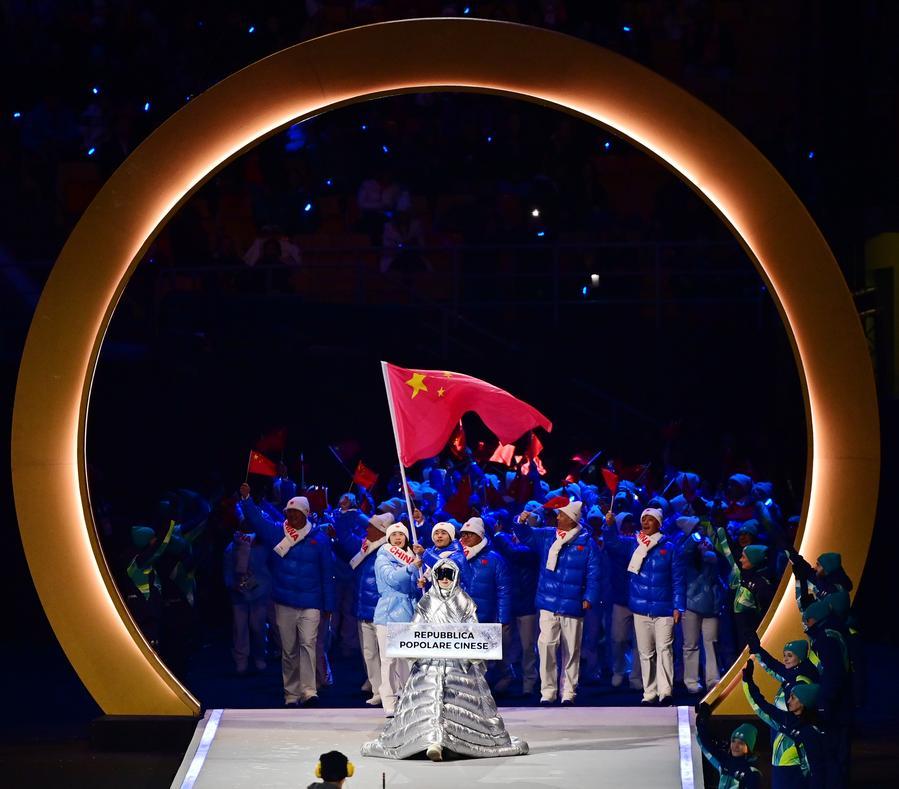
With five gold, four silver and six bronze medals at Milan-Cortina 2026, China achieved its best result at an overseas Winter Olympics, which has reflected the legacy of Beijing 2022 and the country's overall landscape of winter sports development.
by sportswriter Hu Jiali
MILAN, Feb. 22 (Xinhua) -- After Gu Ailing and Li Fanghui secured a 1-2 finish in the women's freeski halfpipe on the final competition day, China capped its Milan-Cortina Winter Olympics campaign with its best result at an overseas Games, winning five gold, four silver and six bronze medals to surpass the previous 5-2-4 record in Vancouver 2010.
However, the journey to this historic finish was not plain sailing.
China sent 126 athletes to Milan-Cortina competing across seven sports and 91 events, the largest delegation and most extensive event participation in an overseas Winter Games.
Standout moments came in freestyle skiing, snowboarding and speed skating.
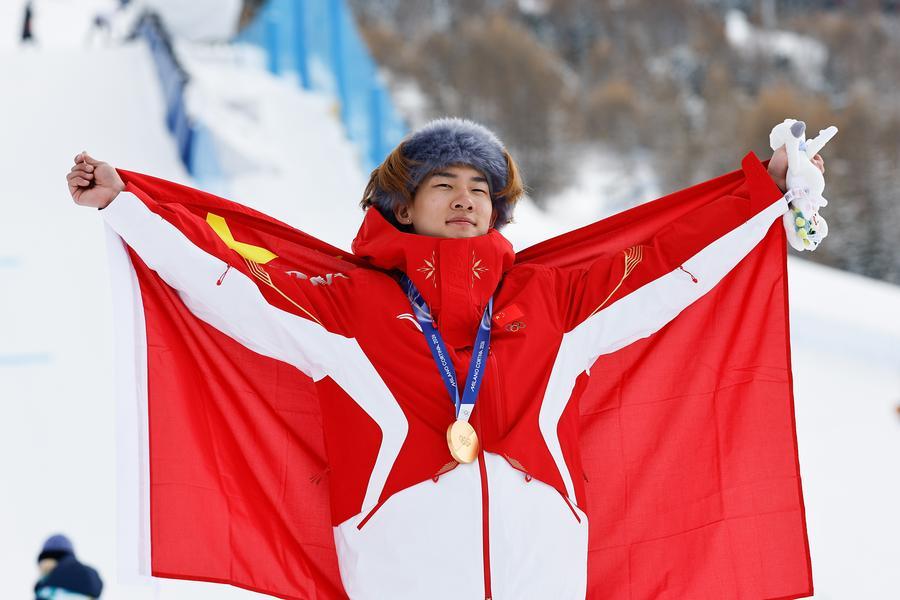
Su Yiming, the flagbearer at Sunday's closing ceremony, won the men's snowboard slopestyle on his 22nd birthday, earning China its first gold of the Games, 12 days after the opening ceremony.
"When the national anthem played, that was the second time I lost control of my emotions," Su said after his win. "After taking bronze in big air, I told myself only gold would allow our anthem to be played. In an international competition like this, letting the world hear China's anthem means everything."
Speed skater Ning Zhongyan upset pre-race favorite Jordan Stolz of the United States to win the men's 1,500m with a new Olympic record of 1:41.98, and added two bronzes in the 1,000m and team pursuit.
"Jordan was like a mountain blocking my road," Ning said. "But today, at the Olympics, I crossed over this big mountain and I saw the view, the skyline, is beautiful."
The victory marked the first gold medal in the event won by an Asian skater since the inaugural Winter Olympics in 1924.
"For Asia, I think this medal showed that we are not weak in this event. We can win gold medals too. Also, for everyone on China's speed skating team, including the staff and athletes, it's something to feel very proud of, and it gives us great motivation," Ning said.
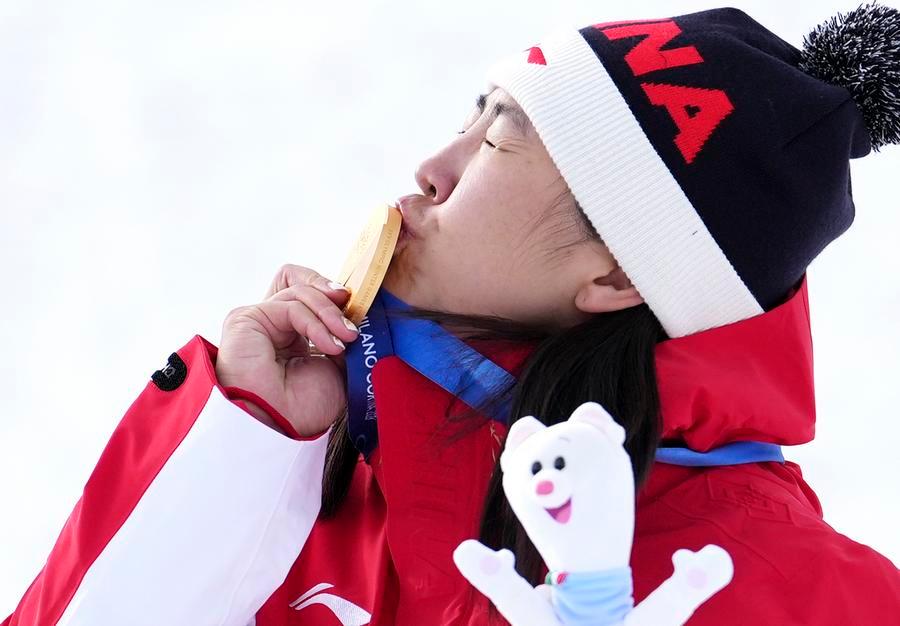
China's freestyle skiing aerials team also made history. Five-time Olympian Xu Mengtao defended her women's aerials title, and her husband Wang Xindi won the men's event, making them a rare married couple to each claim individual Olympic titles at the same Games.
"I've come this far because of my love for the sport," Xu said. "But behind that love stands all the people who love me."
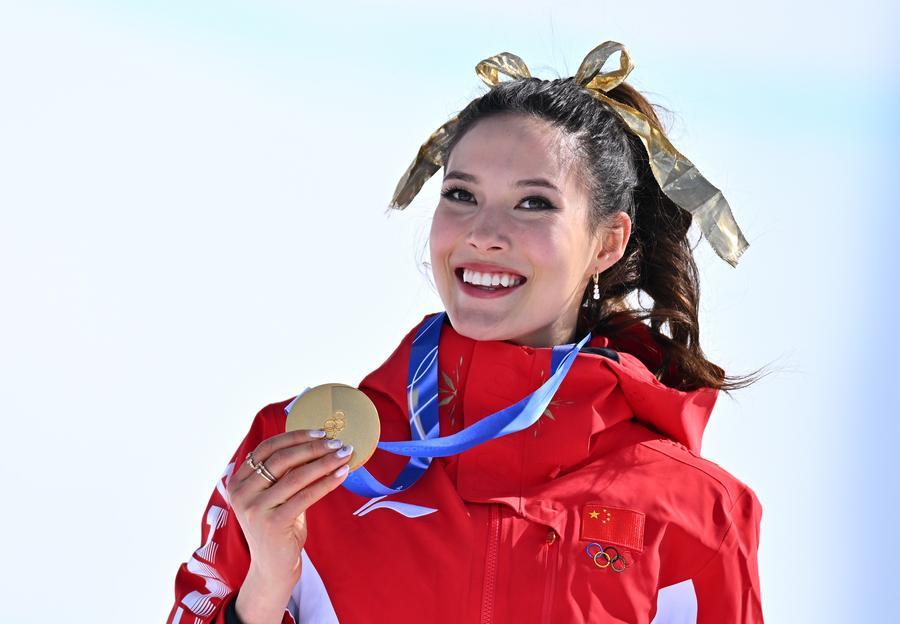
After being crowned in the women's freeski halfpipe, Gu became the most decorated freeskier in Olympic history, having captured three golds and three silvers across two Winter Games.
"I have the most number of medals and most golds, which is pretty special. Going six for six is pretty crazy. I'm so tired, but I'm so happy," said Gu.
"I've been giving 110 percent of myself every single day. It's like a marathon distance, but a sprint pace, because I can't slack off any day," she added.
Apart from podium finishes, China also made strides in sliding and endurance events.
In the men's skeleton, all three athletes qualified and finished in the top eight. The luge team competed in all events for the first time overseas, recording best finishes in men's doubles, women's singles and team relay.
In ski mountaineering's Olympic debut, China's Buluer finished eighth in the men's sprint, the highest-ever placing for an Asian male athlete in the World Cup, World Championships and Olympics in a field dominated by Europeans.
Winter sports are also growing beyond elite competition.
According to a winter sports industry report released in 2025, from 2016 to 2024, the size of China's ice and snow industry surged from 364.7 billion yuan (52.8 billion U.S. dollars) to 980 billion, and is expected to surpass 1 trillion yuan in 2025.
Winter culture has also blended with regional traditions. The northeastern city of Harbin has become a viral tourism destination, while Chongli, one of the competition zones of the 2022 Beijing Winter Olympics, reported that its summer tourist numbers in 2024 surpassed winter arrivals for the first time, supported by trail races and marathon events.
What was once a seasonal boom is increasingly evolving into a year-round business, with winter sports driving growth in equipment manufacturing, event operations, training services and cultural tourism.
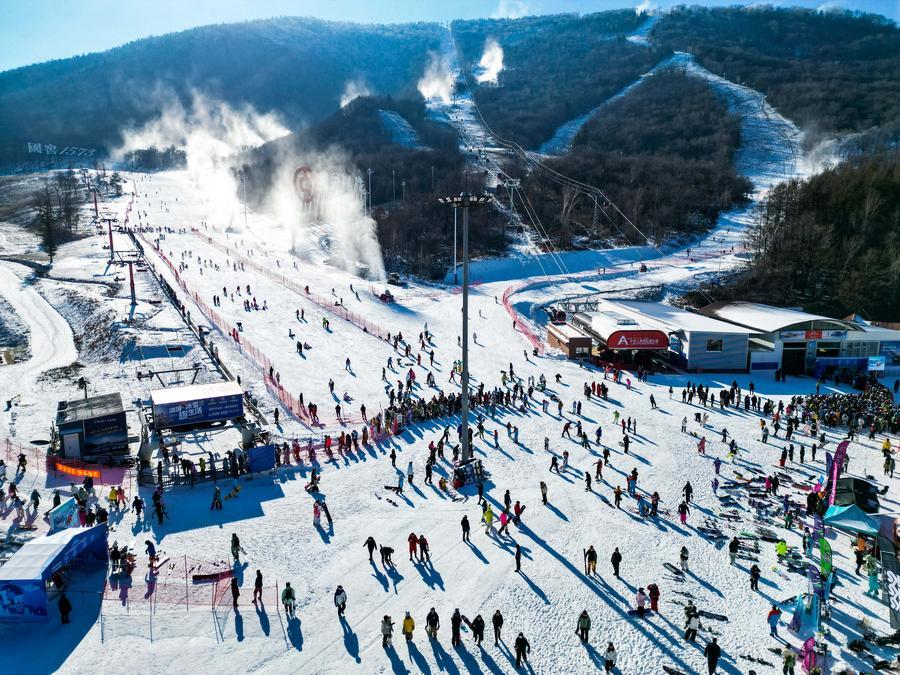
IOC Honorary President Thomas Bach has praised the legacy of the 2022 Beijing Winter Olympics, particularly its role in engaging 300 million people in winter sports and opening venues to the public.
"I always said there would be winter sports before Beijing 2022 and winter sports after Beijing 2022, and this has proven to be true," he told Xinhua last December. "This growth in participation and facilities is a great legacy and will continue to drive winter sports forward, both in China and globally."
With winter sports expanding beyond their traditional strongholds in northeast China, more athletes from southern and western regions are emerging.
At the China's 14th National Winter Games in 2024, 17 provincial-level delegations participated as full teams for the first time. Southern regions such as Shanghai, Guangdong and Zhejiang claimed gold medals, while athletes developed by Henan, Sichuan, Guangxi, Guizhou and Xizang also reached the podium. ■