
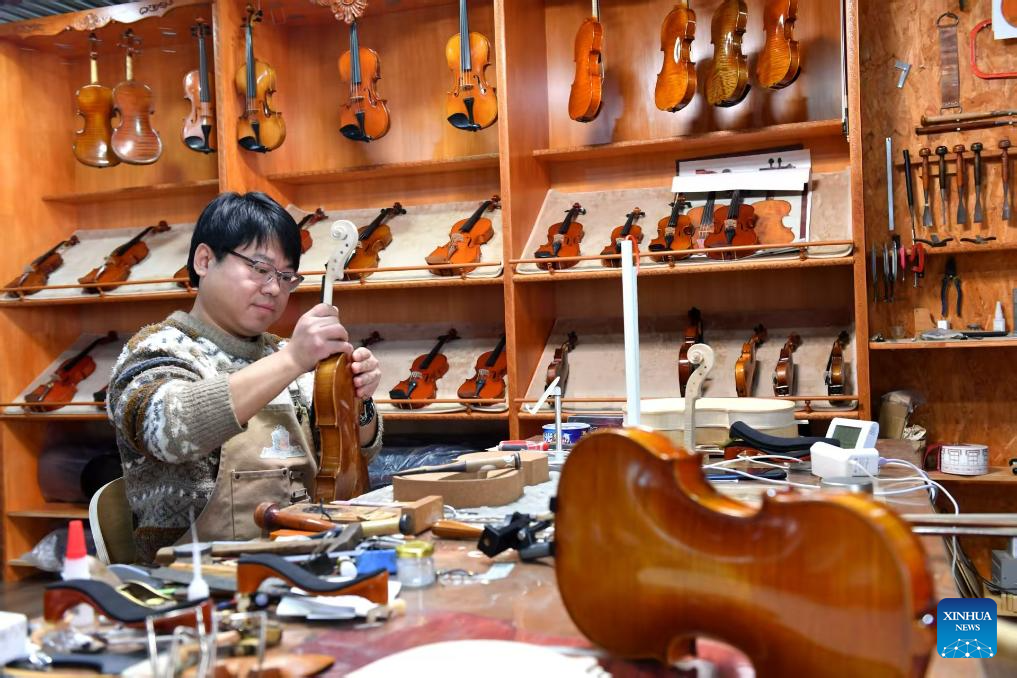
Zhang Jintao, a studio owner, repairs a violin in Zhouwo Village, Wuqiang County, north China's Hebei Province, Feb. 4, 2026. (Xinhua)
SHIJIAZHUANG, Feb. 20 (Xinhua) -- Despite the crisp winter air in north China, Guo Yuguan set her fingers dancing across the keys of an exquisitely crafted saxophone, turning each breath into cheerful melodies to celebrate the Chinese New Year.
The 66-year-old from Zhouwo Village in Hebei Province started learning the Western instrument over a decade ago. "I was too nervous to hold the saxophone during my first performance, but now music has become an integral part of my life," she said.
Guo is not alone. As the leader of a local band composed of fellow residents, she rehearses with other members who work during the day and gather in their free time, sharing a passion for music. The band can play seven instruments in total, ranging from the violin to the drums.
"On average, every household in our village has at least one person who can play an instrument," Zhou Zhixue, head of the village, told Xinhua.
The vibrant musical atmosphere in Zhouwo is closely linked to its burgeoning instrument-making industry. Now, over 20 instrument manufacturers have brought both economic opportunities and cultural enrichment to the once-impoverished village.
Jinyin Group is one of the leading companies. Founded in 1989, the local enterprise identified the potential for the emerging industry and has been committed to producing high-quality orchestral instruments, striving to spread the "golden sound," a vision reflected in its name, to a wider world.
For Chen Xuekong, founder of Jinyin, the growth of his business was not plain sailing. "It's so difficult to kick off due to lack of funds and workforce," he recalled. "We had to cross the river by feeling the stones."
Against all odds, the company has ramped up efforts to train farmers into skilled workers, reach more clients, and coordinate with musical institutions to develop new products, gradually transforming an unknown workshop into an influential instrument maker.
Currently, the group has reached an annual output of 1 million instruments covering 600 types and has exported its products to over 50 countries and regions.
The success of such instrument-making companies proves a boon for locals like Guo, a retired worker of Jinyin. "The job not only enabled me to gain a higher income, but also helped foster my interest in music," Guo said.
While many residents join the assembly lines of large-scale manufacturers, some opt to carve out their own niche in a hometown pulsing with music.
Zhang Jintao owns a studio specializing in making, repairing, and selling violins. What sets his business apart is his commitment to providing customized services.
"A handmade violin is where technique meets art," he said. "It commands a higher price than a standardized product precisely because of its capacity to adapt to the personal needs of each musician."
Having studied and worked in big cities before, Zhang decided to settle in Zhouwo. "It's an ideal workplace for me due to its music-friendly atmosphere, slow-paced lifestyle, and low living costs," he explained.
In recent years, the village has orchestrated its own reinvention as a music-themed tourist destination, aiming to attract both entrepreneurs like Zhang and numerous visitors to savor its glamour.
Strolling through the streets of Zhouwo, visitors are surrounded by a symphony of instrument-shaped sculptures, diverse live performances, and music-related specialty stores. Notably, a museum of global musical instruments is available for those desiring a richer artistic experience.
With all these attractions, Zhouwo has seen a surge in popularity among tourists, especially music enthusiasts. In 2025, the village recorded 300,000 study tour visits, a 15 percent year-on-year increase.
Nowadays, Guo's greatest joy is playing newly learned tunes for tourists. "When asked to perform, I don't hesitate," she said. "It's a great opportunity to showcase the spirit of the Zhouwo people." ■
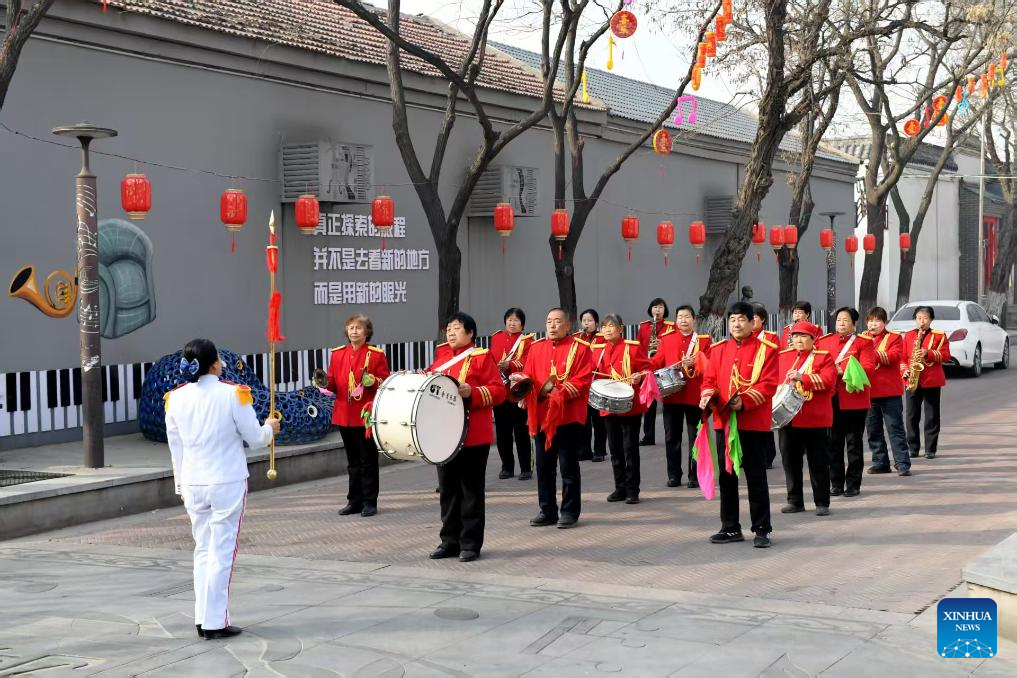
A band composed of rural residents rehearse in Zhouwo Village, Wuqiang County, north China's Hebei Province, Feb. 4, 2026. TO GO WITH "Across China: North China village strikes global chord" (Xinhua/Dong Xiaokun)


